

'Now I am become Death, the Destroyer of Worlds' – the Bhagavad Gita explained
- Written by: Debjani Ganguly, Professor of Literature, Australian Catholic University
In our Guide to the Classics series, experts explain key works of literature.
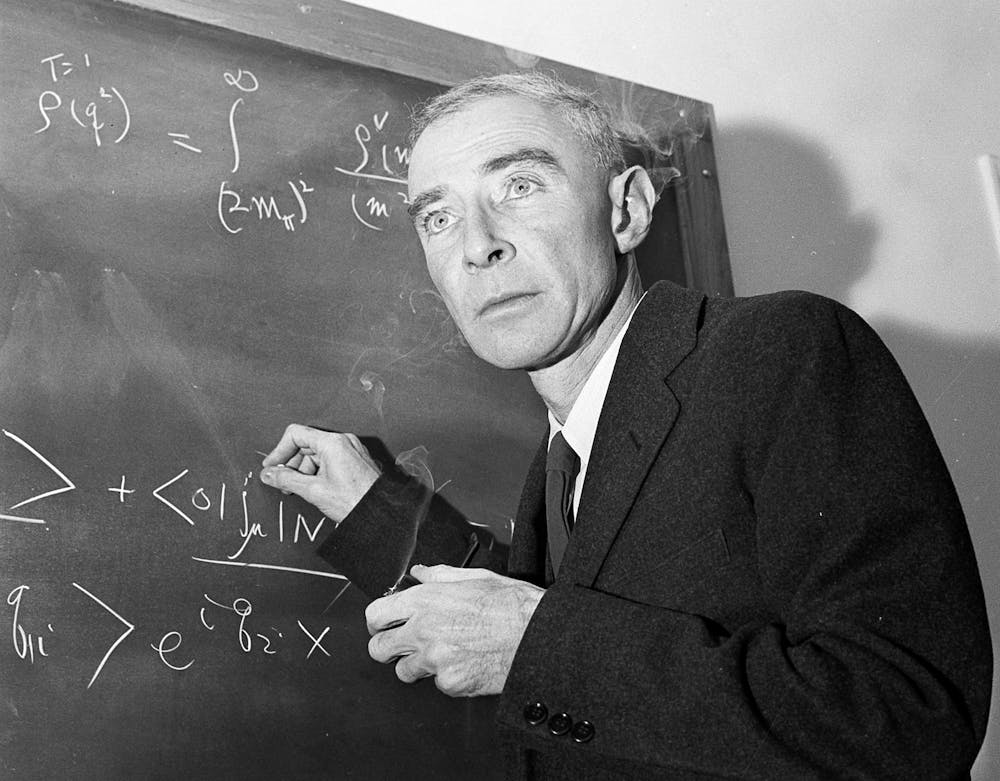
There is a striking photo, taken in 2015, of a deactivated nuclear missile at an air and space museum in Tucson, Arizona. Written in dust on this missile are the words, “Now I am become Death, the Destroyer of Worlds”. These words, from the Sanskrit scriptural text the Bhagavad Gita, are famously attributed to J Robert Oppenheimer, the architect of the atom bomb.
In Christopher Nolan’s grand biopic, Oppenheimer, the physicist recites these lines not during the Trinity blast (the first detonation of this nuclear weapon) but in a scene with his lover Jean Tatlock.
Oppenheimer later referenced another verse from the Bhagavad Gita when recalling his state of mind as he witnessed the Trinity explosion in the New Mexico desert on 16 July, 1945:
If the radiance of a thousand suns were to burst at once into the sky, that would be like the splendour of the mighty one.
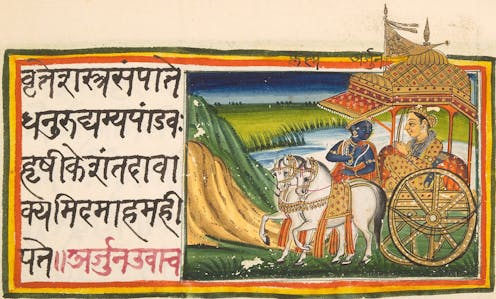
These verses refer to the sublime form, “Vishwarupa”, Lord Krishna takes in the Bhagavad Gita when he reveals his divine nature to the warrior prince, Arjuna.
“Who are you?” asks Arjuna.
“I am Time,” replies Krishna, “powerful destroyer of worlds, grown immense here to annihilate these men”.
Arjuna is blinded by Krishna’s radiance even as he quakes with fear at God’s capacity to destroy evil with the fire emanating from his ferocious visage.
Read more: Oppenheimer’s warning lives on: international laws and treaties are failing to stop a new arms race
Philosophical insights
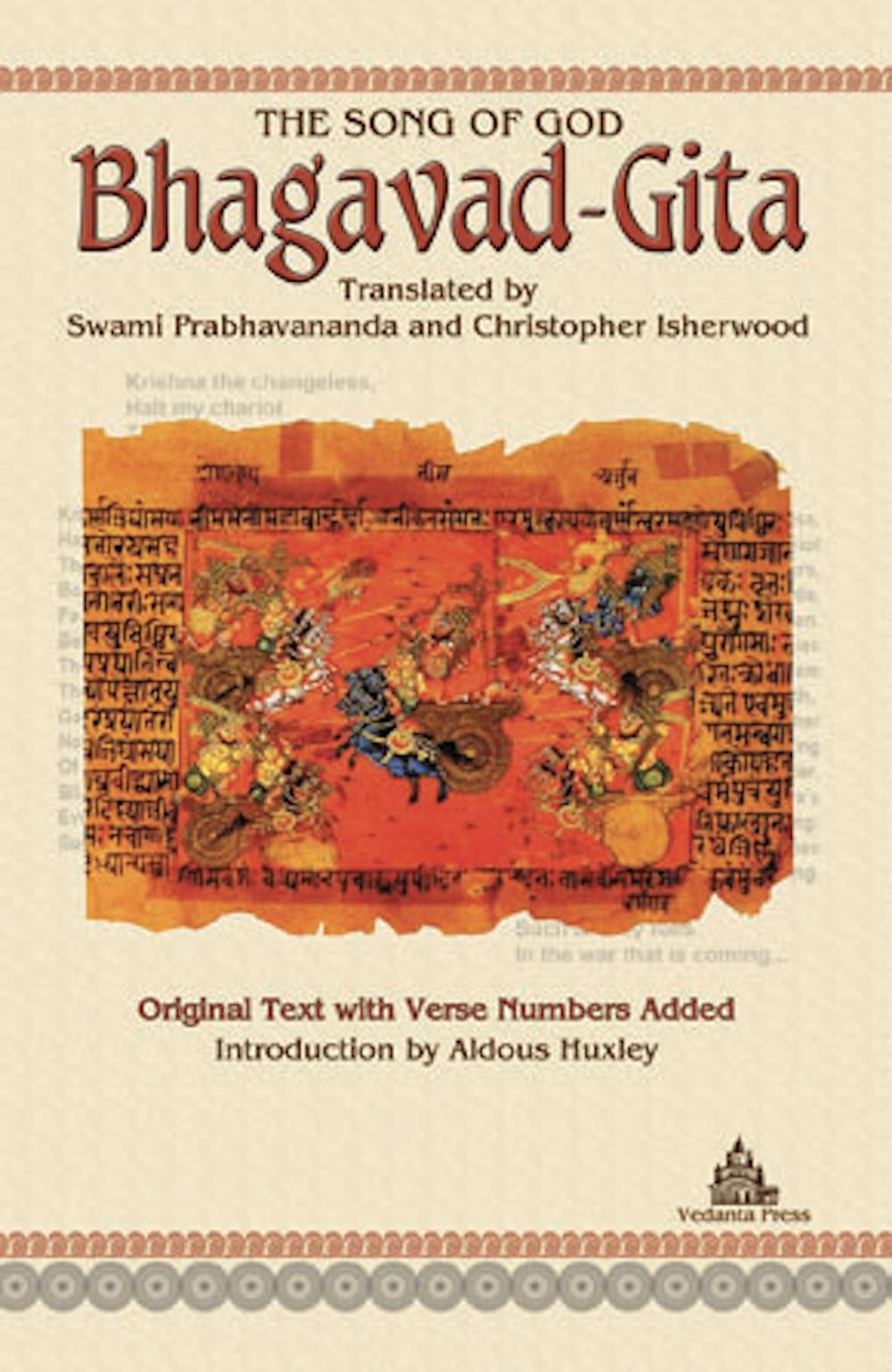
The Bhagavad Gita consists of 700 verses (shlokas) and appears in Book Six of the Sanskrit epic, The Mahabharata. At 100,000 verses and seven times the combined length of the Iliad and the Odyssey, the Mahabharata is the longest poem in the world. Written between 400 BCE and 200 BCE, the epic acquired its written form around the fourth century AD, during the Gupta Empire.
The Bhagavad Gita dramatises a meditative exchange between Arjuna and Lord Krishna, who appears as his charioteer during the momentous battle between two clans, the Pandavas and the Kauravas.
The battlefield is located in Kurukshetra, a town close to New Delhi. Each clan stakes its claim to be the mightiest ruling dynasty of erstwhile Bharat (present day India).
 Wikimedia Commons/Vedanta Press
Poets, philosophers, scientists, public intellectuals and political leaders have been enthralled by the Bhagavad Gita since its first English translation appeared in 1785. Wherein lies Gita’s popular appeal across oral and performative cultures?
The Gita is more than just a sacred text of the Hindus. It distils insights from several schools of philosophy in classical India. Wilhelm von Humboldt, the renowned 19th century German scholar and philologist, called the Bhagavad Gita “the most beautiful, presumably the only real philosophical poem of all known literatures.”
Wikimedia Commons/Vedanta Press
Poets, philosophers, scientists, public intellectuals and political leaders have been enthralled by the Bhagavad Gita since its first English translation appeared in 1785. Wherein lies Gita’s popular appeal across oral and performative cultures?
The Gita is more than just a sacred text of the Hindus. It distils insights from several schools of philosophy in classical India. Wilhelm von Humboldt, the renowned 19th century German scholar and philologist, called the Bhagavad Gita “the most beautiful, presumably the only real philosophical poem of all known literatures.”
 Mahatma Gandhi.
Wikimedia Commons/Dutch National Archives, CC BY
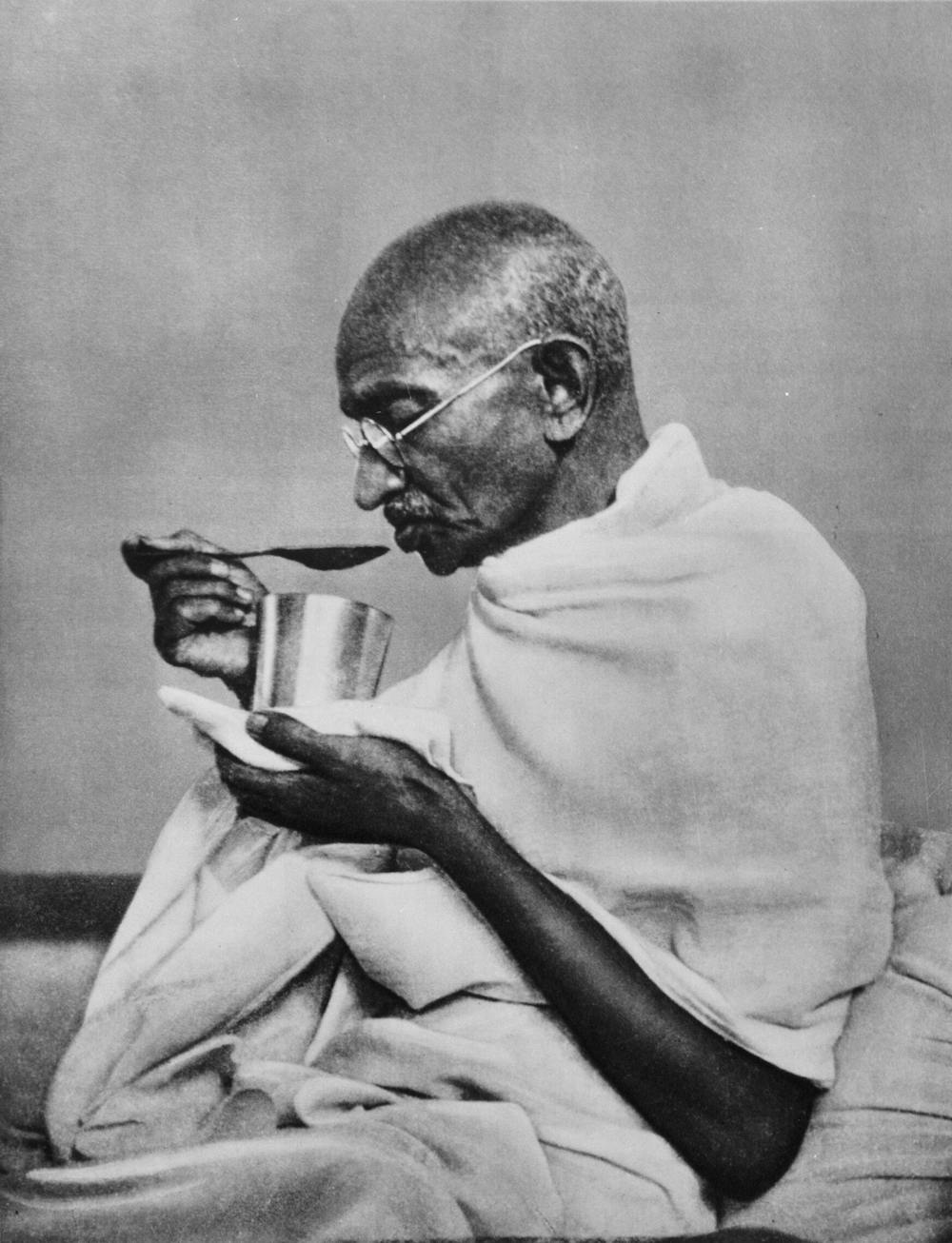
The Indian nationalist leader Mahatma Gandhi revered the Bhagavad Gita as an “infallible guide to conduct,” a beacon to an ethical life combining political pragmatism with devotion to a spiritual cause higher than the self.
The American transcendentalists Ralph Waldo Emerson and Henry David Thoreau admired the Bhagavad Gita’s non-doctrinal universal humanism, and what they perceived as the text’s unity of spirit and matter.
Thoreau famously carried a copy of the text to Walden Pond where he imagined himself communing with a Hindu priest on the banks of the Ganges. The Bhagavad Gita inspired the theosophist Annie Besant and an array of insurgent poets, novelists, and intellectuals at the turn of the 20th century including EM Forster, Christopher Isherwood, WB Yeats, Aldous Huxley, and TS Eliot.
Read more:
A flourishing ecology and a healthy economy? Henry David Thoreau thought you couldn't have one without the other
A recurring predicament
The Oxford philosopher and president of India from 1962-1967, Sarvapalli Radhakrishnan, once remarked the trauma of the two world wars spurred thinkers to turn to Gita for “its dramatization of a perpetually recurring predicament.” Radhakrishnan’s treatise on the Bhagavad Gita continues to be a revered scholarly source.
Th “recurring predicament” at the heart of the Bhagavad Gita is this: what constitutes righteous action in the face of moral ambiguity and the inevitability of violence?
Arjuna is fighting to restore the honour and glory of the Pandavas. The Kaurava princes are malevolent usurpers and sadistic rulers. They are also Arjuna’s first cousins.
Fighting on their side are Arjuna’s uncles and mentors. Halfway through the battle, Arjuna is paralysed by anxiety at the prospect of killing his kin. He contemplates throwing away his mighty weapons and fleeing the battlefield.
This is when Krishna, his charioteer and brother-in-law, counsels him with these immortal words:
Your obligation is to the action, and never to its fruits.Do not be motivated by the fruit of your actions.But do not become attached to non-action either.Abandon your attachment and engage inworldly action, Arjuna, while standing firm in discipline(yoga). Consider success and failure to be equal.This equanimity is called discipline, Arjuna, since theaction itself is much less important than the discipline.
Krishna in the Gita is none other than Vishnu, Lord of the Hindu trinity who preserves the world.
Krishna exhorts Arjuna to fulfil his duty (dharma) as a Kshatriya (warrior) in a spirit of detachment and with steadfast discipline (sthitaprajna). In classical India, these warriors had a monopoly on legitimate violence to preserve social and political order.
The greater good, Krishna tells Arjuna, lies far beyond earthly desires and attachments. The body dies but the soul is immortal. The noblest action is that which recognises the immortal value of the soul and ceases to lament loss and frustrated desire. This action, known as “Nishkama Karma” is taken without any anticipation of a fruitful outcome; action that abjures the myth of control.
Fear of consequences cannot be a justification for inaction. Duty toward the preservation of the moral order is far more important.
Self-knowledge, action without attachment and devotion to Krishna as the supreme soul that contains the entire universe is the path to salvation (moksha). This constitutes the essence of Krishna’s message to Arjuna.
Read more:
Guide to the classics: Homer's Iliad
Discipline
Oppenheimer referred to the Gita in a note to his brother in 1932 when he wrote about the importance of discipline and detachment in the fulfilment of obligations to one’s country and to humanity at large.
At the time, Oppenheimer was engaged in a serious study of Sanskrit texts with his Berkeley mentor and professor of Sanskrit, Arthur W Ryder.
He seemed obsessed with terms such as “sthitaprajna” (disciplined stillness) and “karma yoga” (disciplined action) that recur in the Gita. He was beginning to confront the moral conundrum of unleashing the force of the split atom on an increasingly strife-torn world.
Project Y, the secret laboratory in Los Alamos where the atom bomb was created, was somewhere on the horizon and would take concrete shape in a few years. Gita’s message offered a salve to Oppenheimer’s existential angst.
“I believe that through discipline,” Oppenheimer writes his brother Frank, “[…] we can achieve serenity…”
I believe that through discipline we learn to preserve what is essential to our happiness in more and more adverse circumstances […] Therefore, I think that all things which evoke discipline: study, and our duties to men and to the commonwealth, war […] ought to be greeted by us with profound gratitude.
Popular appeal
The Gita “burst out of its confinement” in the 20th century, writes the Cambridge historian Christopher Bayly,
precisely because it spoke to contemporary global concerns on the following issues: violence and nonviolence, the individual’s duties to society, the boundary between the spiritual and the social, the significance of individual action as compared with fate, the role of the founders of nations in history.
The popular appeal of Bhagavad Gita lies in its dual message of dispassionate action and devotion to Krishna as the embodiment of universal soul-force. Temples across India offer discourses on Gita as part of their evening prayers, a practice popularised by Gandhi in his ashrams.
The Hare Krishna and Chinmaya movements have been inspired by the Gita’s philosophical teachings, as has the Ramakrishna Mission, one of the largest philanthropic and spiritual congregations in India, with branches across the globe.
The Gita has inspired a rich poetic and performative culture. Oral musical and theatrical traditions in South and Southeast Asia enact the exchange between Krishna and Arjuna. “Pieces of the Gita and Krishna float through international musical culture”, writes Richard Davis:
In his posthumous album titled Om (released in 1968), John Coltrane and fellow musicians open and close their improvised free jazz composition by chanting a translated passage from the Gita.
In 1980, the composer Philip Glass staged an opera, Satyagraha, in which he blended Sanskrit chants from the Gita with Gandhian philosophy of non-violence.
While the popular appeal of the Gita lies in its recognition of God-like qualities in the human, the text warns us against the dangers of man as the “herd animal” and men who aspire to dominate the world.
When men deem themselves to be gods on earth […] when they are this deluded by ignorance, they develop a satanic perversity that proclaims both in knowledge and power.
These words have deep relevance for our time as we confront existential threats posed by atomic weapons, artificial intelligence and climate change.
The quest for mastery over human and nonhuman worlds has made our planet fragile. We might do well to heed Gita’s warning even as we dwell on its philosophy of righteous action and devotion to a cause beyond the self.
Authors: Debjani Ganguly, Professor of Literature, Australian Catholic University
Mahatma Gandhi.
Wikimedia Commons/Dutch National Archives, CC BY
The Indian nationalist leader Mahatma Gandhi revered the Bhagavad Gita as an “infallible guide to conduct,” a beacon to an ethical life combining political pragmatism with devotion to a spiritual cause higher than the self.
The American transcendentalists Ralph Waldo Emerson and Henry David Thoreau admired the Bhagavad Gita’s non-doctrinal universal humanism, and what they perceived as the text’s unity of spirit and matter.
Thoreau famously carried a copy of the text to Walden Pond where he imagined himself communing with a Hindu priest on the banks of the Ganges. The Bhagavad Gita inspired the theosophist Annie Besant and an array of insurgent poets, novelists, and intellectuals at the turn of the 20th century including EM Forster, Christopher Isherwood, WB Yeats, Aldous Huxley, and TS Eliot.
Read more:
A flourishing ecology and a healthy economy? Henry David Thoreau thought you couldn't have one without the other
A recurring predicament
The Oxford philosopher and president of India from 1962-1967, Sarvapalli Radhakrishnan, once remarked the trauma of the two world wars spurred thinkers to turn to Gita for “its dramatization of a perpetually recurring predicament.” Radhakrishnan’s treatise on the Bhagavad Gita continues to be a revered scholarly source.
Th “recurring predicament” at the heart of the Bhagavad Gita is this: what constitutes righteous action in the face of moral ambiguity and the inevitability of violence?
Arjuna is fighting to restore the honour and glory of the Pandavas. The Kaurava princes are malevolent usurpers and sadistic rulers. They are also Arjuna’s first cousins.
Fighting on their side are Arjuna’s uncles and mentors. Halfway through the battle, Arjuna is paralysed by anxiety at the prospect of killing his kin. He contemplates throwing away his mighty weapons and fleeing the battlefield.
This is when Krishna, his charioteer and brother-in-law, counsels him with these immortal words:
Your obligation is to the action, and never to its fruits.Do not be motivated by the fruit of your actions.But do not become attached to non-action either.Abandon your attachment and engage inworldly action, Arjuna, while standing firm in discipline(yoga). Consider success and failure to be equal.This equanimity is called discipline, Arjuna, since theaction itself is much less important than the discipline.
Krishna in the Gita is none other than Vishnu, Lord of the Hindu trinity who preserves the world.
Krishna exhorts Arjuna to fulfil his duty (dharma) as a Kshatriya (warrior) in a spirit of detachment and with steadfast discipline (sthitaprajna). In classical India, these warriors had a monopoly on legitimate violence to preserve social and political order.
The greater good, Krishna tells Arjuna, lies far beyond earthly desires and attachments. The body dies but the soul is immortal. The noblest action is that which recognises the immortal value of the soul and ceases to lament loss and frustrated desire. This action, known as “Nishkama Karma” is taken without any anticipation of a fruitful outcome; action that abjures the myth of control.
Fear of consequences cannot be a justification for inaction. Duty toward the preservation of the moral order is far more important.
Self-knowledge, action without attachment and devotion to Krishna as the supreme soul that contains the entire universe is the path to salvation (moksha). This constitutes the essence of Krishna’s message to Arjuna.
Read more:
Guide to the classics: Homer's Iliad
Discipline
Oppenheimer referred to the Gita in a note to his brother in 1932 when he wrote about the importance of discipline and detachment in the fulfilment of obligations to one’s country and to humanity at large.
At the time, Oppenheimer was engaged in a serious study of Sanskrit texts with his Berkeley mentor and professor of Sanskrit, Arthur W Ryder.
He seemed obsessed with terms such as “sthitaprajna” (disciplined stillness) and “karma yoga” (disciplined action) that recur in the Gita. He was beginning to confront the moral conundrum of unleashing the force of the split atom on an increasingly strife-torn world.
Project Y, the secret laboratory in Los Alamos where the atom bomb was created, was somewhere on the horizon and would take concrete shape in a few years. Gita’s message offered a salve to Oppenheimer’s existential angst.
“I believe that through discipline,” Oppenheimer writes his brother Frank, “[…] we can achieve serenity…”
I believe that through discipline we learn to preserve what is essential to our happiness in more and more adverse circumstances […] Therefore, I think that all things which evoke discipline: study, and our duties to men and to the commonwealth, war […] ought to be greeted by us with profound gratitude.
Popular appeal
The Gita “burst out of its confinement” in the 20th century, writes the Cambridge historian Christopher Bayly,
precisely because it spoke to contemporary global concerns on the following issues: violence and nonviolence, the individual’s duties to society, the boundary between the spiritual and the social, the significance of individual action as compared with fate, the role of the founders of nations in history.
The popular appeal of Bhagavad Gita lies in its dual message of dispassionate action and devotion to Krishna as the embodiment of universal soul-force. Temples across India offer discourses on Gita as part of their evening prayers, a practice popularised by Gandhi in his ashrams.
The Hare Krishna and Chinmaya movements have been inspired by the Gita’s philosophical teachings, as has the Ramakrishna Mission, one of the largest philanthropic and spiritual congregations in India, with branches across the globe.
The Gita has inspired a rich poetic and performative culture. Oral musical and theatrical traditions in South and Southeast Asia enact the exchange between Krishna and Arjuna. “Pieces of the Gita and Krishna float through international musical culture”, writes Richard Davis:
In his posthumous album titled Om (released in 1968), John Coltrane and fellow musicians open and close their improvised free jazz composition by chanting a translated passage from the Gita.
In 1980, the composer Philip Glass staged an opera, Satyagraha, in which he blended Sanskrit chants from the Gita with Gandhian philosophy of non-violence.
While the popular appeal of the Gita lies in its recognition of God-like qualities in the human, the text warns us against the dangers of man as the “herd animal” and men who aspire to dominate the world.
When men deem themselves to be gods on earth […] when they are this deluded by ignorance, they develop a satanic perversity that proclaims both in knowledge and power.
These words have deep relevance for our time as we confront existential threats posed by atomic weapons, artificial intelligence and climate change.
The quest for mastery over human and nonhuman worlds has made our planet fragile. We might do well to heed Gita’s warning even as we dwell on its philosophy of righteous action and devotion to a cause beyond the self.
Authors: Debjani Ganguly, Professor of Literature, Australian Catholic University


 Daily Bulletin


