

Read The Times Australia

Daily Bulletin

We built a 'brain' from tiny silver wires. It learns in real time, more efficiently than computer-based AI

  • Written by: Zdenka Kuncic, Professor of Physics, University of Sydney
We built a 'brain' from tiny silver wires. It learns in real time, more efficiently than computer-based AI

The world is infatuated with artificial intelligence (AI), and for good reason. AI systems can process vast quantities of data in a seemingly superhuman way.

However, current AI systems rely on computers running complex algorithms based on artificial neural networks. These use huge amounts of energy, and use even more energy if you are trying to work with data that changes in real time.

We are working on a completely new approach to “machine intelligence”. Instead of using artificial neural network software, we have developed a physical neural network in hardware that operates much more efficiently.

Our neural networks, made from silver nanowires, can learn on the fly to recognise handwritten numbers and memorise strings of digits. Our results are published in a new paper in Nature Communications, conducted with colleagues from the University of Sydney and the University of California, Los Angeles.

A random network of tiny wires

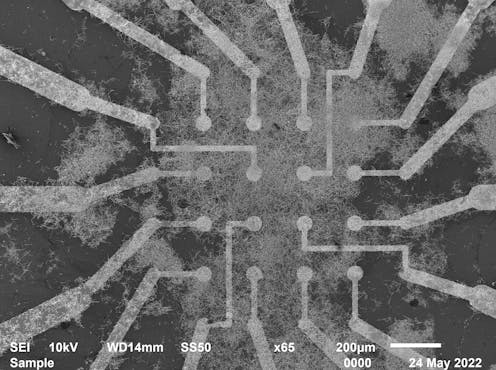
Using nanotechnology, we made networks of silver nanowires about one thousandth the width of a human hair. These nanowires naturally form a random network, much like the pile of sticks in a game of pick-up sticks.

The nanowires’ network structure looks a lot like the network of neurons in our brains. Our research is part of a field called neuromorphic computing, which aims to emulate the brain-like functionality of neurons and synapses in hardware.

A microscope photo showing a messy web of thin grey lines against a black background.
Each nanowire is around one thousandth the width of a human hair, and together they form a random network that behaves much like the web of neurons in our brains. Zhu et al. / Nature Communications

Our nanowire networks display brain-like behaviours in response to electrical signals. External electrical signals cause changes in how electricity is transmitted at the points where nanowires intersect, which is similar to how biological synapses work.

There can be tens of thousands of synapse-like intersections in a typical nanowire network, which means the network can efficiently process and transmit information carried by electrical signals.

Learning and adapting in real time

In our study, we show that because nanowire networks can respond to signals that change in time, they can be used for online machine learning.

In conventional machine learning, data is fed into the system and processed in batches. In the online learning approach, we can introduce data to the system as a continuous stream in time.

With each new piece of data, the system learns and adapts in real time. It demonstrates “on the fly” learning, which we humans are good at but current AI systems are not.

Read more: Networks of silver nanowires seem to learn and remember, much like our brains

The online learning approach enabled by our nanowire network is more efficient than conventional batch-based learning in AI applications.

In batch learning, a significant amount of memory is needed to process large datasets, and the system often needs to go through the same data multiple times to learn. This not only demands high computational resources but also consumes more energy overall.

Our online approach requires less memory as data is processed continuously. Moreover, our network learns from each data sample only once, significantly reducing energy use and making the process highly efficient.

Recognising and remembering numbers

We tested the nanowire network with a benchmark image recognition task using the MNIST dataset of handwritten digits.

The greyscale pixel values in the images were converted to electrical signals and fed into the network. After each digit sample, the network learned and refined its ability to recognise the patterns, displaying real-time learning.
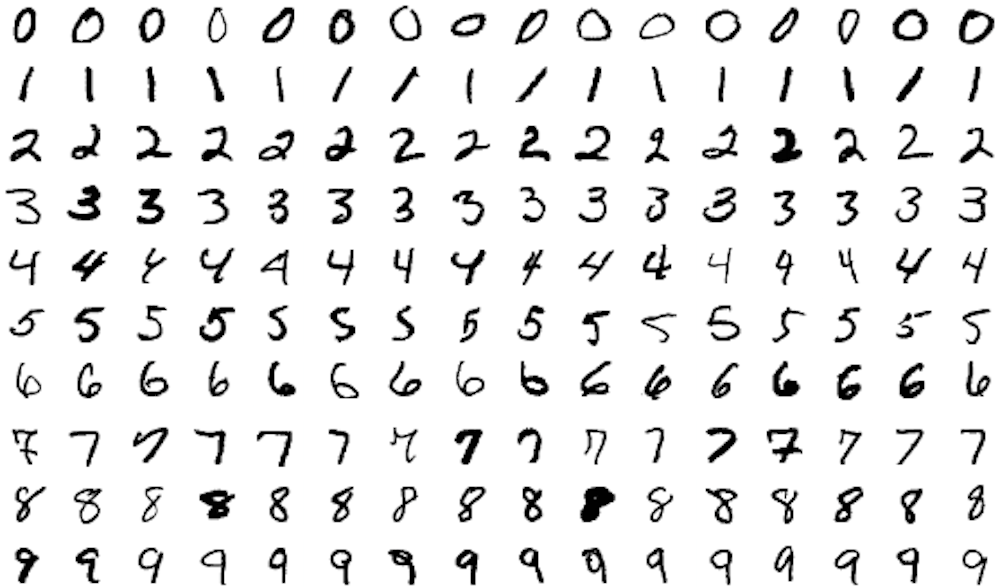
A grid of handwritten digits The nanowire network learned to recognise handwritten numbers, a common benchmark for machine learning systems. NIST / Wikimedia, CC BY-SA

Using the same learning method, we also tested the nanowire network with a memory task involving patterns of digits, much like the process of remembering a phone number. The network demonstrated an ability to remember previous digits in the pattern.

Overall, these tasks demonstrate the network’s potential for emulating brain-like learning and memory. Our work has so far only scratched the surface of what neuromorphic nanowire networks can do.

Authors: Zdenka Kuncic, Professor of Physics, University of Sydney

Read more https://theconversation.com/we-built-a-brain-from-tiny-silver-wires-it-learns-in-real-time-more-efficiently-than-computer-based-ai-216730

Business News

The Rise of Digital Marketplaces in the Australian Trade Sector

For decades, the Australian trade and construction sector operated almost entirely on word-of-mouth recommendations and local community networks. Small business owners typically relied on local newspa...

Daily Bulletin - avatar Daily Bulletin

How Immigration Lawyers Can Help

Introduction Visa decisions can shape employment, family life, study plans, travel, and future residence. A small omission can lead to delay, added expense, or refusal. Immigration lawyers assess l...

Daily Bulletin - avatar Daily Bulletin

How Industrial Drying Equipment Supports Efficient Processing

Many industrial processes require moisture to be removed from compressed air, products or process materials before they move to the next stage. Excess moisture can affect equipment performance, produc...

Daily Bulletin - avatar Daily Bulletin

Practical Ways a Whiteboard Can Improve Workplace Communication

Effective communication helps teams stay organised, share ideas and keep track of important information. While digital tools are now common in many workplaces, a whiteboard continues to provide a simp...

Daily Bulletin - avatar Daily Bulletin

Designing Eco-Friendly Custom Water Bottles for Your Next Event

The Evolution of Sustainable Event Merchandise Event planning has undergone a massive transformation over the last decade. Gone are the days when organizers could hand out cheap, single use plastic...

Daily Bulletin - avatar Daily Bulletin

Why Choosing a Professional Florist Melbourne Makes Flower Delivery Impactful

Flowers have a great power to speak when humans cannot express their feelings with right words. Flowers are the best gifts when you are celebrating a birthday or welcoming a newborn child into your fa...

Daily Bulletin - avatar Daily Bulletin

The Business Case for Choosing Australian Fabricators Over Imported Alternatives

For a long time, you might have defaulted to overseas suppliers when sourcing fabricated metal components for a project. The unit price was lower on paper, and the maths seemed straightforward. That...

Daily Bulletin - avatar Daily Bulletin

Australian organisations are relying on business continuity plans built for a far more predictable world

Tariff escalations, supply chain fragility, geopolitical events, and the ongoing threat of cyber disruption have reshaped the risk environment facing Australian organisations. The problem is that ma...

Daily Bulletin - avatar Daily Bulletin

How to Rent a Car for Uber in Melbourne: What Every New Driver Needs to Know

Starting out as an Uber driver in Melbourne is not as complicated as it sounds but getting the vehicle right is where most new drivers get stuck. Uber has strict requirements around vehicle age, condi...

Daily Bulletin - avatar Daily Bulletin

The Daily Magazine

Microsoft Surface For Business (Microsoft 365 E3, E5, E7) And Modern Workplace Requirements

Understanding Business Device Requirements Microsoft surface for business (microsoft 365 E3, E5, ...

Choosing the Right Split System for Melbourne Homes

Why Split Systems Suit Melbourne Conditions Choosing a heating and cooling system starts with und...

What Happens to Remaining Sperm Stored in the Vas Deferens After the Procedure

Deciding to undergo a permanent contraceptive procedure is a significant life step for many men. Whe...

Top Tips on Combining TMS Therapy with Comprehensive Adult ADHD Care in Sydney

Managing attention-deficit hyperactivity disorder (ADHD) alongside co-occurring mental health condit...

What To Expect Before, During, And After Laser And CRP Hair Loss Treatments

Hair thinning affects millions of Australians, leading many to seek advanced, non-surgical solutions...

What To Ask During A Consultation For Men's Hair Loss Treatment And PRP

Walking into a clinic to address thinning hair can feel daunting, but preparation builds confidenc...

How to Ensure Safe and On-Time Building Material Delivery with Sydney Cargo Transportation Services

Managing a construction site requires precise coordination, where even a minor delay can stall an en...

What to Ask Your Cosmetic Surgeon About Liposuction and Thigh Lift Reduction in Perth

Establishing the Surgeon’s Credentials and Local Experience Your safety depends heavily on the cred...

Top Ergonomic Tips to Enhance Your Neck Pain Treatment and Prevent Back Pain In Sydney

Many office workers in New South Wales spend upwards of eight hours a day hunched over a keyboard, l...