

Secrets in the canopy: scientists discover 8 striking new bee species in the Pacific
- Written by: James B. Dorey, Lecturer in Biological Sciences, University of Wollongong
After a decade searching for new species of bees in forests of the Pacific Islands, all we had to do was look up.
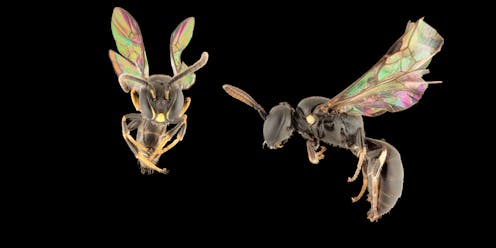
We soon found eight new species of masked bees in the forest canopy: six in Fiji, one in French Polynesia and another in Micronesia. Now we expect to find many more.
Forest-dwelling bees evolved for thousands of years alongside native plants, and play unique and important roles in nature. Studying these species can help us better understand bee evolution, diversity and conservation.
Almost 21,000 bee species are known to science. Many more remain undiscovered. But it’s a race against time, as the twin challenges of habitat loss and climate change threaten bee survival. We need to identify and protect bee species before they disappear forever.
Introducing the new masked bees
Pollinators abound in forests. But scientific research has tended to focus on bees living closer to the ground.
We believe this sampling bias is replicated across much of the world. For example, another related Oceanic masked bee, Pharohylaeus lactiferus (a cloaked bee), was recently found in the canopy after 100 years in hiding.
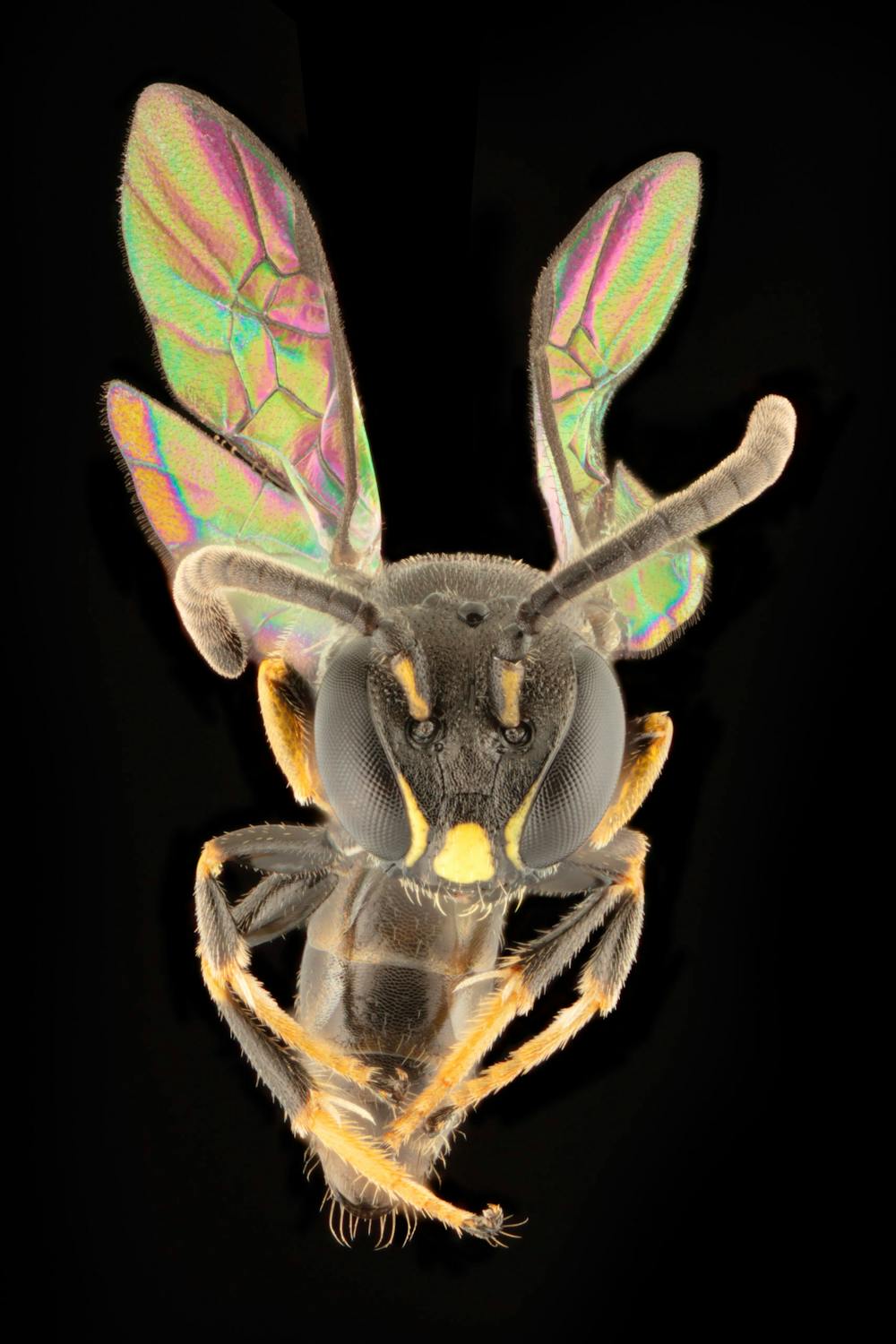 This masked bee was collected from a canopy-flowering mistletoe near Mount Nadarivatu on Viti Levu, Fiji.
James Dorey Photography
This masked bee was collected from a canopy-flowering mistletoe near Mount Nadarivatu on Viti Levu, Fiji.
James Dorey Photography
Our first decade of bee sampling in Fiji turned up only one bee from the genus Hylaeus. This bee probably belonged in the canopy so we were very lucky to catch it near the ground. Targeted attempts over the next few years, using our standard short insect nets, failed to find any more.
But this changed when we turned our attention to searching the forest canopy.
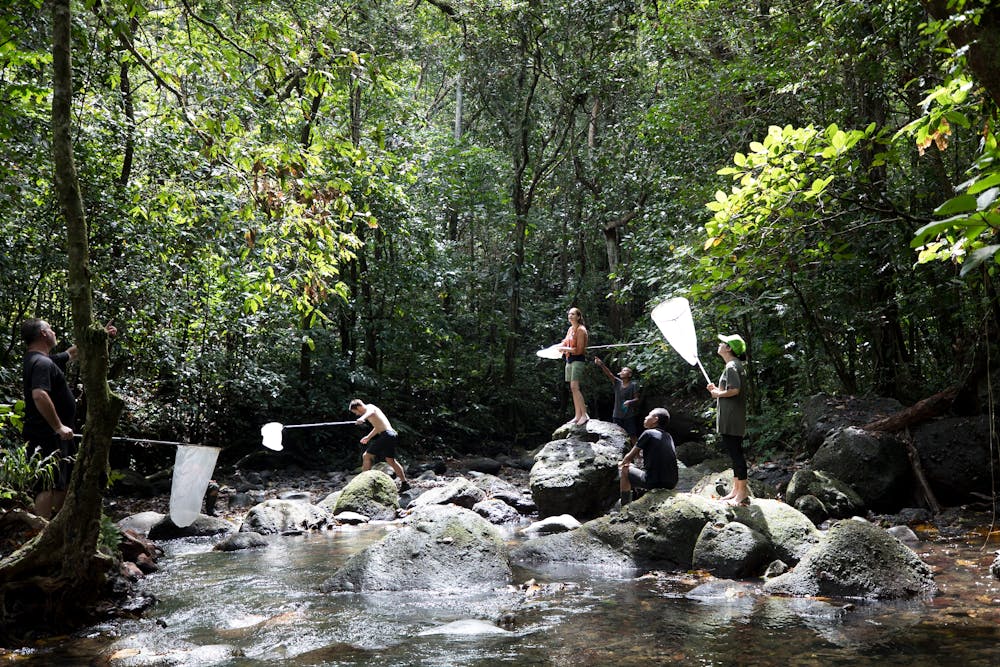
Sampling in the canopy is physically challenging. Strength and skill are required to sweep a long, heavy net and pole through the treetops. It’s quite a workout. We limit our efforts to the edges of forests, where branches won’t tangle the whole contraption.
By lifting our gaze in this way, we discovered eight new bee species, all in the genus Hylaeus. They are mostly black with stunning yellow or white highlights, especially on their faces – hence the name, masked bees.
They appear to rely exclusively on the forest canopy. This behaviour is striking and has rarely been identified in bees before (perhaps because few scientists have been looking for bees up there).
Because the new species live in forests and native tree tops, they’re likely to be vulnerable to land clearing, cyclones and climate change.
More work is needed to uncover the secrets hidden in these dense tropical treetops. It may require engineering solutions such as canopy cranes and drones, as well as skilful tree-climbing using ropes, pulleys and harnesses.
Read more: Move over, honeybees: Aussie native bees steal the show with unique social and foraging behaviours
Michener’s missing links
The journey of bees across the Pacific region is a tale of great dispersals and isolation.
Almost 60 years ago, world-renowned bee expert Charles Michener described what was probably the most isolated masked bee around, Hylaeus tuamotuensis.
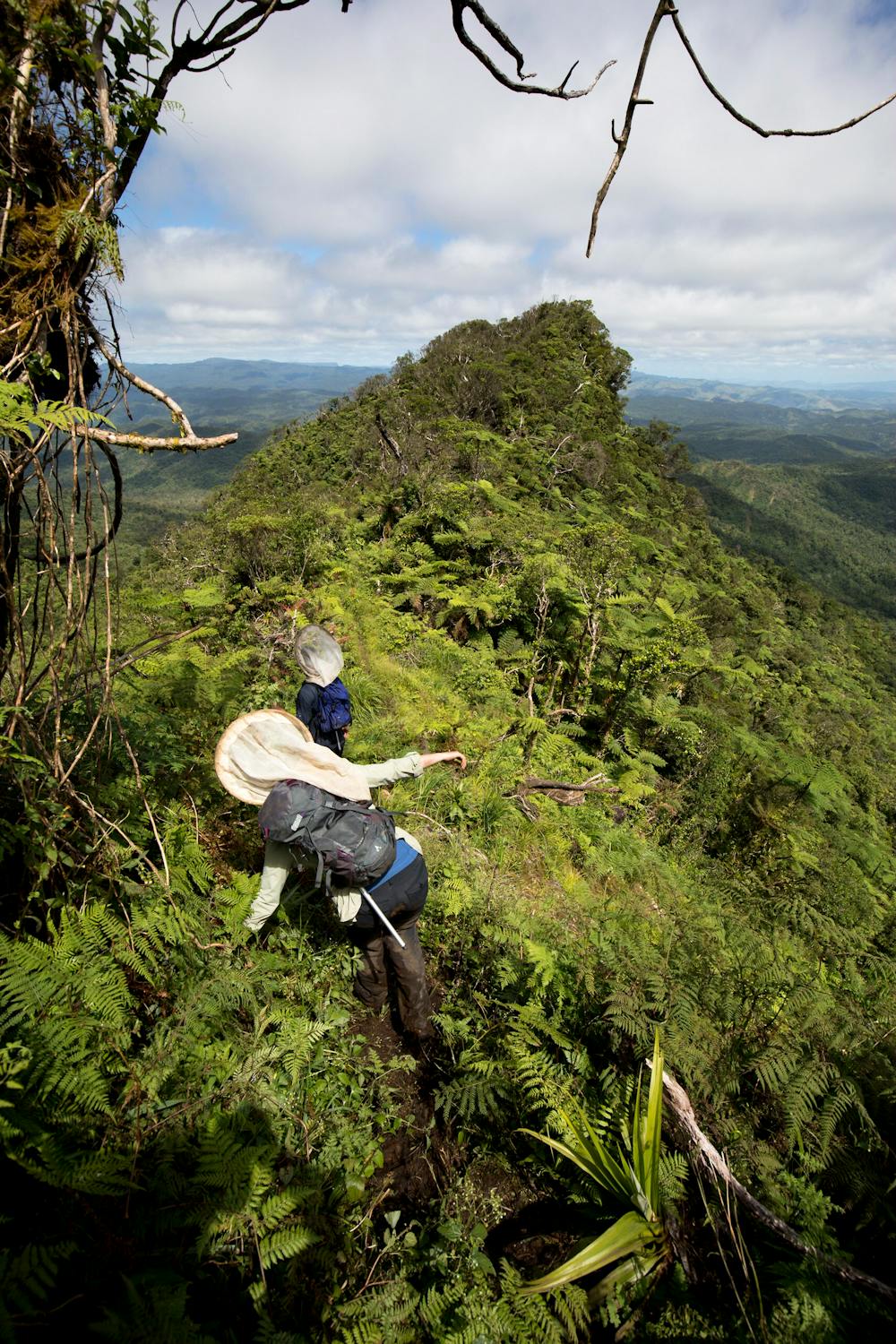 Fiji’s highest peak, Mount Tomanivi, is home to unique bee species.
James Dorey Photography
Fiji’s highest peak, Mount Tomanivi, is home to unique bee species.
James Dorey Photography
The specimen was found in French Polynesia. At the time, Michener said that was “entirely unexpected”, because the nearest relatives were, as the bee flies, 4,000km north in Hawaii, 5,000km southwest in New Zealand, and 6,000km west in Australia.
So how did it get there and where did it come from?
Our research helps to answer these questions. We found eight new Hylaeus species including one from French Polynesia. Using genetic analysis and other methods, we found strong links between these species and H. tuamotuensis.
So Michener’s bee was probably an ancient immigrant from Fiji, 3,000km away. A journey of that magnitude is no mean feat for bees smaller than a grain of rice.
Of course, there are more than 1,700 islands in the Pacific, which can serve as stepping stones for bees on their long journeys.
We don’t yet know how many new Hylaeus species might exist in the South Pacific, or the routes they took to get to their island homes. But we suspect there are many more to be found.
Read more: Phantom of the forest: after 100 years in hiding, I rediscovered the rare cloaked bee in Australia
Our Pacific emissaries
The early origins of Fijian bees – both ground-dwelling Homalictus and forest-loving Hylaeus – can be traced to the ancient past when Australia and New Guinea were part of one land mass, known as Sahul. The ancestors of both groups then undertook epic oceanic journeys to travel from Sahul to the furthest reaches of the Pacific, where they diversified. But the Hylaeus travelled furthest, by thousands of kilometres.
These little emissaries have similarly brought together researchers across the region. We resolved difficulties sampling and gathering knowledge by working with people across the Pacific, including Fiji, French Polynesia, and Hawaii. It shows what can be accomplished with international collaboration.
Together we are making great strides towards understanding our shared bee biodiversity. Such collaborations are our best chance of discovering and conserving species while we can.
We would like to thank Ben Parslow and Karl Magnacca for their contribution to this article. We would further like to thank our collaborators and their home institutions, the Hawiian Department of Land and Natural Resources, Muséum national d’Histoire naturelle, University of the South Pacific, the South Australian Museum and Adelaide University.
Authors: James B. Dorey, Lecturer in Biological Sciences, University of Wollongong


 Daily Bulletin


