

Foy Gibson’s 8,100,000 miles of yarn: how Australians were sold ‘fashionable’ (and ‘healthy’) wool 100 years ago
- Written by: Lorinda Cramer, Lecturer, Cultural Heritage and Museum Studies, Deakin University
How do you describe the feel of wool against your skin? For some that feel is snuggly soft. Others remember a prickly sensation.
But would you call wool “healthy”, “comfortable” or “pure”?
This is how wool was marketed a century ago in mail-order catalogues from Foy & Gibson, an Australian department store and manufacturer.
I’ve been leafing through the catalogues from the first four decades of the 20th century (though Foy & Gibson printed catalogues for longer and plenty of other department stores distributed catalogues, too) to try to understand what attracted Australian customers to wearing wool – with goods so popular that Foy & Gibson spun an astonishing 8,100,000 miles of yarn by the end of the 1920s.
Foy & Gibson
Humans wore wool for thousands of years, driving a thriving wool trade before marketing emerged to help sell even more of the natural fibre.
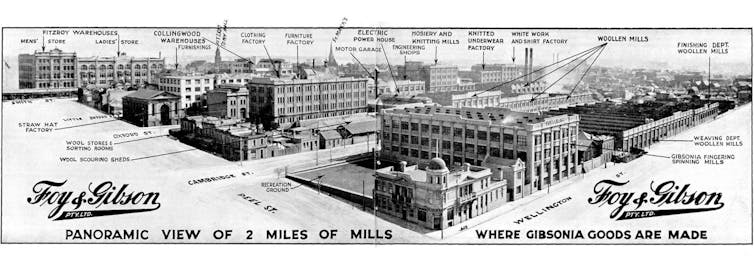
As a major manufacturer of woollen cloths and clothes in Australia, Foy & Gibson’s “two miles of mills” dominated the inner-Melbourne suburb of Collingwood in the 20th century.

The wool spun in these mills was made into cloth and clothing for sale in Foy & Gibson’s flagship Smith Street store. Other stores opened in Melbourne’s city and suburbs, and further afield, including Perth, Brisbane and Adelaide.
Country customers used Foy & Gibson’s mail-order catalogues to help make their selections. Clothing dominated the pages, although dinner sets and dolls, hair lotions and horse harnesses, medicines and manchester, perambulators, pumps and plenty more appeared.
 Foy & Gibson’s flagship store stood on Smith Street, Collingwood.
State Library of Victoria
Foy & Gibson’s flagship store stood on Smith Street, Collingwood.
State Library of Victoria
Women’s coats, with descriptions ranging from “practical” to “fashionable”, could be purchased in tweeds, velours and more. “Handsome” frocks were fashioned on the “smartest styles from abroad”.
Men’s ready-made or made-to-measure suits – the second accessible at a distance through the careful completion of a self-measurement form – were readily available. So were boys’ knickerbocker suits.
These and many more of Foy & Gibson’s clothes were made of wool, though other natural fibres – cotton, linen and silk – appeared in the catalogues. Rayon, the first “man-made” fibre, did too.
 Men’s suits were available ready-made or made-to-order.
University of Melbourne Archives
Men’s suits were available ready-made or made-to-order.
University of Melbourne Archives
Foy & Gibson proudly promoted Australian made, with some goods called “Australian throughout – from greasy wool to finished article”. This wool, Foy & Gibson assured, was the “purest and best” available. It was the “finest Australian wool”.
Purity and quality were important when many wore wool directly against their skin.
Read more: Curious Kids: how is fabric made?
Healthy in wool
In the later decades of the 19th century, dress reformer Gustav Jaeger had introduced his sanitary woollen system.
Wool drew perspiration away from the body, he emphasised, while other cloths clung wetly – and unhealthily – to the body. Jaeger believed wearing wool from underwear through to outer layers allowed “noxious exhalations” from the skin to pass through.
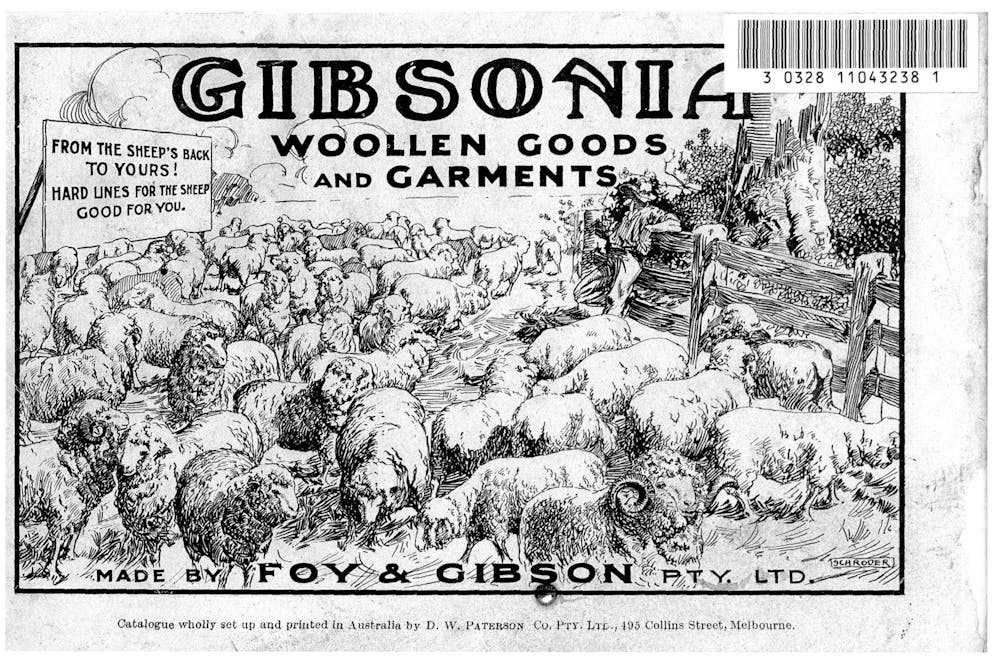 Wool was marketed as ‘good for you’.
State Library of Victoria
Wool was marketed as ‘good for you’.
State Library of Victoria
Jaeger’s system stemmed from a longer history of pure, natural fibres linked to good health. Linen underwear had been worn for hygiene reasons for centuries, as people grappled with cleanliness and how often to wash the body.
Pure fibres and health remained tightly entangled in the 20th century. Foy & Gibson leapt on this trend and assured its customers of “better health” in wool. It kept the body “at a natural comfortable warmth”, transmitted fresh air, absorbed perspiration and prevented chills.
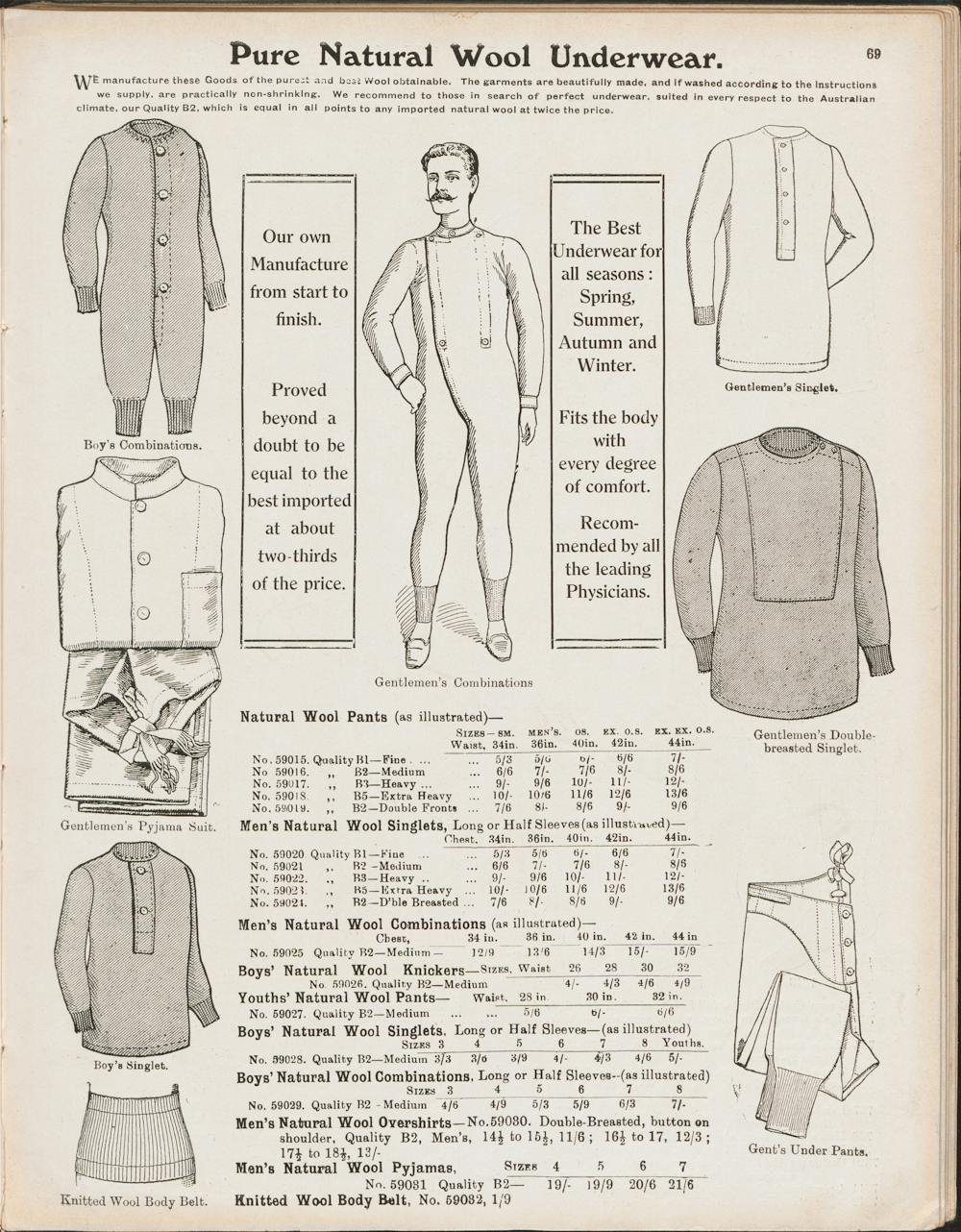 Underwear could reach from neck to ankle.
University of Melbourne Archives
Underwear could reach from neck to ankle.
University of Melbourne Archives
Some donned wool as combinations: underwear joined at the waist that extended from neck to ankle. Others preferred to wear wool “singlets” with long or half sleeves and a single row of buttons at the neck or made with a double-breasted front. Foy & Gibson sold singlets in fine, medium, heavy or extra heavy weights for different seasons.
Comfortable in wool
This experience of wool against the skin – and its healthy qualities – extended to costumes worn to the beach.
A growing interest in physical culture in the 20th century’s first decades saw ideas around fitness, vitality and beauty intersect. Exercising programs gained momentum and beach bathing grew in popularity.
 Woollen bathing suits were popular.
University of Melbourne Archives
Woollen bathing suits were popular.
University of Melbourne Archives
Bathing costumes dramatically transformed. Australia’s beaches provided fresh sea air, invigorating water and warm sun rays that encouraged stripped-down, woollen-clad beachgoers to bare their bodies.
Foy & Gibson made swimsuits in any club colourway for lifesavers, just as they became a national icon.
These woollen swimsuits might have sagged when wet, or clung uncomfortably and unflatteringly, but makers like Foy & Gibson sought to improve fit, elasticity and comfort each year.
New swimsuits were styled for leisure or for active use. Foy & Gibson’s streamlined “Siren” swimsuit, launched in 1930, could be bought in a “speed” or “suntan” cut. Both, customers were told, gave “the close-fitting effect so desirable” while “allowing perfect freedom of movement”.
These costumes were comfortable in and out of the water.
Read more: Wool swimsuits used to be standard beachwear – is it time to bring them back?
Wearing wool today
As we seek sustainable clothing options, mindful of the consequences of fast fashion, waste and synthetic fibre pollution, wool fashioned into underwear and swimwear is again making a resurgence.
And not just that. As the Foy & Gibson catalogues remind us, wool can be made into cloths and clothes of different weights and textures: some thin and light, and others making the warmest winter woollies.
From wedding gowns and wool-denim jeans to activewear and athleisure, wool now – like then – can be worn in diverse ways. Australia’s superfine merino ensures its softness on the skin.
Authors: Lorinda Cramer, Lecturer, Cultural Heritage and Museum Studies, Deakin University
-wool-100-years-ago&media=https://www.dailybulletin.com.au/https://images.theconversation.com/files/587335/original/file-20240411-22-v7vs8u.jpeg?ixlib=rb-1.1.0&q=45&auto=format&w=754&fit=clip&description=Foy%20Gibson’s%208,100,000%20miles%20of%20yarn:%20how%20Australians%20were%20sold%20‘fashionable’%20(and%20‘healthy’)%20wool%20100%20years%20ago "Pin It")

 Daily Bulletin


