

The internet of animals? An inside account of an ambitious plan to track animal movements across the globe
- Written by: Paul McGreevy, Professor of Animal Behaviour and Welfare, University of Sydney
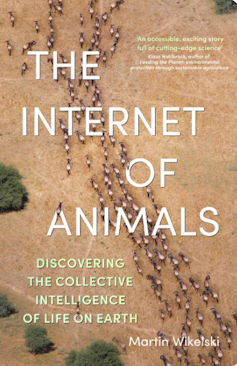
The Internet of Animals is a clever, tempting book title and author Martin Wikelski draws us in with the promise of “discovering the collective intelligence of life on earth”. This book reflects on decades of work tracking animals, offering a vision of future technologies.
Wikelski is director of Germany’s Max Planck Institute of Animal Behavior where he and his colleagues investigate global animal migrations. They have pioneered a system for continuously remotely tracking thousands of animals, called ICARUS, short for International Cooperation for Animal Research Using Space. Their aim is to create an intelligent sensor network of animals (dubbed the “internet of animals”) and protect animals worldwide.
Review: The Internet of Animals – Martin Wikelski (Scribe)
Wikelski’s core research team has mounted an antenna on a satellite, enabling it to track various species, including vultures and toucans, with small, solar-powered trackers.
Its current ICARUS project began collecting data in September 2020. This 18-year journey depended on interactions with the European Space Agency, the European Research Council and Roscosmos (the Russian space agency).

The team’s ultimate goal is to have little GPS devices on representative samples of numerous species to reveal what decisions they make in the world, what knowledge they accumulate over their lifetimes and all the places they have been. The ambition is totally worthy even if the returns on investment so far may seem elusive to some.
Animal gatherings may catch the human eye but their biological functions can be complex. For instance, starlings may learn, from observing each other during their balletic evening murmurations, to identify individuals who have found the best feeding sites.
The ICARUS project has an impressive vision of anticipated data streams and future studies. These are largely intended to study the movements of birds and insects and may well reveal how natural hazards and human interactions affect animal populations. They should also provide data on the possible spread of plant seeds and pathogens.
Rats, cats and storks
Wikelski’s work has taken him all over the world, especially to isolated places. Time spent in isolation has clearly given him the opportunity to reflect on lessons learned from observing animals. The account of his academic journey is peppered with charming anecdotes intended to remind us what we do not yet know about animal behaviour.
These include the tale of a domestic cat he encountered, which responded to human pointing gestures, and a wild fox that spontaneously retrieved thrown sticks.
Wikelski gives names to individual animals whose behaviour lies outside the species norm. Thus we meet Hanzi, the European white stork who took a series of detours and survived a Bavarian winter only because he was cared for by a farming family, and Baby Caruso, a delightfully vocal young, male sea lion.
 A Galapagos rice rat.
MauriceTurner/Wikimedia Commons
A Galapagos rice rat.
MauriceTurner/Wikimedia Commons
Details of his time spent in the Galapagos Islands are truly remarkable, allowing rice rats with negligible experience of predators to take a starring role. The author developed a fondness for these rodents. He makes a gallant attempt to remediate the profile of rats in general although he had to accept these rats would merrily eat through his tent and occasionally bite his buttocks.
A secondary purpose of this tale is to illustrate the rats’ extraordinary homing ability. When one annoying rice rat was relocated a 20-minute walk away from Wikelski’s campsite, it turned up within a couple of hours of departure.
Homing behaviour in various species lends itself to tracking because of its predictability. It has provided an excellent test-bed for telemetry – the remote collection and automatic transmission of data to receiving equipment for monitoring.
The conclusions Wikelski draws from these fascinating observations may alarm those who have been sensitised to anthropomorphism, but they have merit. In keeping with its call for humility on the part of conventional scientists, his book also acknowledges how many First Nations people have drawn on the behaviour of animals to inform strategies for their survival.
Technical questions
Wikelski has developed transmitters small enough to be carried by dragonflies. This deserves praise from a technological perspective but leaves the reader wondering how many animals were impacted by being captured and fitted with prototypes.
 Wikelski has developed transmitters small enough to be carried by dragonflies.
Charles Darwin University/AAP
Wikelski has developed transmitters small enough to be carried by dragonflies.
Charles Darwin University/AAP
We are told birds adjust their own body-weight to accommodate the centre of mass of the tiny transmitters used by Wikelski’s team. In a similar vein, 6-inch (15 cm) long antennae were used on blackbirds even though they projected beyond the tail-feathers. This specification was required for transmission to the satellite but one wonders how authentic the resultant data are when birds are moving with the burden of a foreign body occupying space immediately around them.
Also, Wikelski and many other telemetrists’ use of collars limits research to adult animals because radio collars sized for young wearers become too tight as the animal grows.
Furthermore, as it ages, the epoxy above the solar panel on a tracker can become cracked and grey. This can mean charging is compromised. Meanwhile, the base of the housing touching the back of the animal may be too rough and may damage the pelage or plumage or even the skin of the wearer.
The sixth sense?
Wikelski anticipates the next waves of wearable tracking technology will reveal the sixth sense animals are often said to have. For instance, in apparent anticipation of earthquakes, elephants will travel to higher ground.
In animal behaviour circles, revealing this sixth sense and its true nature is akin to the search in physics for gravitational waves or the Higgs boson particle.
 Elephants will move to higher ground in apparent anticipation of earthquakes.
Ben Curtis/AP
Elephants will move to higher ground in apparent anticipation of earthquakes.
Ben Curtis/AP
We are introduced to Move Bank, an open source archive of the movement of animals across the planet. Resources such as this help to reveal the costs of migration in songbirds (for example, how much energy is being used or the risk of being eaten by predators, or being exposed to dangerous weather systems) and how migrations trend over time. Move Bank was established 25 years ago to help animal tracking researchers manage, share, protect, analyse and archive their data.
Since then Move Bank has been the source of hundreds of research articles but Wikelski gives us a sense of how vulnerable “blue-sky” science projects are to the whims of government and the global economy. Who knew pandemics and wars could also disrupt the best laid plans for international research collaborations?
In a twist of fate, the ICARUS project eventually went live on 20th March 2020 at almost the same time the global COVID pandemic started. This meant human activity on the globe shut down – the so-called anthropause. Fortuitously it meant animal movements could be studied with a minimum amount of human impact.
In the wake of the pandemic, the prospects of using animals’ GPS locations to monitor the spread of zoonotic disease is truly beguiling. For instance, all countries should be interested in the migration of wild birds given its clear relationship to the spread of avian flu.
The collegiality and tenacity multidisciplinary teams require for intercontinental tracking of animals are celebrated in this book and the author demonstrates great humility in listening to technicians and senior authors from related disciplines. The call for greater collaboration among competing research groups is loud and clear.
But Wikelski leaves us in no doubt his discipline’s dependence on satellite tracking has been characterised by serial frustrations. The war on Ukraine has meant the International Space Station is no longer available to host the key tracking satellite involved in the ICARUS Project. (We are told only one receiving device could be made – and mounted – on the satellite.)
Instead, from late 2024, the transmitters fitted to the animals will transmit their position and other data to a receiver on a mini satellite (a CubeSat). From there, the data will be sent to a ground station and published in the Movebank database, which is freely accessible.
 Goodreads
A great deal of research work thus hinges on single items of technology. Nevertheless, Wikelski’s book ends with a veritable shopping list of anticipated research projects.
We are reminded that the “internet of animals” is still in its infancy. But this doesn’t stop the author envisioning what he calls a daily life-cast (not weather forecast) about our planet and the animals in it. He even foresees modern technology allowing a representative online “parliamentary gathering of animals” in which thousands of species can be monitored in the wild by individuals all over the world.
This process of witnessing endangered animals in the wild, he suggests, would be linked to an animal protection payout system levied on the world’s wealthiest people, ensuring their habitats were cared for by local peoples. This, we are assured, would mean animals were no longer persecuted by humans or disadvantaged by decisions we make to further our own lives.
Authors: Paul McGreevy, Professor of Animal Behaviour and Welfare, University of Sydney
Goodreads
A great deal of research work thus hinges on single items of technology. Nevertheless, Wikelski’s book ends with a veritable shopping list of anticipated research projects.
We are reminded that the “internet of animals” is still in its infancy. But this doesn’t stop the author envisioning what he calls a daily life-cast (not weather forecast) about our planet and the animals in it. He even foresees modern technology allowing a representative online “parliamentary gathering of animals” in which thousands of species can be monitored in the wild by individuals all over the world.
This process of witnessing endangered animals in the wild, he suggests, would be linked to an animal protection payout system levied on the world’s wealthiest people, ensuring their habitats were cared for by local peoples. This, we are assured, would mean animals were no longer persecuted by humans or disadvantaged by decisions we make to further our own lives.
Authors: Paul McGreevy, Professor of Animal Behaviour and Welfare, University of Sydney


 Daily Bulletin


