

Plot twist: how giving old graveyards new life as parks can improve our cities
- Written by: Rob Stokes, Industry Professor, Environment and Sustainability, Macquarie University
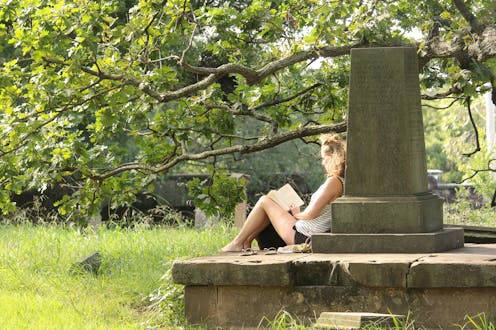
Old graveyards are a forgotten land asset that can find new life as urban parks in crowded cities. As the density of our cities increases, efficient use of urban land becomes paramount. In particular, land for urban parks becomes more important and harder to find.
Church graveyards are one of the land assets left behind as dead space in our cities. Most were closed decades ago as the burial industry created cemeteries and memorial gardens away from churches.
Large necropolises are now being re‑imagined as urban parks while continuing as active burial grounds. In contrast, dormant graveyards are largely overlooked as urban pocket parks. Yet these sites are often found in some of the most densely populated parts of cities.
From rest to recreation
Many cities have long experience converting burial spaces into urban parks. Famous examples include Washington Square Park in central Manhattan, which was converted from a common burial ground to a public park in 1827. Bunhill Fields was a burial space for non-conformist Christians in London from the 1660s until converted into public gardens in the 1850s.
In many instances, cemeteries fulfil the dual role of accommodating new burials while also being public parks. Assistens Cemetery in the Danish capital Copenhagen was founded in the 1750s. Since the early 19th century it has also served the city as a public park.
As urban planning emerged as a separate discipline in the early 20th century, city planners sought to identify and separate discrete land uses. Large allotments on the city fringes were set aside as burial spaces styled as urban parks. Their ancillary use as passive open space was implied in their names – “lawn cemeteries” or “memorial gardens”.
Urban growth and increasing density has led some cities to examine ways to maximise recreational and community uses of these large institutional burial sites.
The untapped potential of urban churchyards
The potential for shared use of small church graveyards remains largely overlooked.
There are 2,265 cemeteries in New South Wales. Most are small church graveyards, which have not been used for interments for many decades.
Across Greater Sydney, the Catholic and Anglican churches own and manage more than 100 cemeteries and columbaria (memorials housing urns of cremated remains). Most are closed to new burials. Many of these sites are located in areas facing a deficit of open space as building densities increase.
One example of this is St Anne’s Church graveyard at Ryde. Established in 1826, it was subject to a partial land resumption for road widening and closed to new interments in the 1950s.
The graveyard is next to high- and medium-density residential apartments. If converted to open space, this area of more than 4,200 square metres would provide extra open space to complement the Ryde Memorial Park to the east of the site.
St Paul’s Anglican Church is about 600 metres from Canterbury Metro station in inner south-western Sydney. The cemetery at St Paul’s was established in the 1860s and measures more than 2,200m². Only the columbarium is still operating. The site does not adjoin the active church buildings.
If converted to open space, the St Paul’s cemetery site could supplement Canterbury Park to the north-west. The surrounding areas of housing have been earmarked for high-density residential development.
Why aren’t more graveyards being used as parks?
Despite the potential of such sites, there are legal, planning and environmental obstacles to converting unused graveyards into public open spaces. Because graveyards are much smaller than cemeteries and are integrated with other land uses, they often face a more complex regulatory environment.
Neighbours may oppose change, preferring to live next to a quiet graveyard rather than an activated parkland. Many urban church graveyards are zoned for infrastructure purposes, with conversion to parkland requiring development consent.
Social attitudes, such as respect for the dead, or fear of “creepy” places, can also create discomfort at converting graveyards to parkland.
As graveyards often include significant heritage items, conversion processes can be complex and costly. Church graveyards may also include habitat for biodiversity. The presence of at-risk species often limits opportunities for greater public use.
Decaying monuments, decrepit headstones and crumbling masonry also create public liability concerns for church management. The safety of monuments in areas used by children is of particular concern.
From hallowed grounds to playgrounds
Despite the complex challenges involved in converting graveyards to parks, there are examples of effective transformations.
St David’s Park is the site of the first church in Hobart, Tasmania, and was used as a burial ground from 1810 to 1872. In 1919 the site was converted into a public park. Tombstones were relocated and conserved along park boundaries to create usable public open space.
Campderdown Cemetery in Newtown, NSW, was founded in 1848 by the Sydney Church of England Cemetery Company. It was converted into public parkland from 1948, becoming a crucial piece of inner-city public space.
Similar conversions have been proposed for other unused urban graveyards. One of these is St John’s Cemetery in central Parramatta, NSW. It was proposed for conversion to a public park in the 1950s.
The architectural historian Keith Eggener observed that cemeteries occupy liminal space where life meets death, nature meets city, present meets past. As our growing cities become more dense, church graveyards may provide valuable community open spaces for the next generation alongside resting places for generations past.
Authors: Rob Stokes, Industry Professor, Environment and Sustainability, Macquarie University


 Daily Bulletin


