

Astronomers just found complex carbon molecules in space – a step closer to deciphering the origins of life
- Written by: Maria Cunningham, Honorary Senior Lecturer, School of Physics, UNSW Sydney
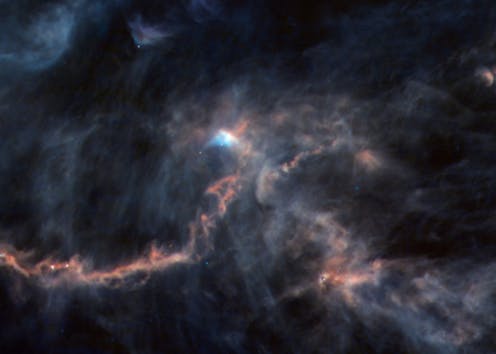
A team led by researchers at MIT in the United States has discovered large molecules containing carbon in a distant interstellar cloud of gas and dust.
This is exciting for those of us who keep lists of known interstellar molecules in the hope that we might work out how life arose in the universe.
But it’s more than just another molecule for the collection. The result, reported today in the journal Science, shows that complex organic molecules (with carbon and hydrogen) likely existed in the cold, dark gas cloud that gave rise to our Solar System.
Furthermore, the molecules held together until after the formation of Earth. This is important for our understanding of the early origins of life on our planet.
Difficult to destroy, hard to detect
The molecule in question is called pyrene, a polycyclic aromatic hydrocarbon or PAH for short. The complicated-sounding name tells us these molecules are made of rings of carbon atoms.
Carbon chemistry is the backbone of life on Earth. PAHs have long been known to be abundant in the interstellar medium, so they feature prominently in theories of how carbon-based life on Earth came to be.

We know there are many large PAHs in space because astrophysicists have detected signs of them in visible and infrared light. But we didn’t know which PAHs they might be in particular.
Pyrene is now the largest PAH detected in space, although it’s what is known as a “small” or simple PAH, with 26 atoms. It was long thought such molecules could not survive the harsh environment of star formation when everything is bathed in radiation from the newborn suns, destroying complex molecules.
In fact, it was once thought molecules of more than two atoms could not exist in space for this reason, until they were actually found. Also, chemical models show pyrene is very difficult to destroy once formed.
Last year, scientists reported they found large amounts of pyrene in samples from the asteroid Ryugu in our own Solar System. They argued at least some of it must have come from the cold interstellar cloud that predated our Solar System.
So why not look at another cold interstellar cloud to find some? The problem for astrophysicists is that we don’t have the tools to detect pyrene directly – it’s invisible to radio telescopes.
Using a tracer
The molecule the team has detected is called 1-cyanopyrene, what we call a “tracer” for pyrene. It is formed from pyrene interacting with cyanide, which is common in interstellar space.
The researchers used the Green Bank Telescope in West Virginia to look at the Taurus molecular cloud or TMC-1, in the Taurus constellation. Unlike pyrene itself, 1-cyanopyrene can be detected by radio telescopes. This is because 1-cyanopyrene molecules act as small radio-wave emitters – tiny versions of earthly radio stations.
As scientists know the proportions of 1-cyanopyrene compared to pyrene, they can then estimate the amount of pyrene in the interstellar cloud.
The amount of pyrene they found was significant. Importantly, this discovery in the Taurus molecular cloud suggests a lot of pyrene exists in the cold, dark molecular clouds that go on to form stars and solar systems.
 A wide-field view of part of the Taurus molecular cloud ~450 light-years from Earth. Its relative closeness makes it an ideal place to study the formation of stars. Many dark clouds of obscuring dust are clearly visible against the background stars.
ESO/Digitized Sky Survey 2. Acknowledgement: Davide De Martin.
A wide-field view of part of the Taurus molecular cloud ~450 light-years from Earth. Its relative closeness makes it an ideal place to study the formation of stars. Many dark clouds of obscuring dust are clearly visible against the background stars.
ESO/Digitized Sky Survey 2. Acknowledgement: Davide De Martin.
The complex birth of life
We are gradually building a picture of how life on Earth evolved. This picture tells us that life came from space – well, at least the complex organic, pre-biological molecules needed to form life did.
That pyrene survives the harsh conditions associated with the birth of stars, as shown by the findings from Ryugu, is an important part of this story.
Simple life – consisting of a single cell – appeared in Earth’s fossil record almost immediately (in geological and astronomical terms) after the planet’s surface had cooled enough to not vaporise complex molecules. This happened more than 3.7 billion years ago in Earth’s approximately 4.5 billion history.
For simple organisms to then appear so quickly in the fossil record, there’s just not enough time for chemistry to start with mere simple molecules of two or three atoms.
The new discovery of 1-cyanopyrene in the Taurus molecular cloud shows complex molecules could indeed survive the harsh conditions of our Solar System’s formation. As a result, pyrene was available to form the backbone of carbon-based life when it emerged on the early Earth some 3.7 billion years ago.
This discovery also links to another important finding of the last decade – the first chiral molecule in the interstellar medium, propylene oxide. We need chiral molecules to make the evolution of simple lifeforms work on the surface of the early Earth.
So far, our theories that molecules for early life on Earth came from space are looking good.
Authors: Maria Cunningham, Honorary Senior Lecturer, School of Physics, UNSW Sydney


 Daily Bulletin


