

Nature and shops: here’s what people told us they want most from urban planning
- Written by: Iain White, Professor of Environmental Planning, University of Waikato
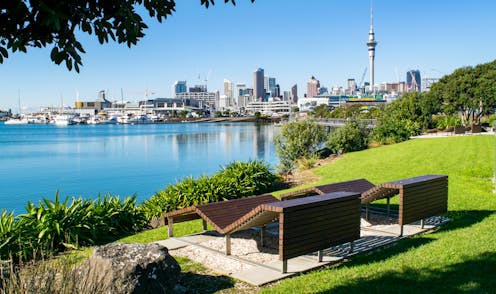
Urban planning has a long history of promoting visionary ideas that advocate for particular futures. The most recent is the concept of the 15-minute city, which has gained traction globally.
But empirical evidence on public preference for what people want is surprisingly thin on the ground.
To help address this gap, we conducted a national survey (1,491 responses) in Aotearoa New Zealand to find out what amenities people want to have easy access to, how much time they prefer to spend getting there, and how this differs between different groups in the population.
Our recently published research provides more depth. The headline messages have significant implications for politicians, policy-makers and others interested in planning cities to better meet the needs of citizens.
People want green space and local shops
The first message is that visions such as 15-minute cities tend to promote the idea of livability connected to easy access to multiple amenities – from education to employment and culture.
However, when we asked what amenities people prefer the most, two things came out far above others: local nature and local shops.
This finding is important as it allows cash-strapped local authorities to prioritise and sequence spending. It also supports the agenda of those who are advocating for an increase in urban green space or local living.
A complete shift to a 15-minute city can be daunting, but investment in these two specific areas could be an excellent first step in improving livability in a way that reflects what citizens want from planning.
We also asked people for their preferred maximum travel time to their most preferred amenity for a one-way trip, using different modes. Nationally, the data were consistent, identifying around 20 minutes as a good rule of thumb for maximum preferred travel time.
Importantly, this time was broadly similar regardless of the transport mode chosen. Whether walking, cycling or travelling by micro-mobility modes such as e-scooters, people wanted to spend no more than 20 minutes doing so – even though the distances vary.
It is important to acknowledge this time is a maximum, not a preference. It is better understood as a threshold or decision point after which people are much more likely to drive or choose not to travel.
This evidence has a wider resonance.
First, it strongly reinforces the 15-minute city or 20-minute neighbourhood as accurately reflecting public preferences for travel time to reach destinations, especially as this figure was consistent regardless of the travel mode.
Second, people are willing to walk further than we typically plan for.
For example, planners may typically apply a walkable catchment of an 800-metre radius around the central business district or transit nodes to allow for higher-density zoning. This distance is a walk of about ten minutes. Our data suggest this area could be expanded and more opportunities created to increase housing volume and diversity.
One size does not fit all
One crucial aspect for improving livability is recognising differences in people’s ability or willingness to walk, cycle or use micro mobility. To explore this, our survey asked people how comfortable they were using each active travel mode after dark.
We reveal a strong gender difference. For example, 41% of people said they were uncomfortable walking after dark. Of this group, 86% were female.
For all travel modes, there was a similar story with females more likely to change travel behaviour, mostly due to safety concerns. The survey also revealed that people with a disability are significantly less comfortable travelling after dark than those without.
This finding is useful for those concerned with equity. Citizen movement is typically modelled on the idea of an able-bodied person who feels equally comfortable in all urban spaces at all times of day or night.
Without considering difference across populations, advocates may promote an equitable 15-minute city during the day and an inequitable car-dependent one after dark.
This also highlights that any new urban strategy or investment needs to understand existing behaviour and the risks of making current disadvantages worse.
Agendas such as 15-minute cities hold significant value in planning for wellbeing and health, economic activity or decarbonisation. They also hold potential for planners to engage with communities to explain the value of planning, the kind of lifestyle citizens can expect in the future, and why authorities are spending public money.
But urban researchers also need urban concepts to be grounded in evidence to avoid becoming the next urban imaginary accused of failing to be transformative.
Our research helps provide some clarity. The general message is that people want easy access to green spaces and local shops more than anything else and they want to spend no more than 20 minutes getting there.
It also highlights context and differences between groups. We need to marry promising urban concepts to empirical research designed to support people’s preferences and encourage movement and equity.
Authors: Iain White, Professor of Environmental Planning, University of Waikato


 Daily Bulletin


