

Indigenous knowledge merges with science to protect people from fish poisoning in Vanuatu
- Written by: Meg Parsons, Associate Professor in Historical Geography, University of Auckland, Waipapa Taumata Rau
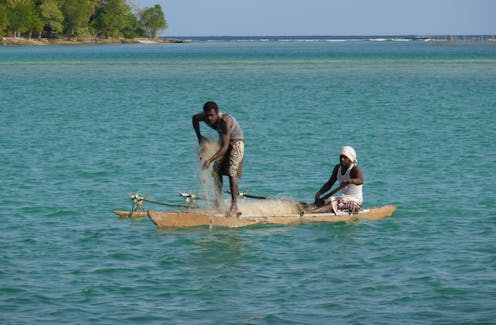
Ciguatera fish poisoning is the world’s most frequently reported seafood-borne illness.
It poses a serious health risk to tropical coastal communities, with some of the highest rates reported in Vanuatu. But now, Indigenous knowledge provides crucial insights for predicting fish poisoning outbreaks.
Our study documents a collaboration between scientists and Indigenous knowledge holders on Vanuatu’s Ambae island. It offers a powerful new model designed to protect people’s health in vulnerable regions.
Ecological indicators and fish poisoning risk
Ciguatera poisoning occurs when people eat fish contaminated with ciguatoxins produced by marine algae that accumulate in reef-feeding fish. Symptoms can range from nausea and muscle pain to severe neurological effects. In some cases, the poisoning can lead to serious illness or even death.
For millennia, Ambae islanders have relied on their knowledge of the local environment to manage their lands and seas in a sustainable manner. They have observed ecological indicators, including environmental changes that precede ciguatera fish poisoning events, to monitor and respond to risks.
For instance, they note how heavy rains wash volcanic sediments into the ocean, triggering algal blooms that produce ciguatoxins. Likewise, jellyfish blooms and shifts in coral growth signal imbalances in the marine ecosystem, often preceding toxic fish contamination.
These ecological indicators, passed down through oral traditions, have guided community decisions about fishing practices and food consumption.
The islanders’ traditional observations are now being woven together with scientific data to create an early-warning system known as the Gigila Framework, named after a local term meaning “risk onset”, to aid public health responses.
Our research documents 14 key environmental indicators used by Ambae island communities. We cross-referenced these indicators with climate, geological and marine data to confirm their accuracy. By comparing Ambae islanders’ observations with scientific data, we identify which Indigenous indicators can be used to assess when and where ciguatera fish poisoning outbreaks take place.
Lessons for other regions
The Gigila framework is a community-driven early-warning system designed to reduce the risk of people eating contaminated fish. It uses visual markers, such as dials, to indicate risk levels.
Village elders appoint local people to act as observers to track environmental changes. They then share their observations (such as jellyfish blooms) with government agencies.
The Gigila model helps local community members make informed decisions about if and where they go fishing. It also strengthens collaborations between Indigenous knowledge holders, scientists and medical professionals.
The approach makes health risk information more accessible and practical. Instead of replacing Indigenous knowledge, it seeks to empower and enhance it. It also helps to ensure that younger generations learn about it.
Challenges of working with different knowledge systems
The weaving together of Indigenous knowledge with scientific knowledge is not without hurdles.
Indigenous knowledge practices are deeply rooted in local culture, passed on through oral traditions and combined with lived experiences. Scientific research, in contrast, relies on standardised testing, numerical data and universal theories.
Unsurprisingly, miscommunication between scientists and Indigenous knowledge holders abounds. Scientists sometimes misinterpret and misunderstand Indigenous knowledge and treat it like data to be extracted and exploited. In doing so, Indigenous peoples’ sacred knowledge systems, cultural identities and ways of life are disrespected and marginalised.
However, the success of the Gigila framework shows that respectful collaborations between scientists and Indigenous knowledge holders are possible. At the heart of this collaboration is respect for Indigenous knowledge holders’ expertise.
Another vital component is that Indigenous communities are active participants in helping to create and maintain the early-warning system designed to protect their health. This approach highlights the strengths of combining different knowledge systems to address local environmental issues, which can be adapted to fit different problems and risks.
Local and global applications
The Gigila framework holds potential beyond Vanuatu. Many small island nations face similar challenges from fish poisoning. Climate change is making these risks worse by creating the environmental conditions that toxic algae favour.
Warmer sea temperatures, ocean acidification, more intense and frequent extreme weather events and changes in the distribution of fish species are all contributing to more frequent fish poisoning outbreaks worldwide, including in areas with no history of it.
This highlights the need for enhanced monitoring and management strategies to reduce the impacts on human health and communities that depend on fisheries.
Other communities could develop their own early-warning systems drawing on the Gigila framework. Globally, Indigenous peoples manage vast ecosystems. Their knowledge and environmental guardianship practices are critical for sustainability and environmental health, but are often sidelined in science and policy.
The Gigila framework highlights the continued relevance and importance of Indigenous knowledge and the need for Indigenous knowledge holders and scientists to work together in a respectful and equitable manner.
As climate change accelerates, partnerships between communities and researchers will be crucial. Governments should support locally led initiatives that promote the deployment of Indigenous knowledge with scientific expertise to produce solutions that are both effective and culturally grounded.
The Gigila framework offers a compelling example of what’s possible when different ways of knowing are woven together. By embracing these approaches, we can build stronger, more resilient and adaptable communities in the face of an uncertain future.
Authors: Meg Parsons, Associate Professor in Historical Geography, University of Auckland, Waipapa Taumata Rau


 Daily Bulletin


