

Earth’s oldest impact crater was just found in Australia – exactly where geologists hoped it would be
- Written by: Tim Johnson, Professor, Geology, Curtin University
We have discovered the oldest meteorite impact crater on Earth, in the very heart of the Pilbara region of Western Australia. The crater formed more than 3.5 billion years ago, making it the oldest known by more than a billion years. Our discovery is published today in Nature Communications.
Curiously enough, the crater was exactly where we had hoped it would be, and its discovery supports a theory about the birth of Earth’s first continents.
The very first rocks
The oldest rocks on Earth formed more than 3 billion years ago, and are found in the cores of most modern continents. However, geologists still cannot agree how or why they formed.
Nonetheless, there is agreement that these early continents were critical for many chemical and biological processes on Earth.
Many geologists think these ancient rocks formed above hot plumes that rose from above Earth’s molten metallic core, rather like wax in a lava lamp. Others maintain they formed by plate tectonic processes similar to modern Earth, where rocks collide and push each other over and under.
Although these two scenarios are very different, both are driven by the loss of heat from within the interior of our planet.
We think rather differently.
A few years ago, we published a paper suggesting that the energy required to make continents in the Pilbara came from outside Earth, in the form of one or more collisions with meteorites many kilometres in diameter.
As the impacts blasted up enormous volumes of material and melted the rocks around them, the mantle below produced thick “blobs” of volcanic material that evolved into continental crust.
Our evidence then lay in the chemical composition of tiny crystals of the mineral zircon, about the size of sand grains. But to persuade other geologists, we needed more convincing evidence, preferably something people could see without needing a microscope.
So, in May 2021, we began the long drive north from Perth for two weeks of fieldwork in the Pilbara, where we would meet up with our partners from the Geological Survey of Western Australia (GSWA) to hunt for the crater. But where to start?

A serendipitous beginning
Our first target was an unusual layer of rocks known as the Antarctic Creek Member, which crops out on the flanks of a dome some 20 kilometres in diameter. The Antarctic Creek Member is only 20 metres or so in thickness, and mostly comprises sedimentary rocks that are sandwiched between several kilometres of dark, basaltic lava.
However, it also contains spherules – droplets formed from molten rock thrown up during an impact. But these drops could have travelled across the globe from a giant impact anywhere on Earth, most likely from a crater that has now been destroyed.
After consulting the GSWA maps and aerial photography, we located an area in the centre of the Pilbara along a dusty track to begin our search. We parked the offroad vehicles and headed our separate ways across the outcrops, more in hope than expectation, agreeing to meet an hour later to discuss what we’d found and grab a bite to eat.

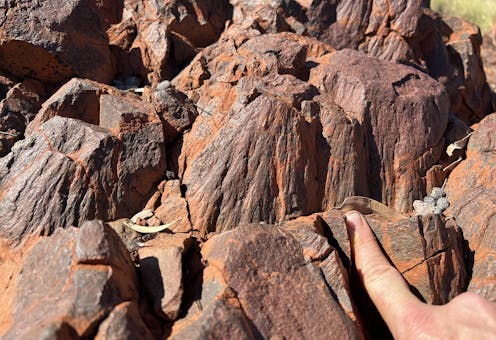
Remarkably, when we returned to the vehicle, we all thought we’d found the same thing: shatter cones.
Shatter cones are beautiful, delicate branching structures, not dissimilar to a badminton shuttlecock. They are the only feature of shock visible to the naked eye, and in nature can only form following a meteorite impact.
 An approximately one metre tall shatter cone ‘hut’, with the rolling hills of the Pilbara in the background.
Chris Kirkland
An approximately one metre tall shatter cone ‘hut’, with the rolling hills of the Pilbara in the background.
Chris Kirkland
Little more than an hour into our search, we had found precisely what we were looking for. We had literally opened the doors of our 4WDs and stepped onto the floor of a huge, ancient impact crater.
Frustratingly, after taking some photographs and grabbing a few samples, we had to move on to other sites, but we determined to return as soon as possible. Most importantly, we needed to know how old the shatter cones were. Had we discovered the oldest known crater on Earth?
It turned out that we had.
There and back again
With some laboratory research under our belts, we returned to the site in May 2024 to spend ten days examining the evidence in more detail.
Shatter cones were everywhere, developed throughout most of the Antarctic Creek Member, which we traced for several hundred metres into the rolling hills of the Pilbara.
Our observations showed that above the layer with the shatter cones was a thick layer of basalt with no evidence of impact shock. This meant the impact had to be the same age as the Antarctic Member rocks, which we know are 3.5 billion years old.
 Delicate shatter cones within rocks typical of the Antarctic Creek Member.
Tim Johnson
Delicate shatter cones within rocks typical of the Antarctic Creek Member.
Tim Johnson
We had our age, and the record for the oldest impact crater on Earth. Perhaps our ideas regarding the ultimate origin of the continents were not so mad, as many told us.
Serendipity is a marvellous thing. As far as we knew, other than the Traditional Owners, the Nyamal people, no geologist had laid eyes on these stunning features since they formed.
Like some others before us, we had argued that meteorite impacts played a fundamental role in the geological history of our planet, as they clearly had on our cratered Moon and on other planets, moons and asteroids. Now we and others have the chance to test these ideas based on hard evidence.
Who knows how many ancient craters lay undiscovered in the ancient cores of other continents? Finding and studying them will transform our understanding of the early Earth and the role of giant impacts, not only in the formation of the landmasses on which we all live, but in the origins of life itself.
Authors: Tim Johnson, Professor, Geology, Curtin University


 Daily Bulletin


