

Travelling with food allergies? These 9 tips can help you stay safer in the skies
- Written by: Jennifer Koplin, Evidence and Translation Lead, National Allergy Centre of Excellence; Chief Investigator, Centre of Food Allergy Research; Associate Professor and Group Leader, Childhood Allergy & Epidemiology Group, Child Health Research Centre, The
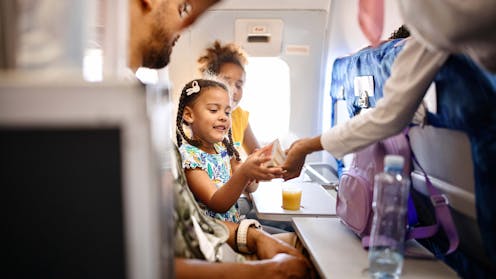
With the school holidays approaching, many families will be travelling, including on planes interstate and overseas. But travel can pose unique challenges for people with serious food allergies.
Research shows air travel is a significant source of anxiety for people living with or caring for someone with a food allergy. In a global survey of 4,704 people with food allergies and their caregivers published in 2024, 98% said having a food allergy adds anxiety to air travel.
Fortunately, there are things you can do to help keep yourself or children with food allergies safe in the skies.
What are the concerns about plane travel with allergies?
Reassuringly, documented allergic reactions during flights are very rare. A 2023 review that combined data from 17 studies estimated about seven in every 10 million passengers had an allergic reaction while flying.
While many people have more mild food allergies, some are at risk of anaphylaxis (a life-threatening allergic reaction) and need to carry adrenaline with them at all times in the form of an EpiPen or Anapen. The review found reports of severe reactions needing adrenaline were even rarer – about eight cases per 100 million passengers.
In fact, this study concluded people were less likely to experience an allergic reaction on a plane than in their everyday lives. However, some of this might be due to the precautions passengers with food allergies already take.
People with food allergies are sometimes worried about food particles travelling in the air of the plane cabin and causing a reaction.
Thankfully, research has shown this risk is very low. It’s difficult for food proteins (the part of the food that causes the allergic reaction) to become airborne. And if they do, air filters fitted on large commercial planes can remove any airborne food particles quickly from the cabin air.
Peanuts are one of the foods commonly associated with anaphylaxis. Studies that have tested opening and shaking containers containing peanuts and de-shelling peanuts found peanut proteins were only detected directly above the container, at a low level, and for a short period of time.
Other studies have found airborne peanut was not detected when eating peanuts in a confined space. And studies found no severe reactions among people with peanut allergy when peanut butter or peanuts were held close to their face or kept in a bowl close by in a small room.
A bigger risk for reactions is the food protein ending up on a seat or tray table. However, casual contact with food crumbs or smears is highly unlikely to cause a severe allergic reaction. This type of contact can cause mild to moderate skin reactions that can be treated with antihistamines if needed.
Staying safe on a plane with allergies
For people at risk of anaphylaxis:
take your adrenaline in your hand luggage (not your checked baggage). Store it under the seat in front of you or in the seat pocket so it’s in easy reach
carry a travel plan and action plan for anaphylaxis, completed and signed by a medical professional, or similar documentation, showing the traveller’s food allergy status and what to do in an emergency. (Templates of these plans are available via the Australasian Society of Clinical Immunology and Allergy)
let the flight crew know you have an allergy and indicate the location of your adrenaline and anaphylaxis action plan. This is particularly important for people travelling alone, since anaphylaxis can be mistaken for other non-allergic symptoms, which could lead to a delay in receiving adrenaline.
For people with food allergies generally:
let the airline know you have a food allergy and ask about their food and medication policies when booking or before travelling
take allergy-safe food from home. Airlines don’t guarantee allergy-safe food will be available, and not all food supplied on a plane will have an ingredient label (but check liquid restrictions and be aware of potential restrictions on taking fresh food across borders)
wipe down surfaces such as the seat, armrests and tray table with wet wipes when boarding. You can request early boarding from airlines to do this
wash your hands before eating (wet wipes and handwashing with soap are more effective than plain water or hand sanitiser)
you may choose to sit a child with food allergy away from areas where food or drink will be passed over the top of them (for example, next to a window or between family members). Tell passengers sitting next to your child about their allergy so they don’t offer to share food or drink
if you think you’re experiencing an allergic reaction, let the flight crew know immediately.
What can other passengers and airlines do?
If you’re travelling, you could wipe down surfaces around you at the end of the flight. Remove rubbish from seatbacks and other areas around your seat and aisle before disembarking.
Also, ask about allergies before offering to share any food with your neighbours during the flight (and check with parents before offering anything to their children).
Airlines, meanwhile, should have clear policies relating to food allergies easily available and consistently applied by ground staff and cabin crew, such as allowing early boarding on request.
The patient support organisation Allergy & Anaphylaxis Australia has a Food Allergy Travel Hub with advice on how to stay safe when travelling with food allergies.
Authors: Jennifer Koplin, Evidence and Translation Lead, National Allergy Centre of Excellence; Chief Investigator, Centre of Food Allergy Research; Associate Professor and Group Leader, Childhood Allergy & Epidemiology Group, Child Health Research Centre, The University of Queensland


 Daily Bulletin


