

The discovery of an extinct shelduck highlights the rich ancient biodiversity of the remote Rēkohu Chatham Islands
- Written by: Nic Rawlence, Associate Professor in Ancient DNA, University of Otago
Islands are natural laboratories where evolution can run rampant as plants and animals adapt to new environmental conditions and vacancies in the ecosystem.
This creates all manner of unique animals, although sadly extinction rates are high on islands and many species are now gone. Examples include a blind, flightless duck with a sensory bill (like a platypus) on Hawaii, and pygmy mammoths on islands off the coast of southern California.
The Rēkohu Chatham Islands, an archipelago 785 kilometres east of mainland Aotearoa New Zealand, are no exception.
The islands were once home to a rich assemblage of unique birds, with 64 breeding species at the time of human arrival. Some 34 species and subspecies were found nowhere else on Earth.
This includes the endangered parea Chatham Island pigeon and the extinct mehonui Hawkin’s rail.
Our new research adds a unique species of shelduck to this group and illustrates just how quickly birds can adapt to life on isolated islands.
The Rēkohu Chatham Islands rose above the waves, taking their present form, around 3.5 million years ago. The archipelago is an ideal place to observe how ecosystems form and new species evolve.
Many of the birds on Rēkohu are closely related to species found on the mainland, but were changed by their new island home. Some are subtly different, such as the extinct Chatham Island kākā, which had a longer bill, larger thigh bones and wider pelvis than its mainland cousin. This suggests it could still fly but spent more time on the ground.
Other birds underwent major changes, such as the extinct Chatham Island duck, which was large, flightless and had bony spurs on its wings which were probably used in fights over territory.
Evolution of the Rēkohu shelduck
Shelducks are a group of semi ground-dwelling ducks found in Eurasia, Africa, Australia and the New Zealand region. In Aotearoa, they are represented by the familiar pūtangitangi paradise shelduck.
During the 1990s, Museum of New Zealand Te Papa Tongarewa palaeontologist Phil Millener found isolated bones and associated skeletons of an extinct shelduck in the rich fossil deposits around the Chatham Islands archipelago. He noted the bones may belong to a new species and they were archived at the museum until scientific advances allowed us to test this idea.
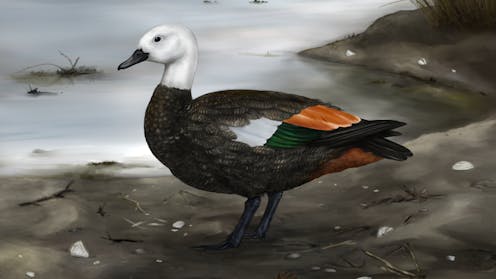
We reconstructed the family tree to uncover the identity of the Rēkohu bird, using ancient DNA from its bones. As Millener hypothesised, the Rēkohu shelduck was most closely related to the mainland paradise shelduck. Its ancestors arrived on the islands a mere 390,000 years ago.
On evolutionary scales, 390,000 years is not a long time, but it was long enough for the Rēkohu shelduck to go down its own evolutionary path. Like the paradise shelduck, males were bigger than females, but the Rēkohu shelduck was taller and more robust. These changes meant Rēkohu shelducks were poorer fliers than their mainland cousins.
Flight is energetically expensive. It is often lost when the cost outweighs its advantages. This is part of the “island syndrome”, a suite of changes in bone shape and behaviour observed in island species. On Rēkohu, an abundance of food, strong winds and a paucity of large predators meant flying wasn’t as beneficial as on the mainland, where predators such as kērangi Eyle’s harrier, Haast’s eagle, whēkau laughing owl and adzebill abounded.
Over time, a preference to spend more time on the ground resulted in the wing bones of the Rēkohu shelduck becoming shorter, more robust and less able to support flight. At the same time, its leg bones became longer and more robust. The Rēkohu shelduck was on a trajectory to flightlessness when it became extinct shortly after humans arrived.
A rich Rēkohu waterfowl community
The rich fossil deposits on Rēkohu continue to reveal much about the history of the islands. There are likely more undescribed species awaiting discovery.
Our lab continues to investigate the fauna of the islands, with ongoing work to determine if an extinct falcon represents another unique Rēkohu bird.
Working with Indigenous communities is paramount if we are committed to the process of decolonising palaeontology. The shelduck’s scientific (Tadorna rekohu) and common (Rēkohu shelduck) names were gifted to us by the Hokotehi Moriori Trust, the tchieki (guardians) of Rēkohu biodiversity, with which they are interconnected through shared hokopapa (genealogy).
The discovery and naming of the Rēkohu shelduck helps connect the Moriori imi (tribe) with miheke (treasure) of the past, allowing people to reclaim some of the pages of their biological heritage that have been lost.
The Rēkohu shelduck is part of a rich native and endemic waterfowl assemblage (nine different species) that was present when people arrived. These birds are survived only by the parera grey duck. We are only just beginning to understand how the ecological community of the islands once functioned.
The Rēkohu shelduck was on a unique evolutionary trajectory when it went extinct after humans colonised the islands but prior to the arrival of Europeans and Māori. This is a fate shared by many of Rēkohu’s birds.
The discovery of the Rēkohu shelduck is a demonstration of the speed at which island species can be changed by their environment. It highlights both the distinctiveness of Rēkohu animals and their close relationship with mainland Aotearoa New Zealand.
Authors: Nic Rawlence, Associate Professor in Ancient DNA, University of Otago


 Daily Bulletin


