

Read The Times Australia

Daily Bulletin

Why was the Afghanistan earthquake so deadly? A disaster resilience expert explains

  • Written by: Iftekhar Ahmed, Associate Professor in Construction Management/Disaster Resilience, University of Newcastle
Why was the Afghanistan earthquake so deadly? A disaster resilience expert explains

The death toll following the recent earthquake in Afghanistan continues to rise. Taliban-led health authorities now say at least 800 people have been killed and 2,000 injured.

The earthquake struck just before midnight local time on Sunday in a mountainous region near the city of Jalalabad, along the eastern border with Pakistan. It was of a relatively low 6.0 magnitude. But its epicentre was shallow at 8km underground, resulting in strong shaking on the surface and a series of aftershocks.

Most of the dead and injured were sleeping indoors at the time of the earthquake, and were crushed by collapsing buildings. Because of the remoteness of the affected areas, and also blockage of road networks from landslides caused by the earthquake, the exact death toll may take a long time to find out.

A region prone to earthquakes

The Himalaya and Hindu Kush mountains, and their foothills, where the impacted area in Afghanistan is located, are seismically active because of the ongoing friction between the Eurasian and Indian tectonic plates.

This has led to some of the most devastating earthquakes in the region such as the 2015 Gorkha earthquake in Nepal and 2005 Kashmir earthquake in Pakistan.

Afghanistan also has its fair share of earthquakes, especially in the currently impacted region. In October 2023 an earthquake here killed more than 1,500 people. The previous year, more than 1,000 people were killed by another earthquake.

The 2011 earthquake in Christchurch, New Zealand, was of a similar magnitude and occurred at a shallower depth as the most recent one in Afghanistan. Yet, even though it impacted a built-up city, only 185 people died.

The hundreds of deaths in scattered rural hamlets in Afghanistan present a sharp contrast.

A helicopter in a field, next to a crowd of people and three bodies in white bags.
At least 800 people have been killed and some 2,000 injured after a shallow magnitude 6.0 earthquake in rural Afghanistan. Samiullah Popal/EPA

Earthquakes don’t kill people, buildings do

An oft-quoted phrase, “earthquakes don’t kill people, buildings do”, is helpful to understand the factors that contribute to the high death toll of this earthquake and past ones in Afghanistan.

Rural communities in Afghanistan can’t afford sturdy and manufactured building materials. Because of this they build homes with locally available natural materials such as earth, stone and raw lumber.

Such buildings do not follow engineered designs, building codes or formal professional standards that prevent easy damage by earthquakes in wealthier countries.

A typical form of construction in Afghan rural areas is walls made of mud bricks or stone masonry. This is known as “monolithic” construction.

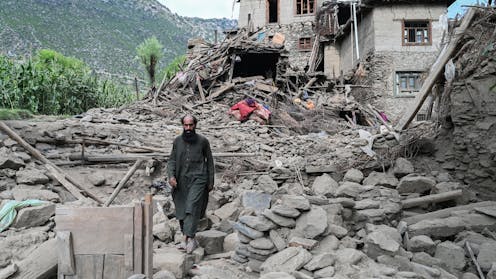
Such construction is unable to resist the strong side-to-side shaking caused by an earthquake. As a result, buildings easily tumble and crush people. Reports of collapsed rubble where there were once buildings are emerging widely from Afghanistan, as was also the case in previous earthquakes.

A collapsed mudbrick building.
Mudbrick buildings are common in Afghanistan but are unable to resist the strong side-to-side shaking caused by an earthquake. Samiullah Popal/EPA

A trigger for design change

Examples from other countries in the region demonstrate a better level of earthquake-resilient building design can be achieved in similar socio-economic conditions.

After the 2005 Kashmir Earthquake in Pakistan, the government established the Earthquake Reconstruction and Rehabilitation Authority. It assisted in helping affected people build safer houses through a community-based program backed by technical guidance.

In Nepal, after the 2015 Gorkha earthquakes the government established the minimum standards of their National Building Code, that allow rules of thumb to comply with a basic level of earthquake resilience.

More than 25 years ago, Indian earthquake engineer Anand Arya pioneered his approach to reducing earthquake risk for “non-engineered” buildings. Among other techniques, this approach includes adding continuous bands in the walls, and reinforcements in the corners of a building and along doors and windows, which can provide strength to traditional masonry buildings.

These examples demonstrate that not a lot of money is always required to improve earthquake resilience. Rather, a degree of technical and institutional support can achieve safety in cost-effective ways.

Admittedly, such buildings would not be entirely earthquake-proof. But they would still impart a level of strength that can lead to less damage, and importantly, save lives.

One can hope this earthquake will be a trigger for such an initiative in Afghanistan, so a “building back better” process can assist the impacted communities to be more resilient to future earthquakes.

Authors: Iftekhar Ahmed, Associate Professor in Construction Management/Disaster Resilience, University of Newcastle

Read more https://theconversation.com/why-was-the-afghanistan-earthquake-so-deadly-a-disaster-resilience-expert-explains-264274

Business News

How Fulfilment Services in Australia Help Businesses Scale Efficiently

The growth of e-commerce and modern retail has transformed customer expectations. Consumers now expect fast shipping, accurate order processing, and seamless delivery experiences regardless of where...

Daily Bulletin - avatar Daily Bulletin

Practical Ways Australian Workplaces Can Reduce Operating Costs

Reducing business costs doesn’t always mean cutting staff, shrinking services or making the workplace feel bare-bones. In many cases, the smarter savings are hiding in everyday operations: the light...

Daily Bulletin - avatar Daily Bulletin

Executive Recruitment Solutions That Help Organisations Secure Exceptional Leaders

Leadership has a direct impact on organisational performance, employee engagement, strategic growth, and long-term success. Businesses operating in increasingly competitive environments require experi...

Daily Bulletin - avatar Daily Bulletin

Why A WooCommerce Website Designer Matters For Online Growth

Running an online store today requires more than simply listing products and waiting for customers to arrive. Businesses need a website that is fast, reliable, easy to navigate, and designed to suppor...

Daily Bulletin - avatar Daily Bulletin

Turning Your Empty Tables into Revenue

The rise of AI demand tools in hospitality, the EatClub–CommBank partnership, and seven trends reshaping Australian dining  A growing number of Australian venues are turning to AI-powered demand ma...

Daily Bulletin - avatar Daily Bulletin

High-Impact Dental Marketing Strategies That Are Driving Real Practice Growth Today

The landscape of dental practice growth in Australia has shifted dramatically over recent years. Standard, broad-spectrum advertising campaigns no longer yield the return on investment they once did. ...

Daily Bulletin - avatar Daily Bulletin

How Telematics Helps Australian Companies Improve Productivity

Operating a commercial fleet in Australia is a uniquely demanding endeavour. Between the sprawling urban sprawl of cities like Sydney and Melbourne and the immense, unforgiving stretches of the Outb...

Daily Bulletin - avatar Daily Bulletin

Inside the Icon: The BridgeMuseum Officially Opens at the Sydney Harbour Bridge

A bold new way to experience one of Australia’s most recognisable landmarks has arrived, with BridgeClimb Sydney officially opening the all-new BridgeMuseum.  Located inside the Sydney Harbour Bridge...

Daily Bulletin - avatar Daily Bulletin

Is Your Brand Showing Up in AI Search? Most Melbourne Brands Aren't.

The New Front Door Nobody Told You About Something changed. Quietly. Without a press release. The way buyers find businesses in Australia has been rewired. Not replaced, rewired. Google isn't dead...

Daily Bulletin - avatar Daily Bulletin

The Daily Magazine

Traffic Light System Solutions For Safer And More Efficient Traffic Management

Modern cities and growing communities rely heavily on effective traffic management to ensure safety...

Gold Migration Lawyers in Liquidation: How the Closure Affects Your ART Appeal

If your appeal was with Gold Migration Lawyers, a recent change to how the Tribunal decides cases ...

The pressure cooker: life in urban Australia in 2026

Australian cities have always been demanding. Long commutes, rising housing costs, busy schedules a...

What Actually Makes a Good Criminal Lawyer in Melbourne

Most people only think about this question once. That is usually too late. Most people charged wi...

Why Working With A Chatswood Tutor Can Improve Academic Performance

Academic expectations continue increasing for students across primary school, high school, and senio...

Is It Worth Getting Solar Panels in Melbourne?

The real question is not whether solar works in Melbourne. It works. The question is what it is co...

How A Diploma Of Project Management Builds Practical Skills For Modern Work Environments

Developing the ability to plan, execute, and deliver outcomes efficiently is a key requirement in to...

How to Choose the Right Football for Every Level

Choosing a football may seem straightforward, but the right option depends on who will be using it a...

What to Ask a Wedding Photographer Before You Book

Booking a wedding photographer can feel deceptively simple: you like the photos, you like the vibe...