

Solar power cuts electricity bills and carbon emissions – NZ needs to scale up faster
- Written by: Paul Hume, Senior Research Fellow in Materials Science, Te Herenga Waka — Victoria University of Wellington
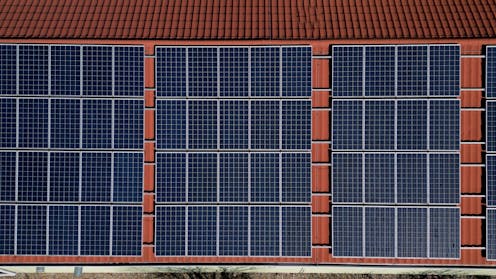
Solar power is now the cheapest form of electricity in most countries, including New Zealand, and its global uptake is growing exponentially.
So far, New Zealand’s adoption of solar electricity generation has been slower than elsewhere, but it is accelerating quickly. Scaling up installation could help reduce high consumer energy prices and meet New Zealand’s emissions budgets.
Based on current policies, New Zealand is at risk of exceeding its emissions budget for the period from 2026 to 2030, and current plans are insufficient to stay within the subsequent five-year budget up to 2035.
The Climate Change Commission estimates solar combined with battery storage could cut 3.9 million tonnes of carbon dioxide equivalent emissions between 2031 and 2035.
This is important, as a major part of the government’s plan for cutting emissions over the next five years rested on a carbon capture project at the Kapuni gas field, which seems to have fallen through.
New Zealand is also facing an energy shortage, leading to high electricity prices. But solar could be part of the solution because global reductions in the price of panels mean residential solar is now likely the cheapest option for households.
Solar on the rise
The solar energy reaching Earth each hour is roughly equivalent to a year of humankind’s global energy consumption.
This is not to say our current energy demand should be the target. We need to reduce consumption and use energy more efficiently, even as we continue the shift to more renewable power generation.
But a small fraction of sunlight can go a long way and many countries are taking advantage of this. For example, a consumer-led solar revolution is happening in Pakistan in response to longstanding energy supply problems. This year, solar became the largest source of electricity in Pakistan, surging to 25% of generation from about 5% just three years ago.
The uptake of solar electricity generation is also growing in New Zealand, with a significant uptick in projects for both utility-scale solar farms and household installations.
New Zealand has five large-scale solar farms in operation, and many more in the pipeline (nine at delivery stage, 33 under investigation). We also have more than 65,000 residential solar installations, up from about 7,500 a decade ago.
Despite the rapid growth in recent years, this is still a relatively low adoption rate compared to some other countries, with only about 3-4% of homes having solar installed.
A frequent argument against solar electricity generation is that it is intermittent. But solar panels can use hot water cylinders or batteries to store energy for later use.
And while New Zealand may not get quite as much sunshine as other countries, our existing renewable generation and hydro-lake storage mean we don’t have to invest as much in batteries to buffer intermittent generation.
Also, the flip side of intermittent power sources is that they turn back on – fossil fuels can only be used once.
Managing solar at scale
The energy and emissions-cutting benefits of solar generation are well quantified. Solar panels generate the amount of energy required to manufacture them in less than two years, compared with a total lifetime of about 30 years.
It takes slightly longer to pay back the carbon emissions from their manufacture in New Zealand than elsewhere, because we already have a comparatively high proportion of renewable electricity generation. The carbon payback is faster if solar is used in ways that directly displace fossil fuels (for example, electricity from gas or coal) or if the panels are manufactured in places with low carbon intensity (low emissions per unit of economic activity or energy produced).
There is still work to do. We need to address practical challenges such as effective grid integration and storage, as well as social issues such as ensuring that low-income households aren’t disadvantaged.
Globally, the mining of raw materials for solar panels is a key issue, and we need to ensure ethical supply chains and labour practises associated with materials and manufacture. Ultimately, we need to reach a system where solar panels are recycled to avoid the need for indefinite mining, and to keep panels out of landfills.
This goal looks promising. Solar panel recycling is an active area of research and already possible, although not yet profitable.
As the uptake of solar accelerates, New Zealand should make sure suitable policies are in place. In terms of materials, we should require recycling of solar panels. On the social side, we should ensure support for low-income households and consider incentives for solar installations on rental properties.
Researchers are also exploring next-generation solar power with lower energy and material demands in their manufacture. In most commercial solar panels, the dominant contribution to manufacturing emissions is the silicon “active layer”. There are multiple alternatives to silicon and new technologies use different materials for the active layer.
For example, my research focuses on solution-printable organic semiconductors. These materials absorb light very strongly, which means the active layer is about a thousand times thinner than in a silicon solar panel. A kilogram of material can cover more than 5,000 square metres.
It will take time for these new technologies to reach the same level of development as today’s solar panels. They will likely first enter the market as complementary products such as lightweight installations on low load-bearing surfaces (warehouse roofs) and in building-integrated applications.
Economically viable solar energy generation is a triumph of long-term scientific and engineering development that began in the 1950s and is poised to play a key role in decarbonisation. New Zealand needs to think about how to manage this technology at scale if we want to make the most of this opportunity.
Authors: Paul Hume, Senior Research Fellow in Materials Science, Te Herenga Waka — Victoria University of Wellington


 Daily Bulletin


