

Managing mould, housemates, and landlords: new research reveals sharehousing horror stories
- Written by: Zoe Goodall, Research Associate, HHAUS research group, Swinburne University of Technology
Sharehousing has traditionally been a rite of passage for many young people and students in Australia, but is also increasingly common among all age groups.
Conflicts with landlords – over issues such as repairs, leaks or mould – are too often part of the renting experience. Our new research explores how renting is complicated for sharehouses – where relationships between housemates can vary from a tight-knit group of friends who share everything and care for each other, to renting a room from a stranger.
Our paper, published today in the journal Housing, Theory and Society, is based on interviews with 25 sharehouse tenants in Melbourne.
We found that achieving “housing justice” is often no simple matter for people living in a sharehouse. Problems with housing conditions, between housemates, and the landlord or real estate agent, can overlap and compound each other.
When faced with these issues, sharehouse tenants can pursue legal action, attempt to negotiate, move out, or just put up with it. But these strategies can cause problems for tenants, especially when not not everyone in the sharehouse agrees on the way forward.
Mould and other housing problems
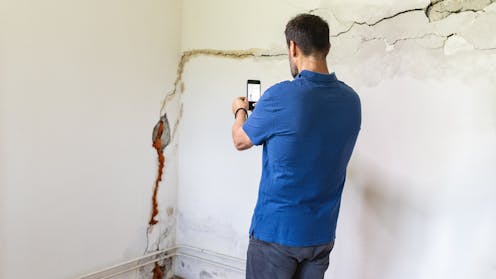
Many participants spoke about living – currently or previously – in poor-quality housing. One enduring theme that emerged was the problem of mould.
Penelope (all names changed to protect identities) said she’d lived in a sharehouse that was “decrepit” and
excessively damp and mouldy, to the point where all of our furniture and clothes and stuff started to get mould on it.
She considered taking the landlord to the Victorian Civil and Administrative Tribunal (VCAT) but “didn’t end up getting all the way to VCAT, because it’s extremely difficult.”
In the end, Penelope and her housemate had to leave the house
very urgently because our stuff was starting to get ruined.
They were temporarily homeless, while the landlord and real estate agent “got away with it” and continued to rent out the house.
Lucas, meanwhile, described the futility of trying to negotiate with property managers who would not respond to maintenance requests, meaning he had to put up with “untenable” housing:
There’s definitely been times where I’ve just felt like, all I have to do is grit my teeth and take it. Because otherwise, I’m just gonna lose.
Sharing as a source of both solidarity and conflict
Housemate relationships are at the heart of sharehousing.
One positive aspect of these relationships is that they may help build solidarity when experiencing problems with housing quality or other conflicts with the property manager.
One participant, Sarah, told of how her housemate successfully secured compensation from their property manager after the landlord started major renovations while she and her housemates were still living there. Seeing her housemate gain compensation enabled her to do the same.
On the other hand, relationships with housemates can complicate attempts to achieve justice.
Stacey, another interviewee, reported how efforts to negotiate with a property manager eventually led to “internal conflict within the house”, and how one housemate became hostile during the process.
Another interviewee, Tayler, also experienced problems with a landlord who was also his housemate, which intensified the conflict.
One participant, Jess, had also experienced domestic violence from a housemate.
I had to, I left before the lease was up. Like I moved back in with my parents because it was so bad. But I continued paying rent because […] I just didn’t want to deal with the further consequences of that.
While Jess was able to move out in this scenario, others described how this wasn’t possible due to a shortage of affordable housing. For example, Janet described how she’d prefer to move out rather than confront a housemate, but didn’t always have the option:
I’ve only left when I’ve had the capacity to do so. Often I’ve had to stay quite a lot longer than I would have liked to, because [I] don’t have the option to move, can’t afford it or nothing available.
Relationships and regulations
Regulations surrounding renters and landlords are framed in a way that assumes there are two parties in a dispute: the tenant and the property owner.
This renders the relationships within sharehousing invisible. Yet, there is clear evidence they impact the way tenancy disputes are managed and addressed.
For example, one interviewee named May was invited to move into a sharehouse by her friend. However, the friend’s property manager said May could not move in if she brought her cat (which is illegal in Victoria).
This shows how sharehousing depends on relationships between housemates and relationships with the property manager. May was aware of the need to put up with this to secure housing:
renters aren’t in a position of power. So, you kind of have to play the game just to have a roof over your head.
Relationships matter when we think about renting problems. While this research focused on sharehousing, there are implications for other renter households especially where conflict or even family or intimate partner violence occur.
Our future research will look at possible policy solutions to better capture the nuances of sharehousing in Australia.
Authors: Zoe Goodall, Research Associate, HHAUS research group, Swinburne University of Technology


 Daily Bulletin


