

By not recognising a Palestinian state, NZ puts its own hard-won reputation on the line
- Written by: Robert G. Patman, Professor of International Relations, University of Otago
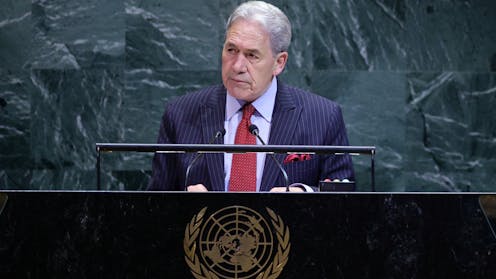
There seems to be a mismatch between what a UN inquiry recently described as genocide in Gaza and New Zealand’s announcement at the United Nations on Saturday that it will not yet join 157 other countries in recognising a Palestinian state.
The government decision, relayed by Foreign Minister Winston Peters at the UN General Assembly, was welcomed by Israel’s ambassador to New Zealand, who claimed recognition of a Palestinian state legitimises Hamas – a designated terrorist organisation.
On the other hand, former Labour prime minister Helen Clark said, “New Zealand has placed itself very much on the wrong side of history”. She said the government’s position overall was “confusing”.
In practice, the stance of the National-led coalition has certainly been ambiguous. It has called for a lasting ceasefire in Gaza, reiterated its support for a two-state solution, and repeatedly said recognition of a Palestinian state is a question of “when not if”.
However, in January 2024, it also agreed to a small Defence Force deployment as part of a United States-led coalition against Houthi rebel attacks on shipping in the Red Sea, despite the US using its Security Council veto to prevent a ceasefire in Gaza.
Equally striking was the government’s relative silence on President Donald Trump’s proposal in February this year to extinguish the prospect of a two-state solution by taking ownership of Gaza and effectively evicting two million Palestinian residents from the territory.
It also had little to say about the US-Israeli venture to start the Gaza Humanitarian Foundation in late May, a controversial move that sidelined the UN in aid distribution and has led to the killing of more than 1,000 Palestinians while seeking food.
And then in June, along with the United Kingdom, Australia, Canada and Norway, the government imposed sanctions on two far-right Israeli government ministers, Bezalel Smotrich and Itamar ben Gvir for “inciting extremist violence” against Palestinians.
That decision was strongly criticised by the Trump administration, but it seemed to signal the New Zealand position (along with that of its close allies) was hardening.
In August, Prime Minister Christopher Luxon declared Israel’s military assault on Gaza City was “utterly unacceptable”, and said Israeli Prime minister Benjamin Netanyahu had “lost the plot”.
None of which, we now know, was enough to convince the government to follow other liberal democracies such as Australia, Canada, the UK, France and Portugal in recognising Palestinian statehood.
The political reasoning, according to Peters, is that while Hamas remains the de facto government of Gaza and “with a war raging”, there is no viable Palestinian state to recognise.
According to the prime minister, this was a “balanced” decision and consistent with an independent foreign policy. But it can also be argued the approach rests on some shaky assumptions.
While Israel has not been able to destroy Hamas, nor has Hamas been able to stop Gaza being reduced to piles of rubble. According to the Israeli Finance Minister Smotrich, such destruction has “no precedent globally. And the world isn’t stopping us.”
By presenting Hamas as an obstacle to the recognition process, the government also seems to be overlooking the governance role the internationally recognised Palestinian Authority in the West Bank could play in Gaza in a future Palestinian state.
Netanyahu has consistently opposed any such role for the Palestinian Authority, a position New Zealand now seems to tacitly accept.
Peters has described the situation in Gaza as “simply intolerable”. If that’s the case, it has been allowed to happen without New Zealand’s recognition of a Palestinian state. So, how does delaying recognition improve things?
After all, Netanyahu has opposed the concept of a two-state solution since the mid-1990s. And his far-right coalition government has pledged to take full control of Gaza and annex the West Bank – in complete violation of international law and numerous UN resolutions.
It is the belated realisation by a number of democracies that Netanyahu will never accept a Palestinian state that has prompted the latest flurry of statehood recognition, before Israel’s attempt to absorb the occupied territories is completed.
Those countries that have now recognised a Palestinian state will have also weighed up the factors for and against doing so. But they have clearly chosen to make a moral and legal stand – albeit symbolic – on the Palestinian right of political self-determination.
By not joining them, there is a real risk New Zealand will be seen as aligning with those states – Israel and the US – that bear significant responsibility for prolonging the catastrophic conflict in Gaza.
If this perception is widely shared, New Zealand’s hard-won reputation as a state that firmly upholds an international rules-based order could be dealt a major blow.
Authors: Robert G. Patman, Professor of International Relations, University of Otago


 Daily Bulletin


