

What Trump’s Gaza peace plan means for NZ’s stance on Palestinian statehood
- Written by: Alexander Gillespie, Professor of Law, University of Waikato
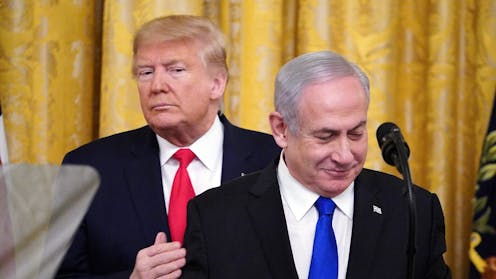
The situation in the Middle East is moving exceptionally fast. New Zealand and the international community had barely digested the debate about Palestinian statehood before United States President Donald Trump presented a 20-point peace plan for Gaza.
There are good reasons to be sceptical about the plan’s success, given the actors involved and the lack of trust on all sides. But from New Zealand’s perspective there are positive aspects contained within it, including:
the proposed ceasefire and immediate release of hostages held by Hamas and a large number of prisoners held by Israel, followed by the independently verified demilitarisation of Hamas
the return of full humanitarian assistance and essential civil services, with aid distributed through the United Nations and its agencies, the Red Crescent and other neutral international institutions
the pledge that “no one will be forced to leave Gaza, and those who wish to leave will be free to do so and free to return”.
These and other points in the plan all dovetail with the conditions called for by the countries that have recently recognised Palestinian statehood, including Britain, Australia and Canada.
They also match New Zealand’s demands, despite the government’s decision not to recognise a Palestinian state. But things become less clear in the proposal to create and deploy an “International Stabilization Force” in Gaza.
Driven primarily by the US, in consultation with Egypt and Jordan, there will also be a role for “international partners” to help train and provide support to “vetted Palestinian police forces”.
The obvious question is whether New Zealand will be asked to help, and whether it will agree to.
Similarly, the proposal to put Gaza under the “temporary transitional governance of a technocratic, apolitical Palestinian committee”, supervised by a “Board of Peace” headed and chaired by Trump (with former British prime minister Tony Blair a member), is very vague.
We don’t know how much of a closed shop this board will be, or whether membership might stretch as far as New Zealand’s former leaders.
What’s missing in the plan
But one positive aspect of this proposal is that it would last only until “such time as the Palestinian Authority has completed its reform program” – code for new elections, guaranteed civil liberties and improved governance.
This too dovetails with the official New Zealand view on the Palestinian Authority, and the pledge “to continue to do our part to strengthen its capability”.
But the problem of Israel’s occupation of Palestinian territory remains real. The plan states Israel will not occupy or annex Gaza, but Trump’s apparent promise that he will not let Israel annex the West Bank is not in the 20 points.
Nor is there any discussion of how to deal with the ramping up of illegal Israeli settlements in the West Bank. New Zealand agrees with the International Court of Justice (ICJ) ruling that Israel’s continued presence there is unlawful.
On the other side, New Zealand may also have a problem with the Trump plan’s proposal that Hamas members who lay down their weapons and pledge peaceful coexistence may be granted amnesty. This assumes there will be no accountability for any war crimes that may have been committed.
And not only is there no commitment to hold Israel to account for war crimes, but the Palestinian Authority will have to drop all involvement in the cases being taken against the US or Israel at the ICJ and the International Criminal Court (ICC).
This is a problem because New Zealand, like many countries, wants international humanitarian law to be upheld by the ICC.
And while New Zealand has not joined the growing list of countries seeking a definitive determination by the ICJ on whether genocide has been committed in Gaza, many other nations want a final answer and accountability.
When, not if
Finally, the Trump plan holds out the possibility of a two-state solution to the overall impasse in Israel-Palestine, which has now been on the table for nearly eight decades.
Keeping that possibility alive was one of the motivations for other countries recognising Palestinian statehood. New Zealand took a different view, arguing recognition has to be contingent on real progress towards a comprehensive political settlement.
Trump may now have delivered some prospect of that, promising that “while Gaza redevelopment advances and when the Palestinian Authority reform program is faithfully carried out, the conditions may finally be in place for a credible pathway to Palestinian self-determination and statehood”.
However, this also blurs the timeline, imposes difficult conditions and then only offers a possibility of this happening. Israeli Prime Minister Benjamin Netanyahu is on the record as saying “there will be no Palestinian state”.
New Zealand has always maintained that recognition of Palestinian statehood is a matter of “when, not if”. Given this latest plan, and with the chance the brutal conflict might now abruptly end, it may be time to reconsider exactly what is meant by “when”.
Authors: Alexander Gillespie, Professor of Law, University of Waikato


 Daily Bulletin


