

Read The Times Australia

Daily Bulletin

Today’s AI hype has echoes of a devastating technology boom and bust 100 years ago

  • Written by: Cameron Shackell, Sessional Academic, School of Information Systems, Queensland University of Technology
Today’s AI hype has echoes of a devastating technology boom and bust 100 years ago

The electrification boom of the 1920s set the United States up for a century of industrial dominance and powered a global economic revolution.

But before electricity faded from a red-hot tech sector into invisible infrastructure, the world went through profound social change, a speculative bubble, a stock market crash, mass unemployment and a decade of global turmoil.

Understanding this history matters now. Artificial intelligence (AI) is a similar general purpose technology and looks set to reshape every aspect of the economy. But it’s already showing some of the hallmarks of electricity’s rise, peak and bust in the decade known as the Roaring Twenties.

The reckoning that followed could be about to repeat.

First came the electricity boom

A century ago, when people at the New York Stock Exchange talked about the latest “high tech” investments, they were talking about electricity.

Investors poured money into suppliers such as Electric Bond & Share and Commonwealth Edison, as well as companies using electricity in new ways, such as General Electric (for appliances), AT&T (telecommunications) and RCA (radio).

It wasn’t a hard sell. Electricity brought modern movies, new magazines from faster printing presses, and evenings by the radio.

It was also an obvious economic game changer, promising automation, higher productivity, and a future full of leisure and consumption. In 1920, even Soviet revolutionary leader Vladimir Lenin declared: “Communism is Soviet power plus the electrification of the whole country.”

Today, a similar global urgency grips both communist and capitalist countries about AI, not least because of military applications.

A cover story of the New York Times Magazine in October 1927. The New York Times

Then came the peak

Like AI stocks now, electricity stocks “became favorites in the boom even though their fundamentals were difficult to assess”.

Market power was concentrated. Big players used complex holding structures to dodge rules and sell shares in basically the same companies to the public under different names.

US finance professor Harold Bierman, who argued that attempts to regulate overpriced utility stocks were a direct trigger for the crash, estimated that utilities made up 18% of the New York Stock Exchange in September 1929. Within electricity supply, 80% of the market was owned by just a handful of holding firms.

But that’s just the utilities. As today with AI, there was a much larger ecosystem.

Almost every 1920s “megacap” (the largest companies at the time) owed something to electrification. General Motors, for example, had overtaken Ford using new electric production techniques.

Essentially, electricity became the backdrop to the market in the same way AI is doing, as businesses work to become “AI-enabled”.

No wonder that today tech giants command over a third of the S&P 500 index and nearly three-quarters of the NASDAQ. Transformative technology drives not only economic growth, but also extreme market concentration.

In 1929, to reflect the new sector’s importance, Dow Jones launched the last of its three great stock averages: the electricity-heavy Dow Jones Utilities Average.

But then came the bust

The Dow Jones Utilities Average went as high as 144 in 1929. But by 1934, it had collapsed to just 17.

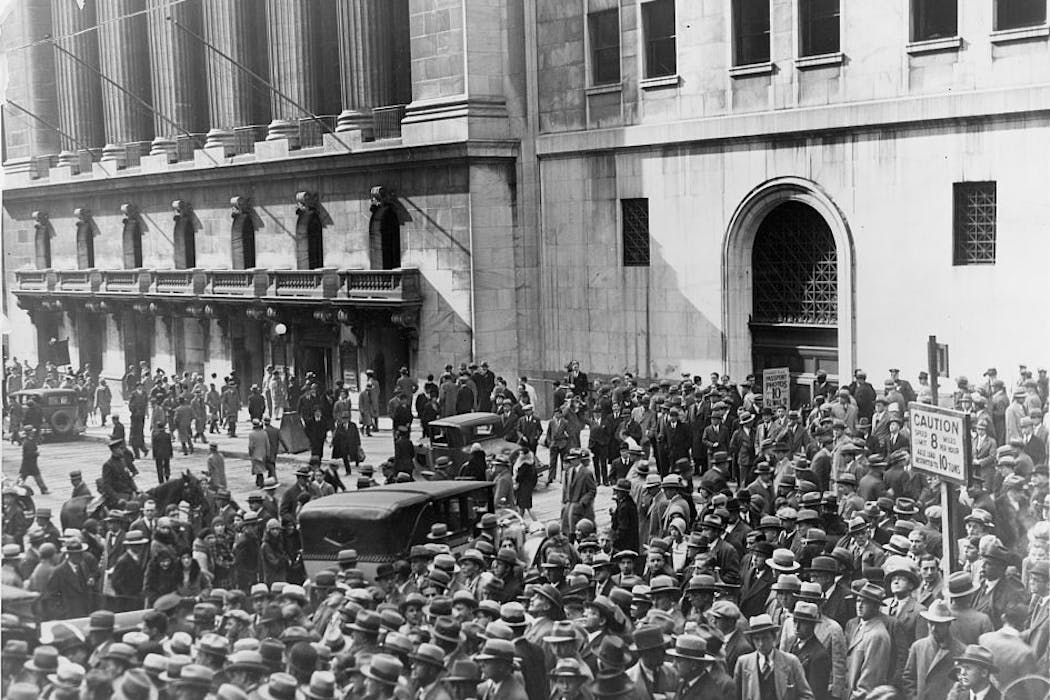
No single cause explains the New York Stock Exchange’s unprecedented “Great Crash”, which began on October 24 1929 and preceded the worldwide Great Depression.

That crash triggered a banking crisis, credit collapse, business failures, and a drastic fall in production. Unemployment soared from just 3% to 25% of US workers by 1933 and stayed in double figures until the US entered the second world war in 1941.

Lithograph of Wall Street, New York City, with panicked crowd, lightning, people jumping out of buildings, buildings falling, at time of stock market crash in 1929.
Lithograph of Wall Street, New York City, after the 1929 stock market crash. Jame Rosenberg, Ben and Beatrice Goldstein Foundation collection, US Library of Congress The ripple effects were global, with most countries seeing a rise in unemployment, especially in countries reliant on international trade, such as Chile, Australia and Canada, as well as Germany. The promised age of shorter hours and electric leisure turned into soup kitchens and bread lines. The collapse exposed fraud and excess. Electricity entrepreneur Samuel Insull, once Thomas Edison’s protégé and builder of Chicago’s Commonwealth Edison, was at one point worth US$150 million – an even more staggering amount at the time. But after Insull’s empire went bankrupt in 1932, he was indicted for embezzlement and larceny. He fled overseas, was brought back, and eventually acquitted – but 600,000 shareholders and 500,000 bondholders lost everything. However, to some Insull seemed less a criminal mastermind than a scapegoat for a system whose flaws ran far deeper. Reforms unthinkable during the boom years followed. The Public Utility Holding Company Act of 1935 broke up the huge holding company structures and imposed regional separation. Once exciting electricity darlings became boring regulated infrastructure: a fact reflected in the humble “Electric Company” square on the original 1935 Monopoly board. Lessons from the 1920s for today AI is rolling out faster than even those seeking to use it for business or government policy can sometimes manage properly. Like electricity a century ago, a few interconnected firms are building today’s AI infrastructure. And like a century ago, investors are piling in – though many don’t know the extent of their exposure through their superannuation funds or exchange traded funds (ETFs). Just as in the late 1920s, today’s regulation of AI is still loose in many parts of the world – though the European Union is taking a tougher approach with its world-first AI law. US President Donald Trump has taken the opposite approach, actively cutting “onerous regulation” of AI. Some US states have responded by taking action themselves. The courts, when consulted, are hamstrung by laws and definitions written for a different era. Can we transition to AI being invisible infrastructure like electricity without a another bust, only then followed by reform? If the parallels to the electrification boom remain unnoticed, the chances are slim. Authors: Cameron Shackell, Sessional Academic, School of Information Systems, Queensland University of Technology

Read more https://theconversation.com/todays-ai-hype-has-echoes-of-a-devastating-technology-boom-and-bust-100-years-ago-265492

Business News

How Telematics Helps Australian Companies Improve Productivity

Operating a commercial fleet in Australia is a uniquely demanding endeavour. Between the sprawling urban sprawl of cities like Sydney and Melbourne and the immense, unforgiving stretches of the Outb...

Daily Bulletin - avatar Daily Bulletin

Inside the Icon: The BridgeMuseum Officially Opens at the Sydney Harbour Bridge

A bold new way to experience one of Australia’s most recognisable landmarks has arrived, with BridgeClimb Sydney officially opening the all-new BridgeMuseum.  Located inside the Sydney Harbour Brid...

Daily Bulletin - avatar Daily Bulletin

Is Your Brand Showing Up in AI Search? Most Melbourne Brands Aren't.

The New Front Door Nobody Told You About Something changed. Quietly. Without a press release. The way buyers find businesses in Australia has been rewired. Not replaced, rewired. Google isn't dead...

Daily Bulletin - avatar Daily Bulletin

How Australian Businesses Can Measure SEO ROI

SEO can feel vague when you are staring at a dashboard full of numbers that do not clearly connect to revenue. The key is to measure the right signals in the right order, then tie them back to outcome...

Daily Bulletin - avatar Daily Bulletin

How Commercial Roller Shutters Improve Site Security Without Slowing Operations

Security upgrades can be frustrating when they make everyday work harder. A door that takes too long to open, creates bottlenecks at shift change, or fails at the worst time can turn “better protectio...

Daily Bulletin - avatar Daily Bulletin

Why a Document Destruction Service Still Matters for Modern Businesses

Businesses generate large volumes of information every day, from staff records and contracts to invoices, reports and customer files. While attention often focuses on how documents are stored, the way...

Daily Bulletin - avatar Daily Bulletin

Bicycle Rack Safety and Space-Smart Storage

Bike storage problems usually show up as small annoyances first: tangled handlebars, scratched frames, and bikes that topple when you pull one out. Over time, those issues become safety risks, especia...

Daily Bulletin - avatar Daily Bulletin

How to Tell if a Childcare Centre Is a Good Fit for Your Child

Choosing childcare can feel like you’re making a huge decision with limited information. Tours are short, centres are often on their best behaviour, and your child might act differently in a new space...

Daily Bulletin - avatar Daily Bulletin

Car Import Timeline: What Usually Happens at Each Stage

Importing a car into Australia can feel confusing because multiple agencies and checkpoints are involved, and the timeline is shaped as much by paperwork quality as it is by shipping speed. The most u...

Daily Bulletin - avatar Daily Bulletin

The Daily Magazine

Gold Migration Lawyers in Liquidation: How the Closure Affects Your ART Appeal

If your appeal was with Gold Migration Lawyers, a recent change to how the Tribunal decides cases ...

The pressure cooker: life in urban Australia in 2026

Australian cities have always been demanding. Long commutes, rising housing costs, busy schedules a...

What Actually Makes a Good Criminal Lawyer in Melbourne

Most people only think about this question once. That is usually too late. Most people charged wi...

Why Working With A Chatswood Tutor Can Improve Academic Performance

Academic expectations continue increasing for students across primary school, high school, and senio...

Is It Worth Getting Solar Panels in Melbourne?

The real question is not whether solar works in Melbourne. It works. The question is what it is co...

How A Diploma Of Project Management Builds Practical Skills For Modern Work Environments

Developing the ability to plan, execute, and deliver outcomes efficiently is a key requirement in to...

How to Choose the Right Football for Every Level

Choosing a football may seem straightforward, but the right option depends on who will be using it a...

What to Ask a Wedding Photographer Before You Book

Booking a wedding photographer can feel deceptively simple: you like the photos, you like the vibe...

Why Stress Relief For Dogs Is Essential For Emotional Balance And Long-Term Wellbeing

Managing emotional health is just as important as physical care when it comes to pets, which is why ...