

Australia-PNG defence treaty: what we can learn from history to make this new alliance work
- Written by: Tristan Moss, Senior Lecturer in History, UNSW Sydney
After a slight delay, Australia and Papua New Guinea formally signed a defence treaty this week committing the two nations to come to each other’s aid if one is faced with an attack.
According to Prime Minister Anthony Albanese, the treaty also allows for up to 10,000 Papua New Guineans to join the Australian Defence Force (ADF). Some Australians may in turn join the PNG Defence Force.
This is a monumental change for the ADF and for its relationship with PNG. But it is far from an unprecedented one.
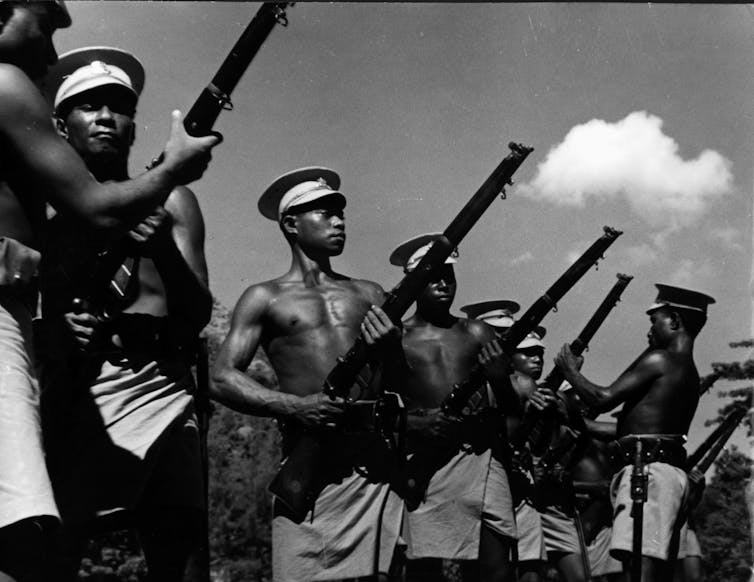
In fact, Australia has a long history of not only working with PNG on defence, but also of Papua New Guineans being an integral part of Australia’s armed forces. This history can now be a source of vital lessons for the two countries’ newly expanded cooperation.
A long history of serving together
Many Australians might remember the “fuzzy wuzzy” angels, the term (now considered derogatory) given to Papua New Guineans who carried supplies and wounded Australian soldiers on stretchers in the second world war.
These men were essential to victory against the Japanese, but laboured under tough conditions and were often forcibly conscripted.
Around 4,000 Papua New Guinean men also served as soldiers in defence of Australia in the war. These men participated in Australia’s first battles along the Kokoda Track, and almost every one after that.
In 1951, a new unit of Papua New Guineans was created as part of the Australian Army in response to rising Cold War tensions. Named the Pacific Islands Regiment, this unit had about 3,000 Papua New Guineans serving in it, along with support units, at the time of independence in 1975.
This meant around one in 11 members of the regular Australian Army were Papua New Guinean.
In turn, around 500 Australians were serving with the Australian Army’s forces in PNG at any time during the 1960s and 1970s.
Papua New Guinean units were not a foreign part of the Australian Army: until PNG’s independence, Papua New Guineans were Australian citizens, albeit treated as distinctly second class because of their race.
As such, these soldiers were an integral and integrated part of the Australian Army, as much a part of it as the Royal Australian Regiment.
The same applied to the small Papua New Guinean naval unit based at Manus Island, which was part of the Royal Australian Navy. PNG officers trained in Australia, and PNG sailors gained experience on Australian ships.
These units were a vital part of defending Australia, particularly when tensions were high with Indonesia in the early 1960s. During that time, PNG soldiers were the first line of Australia’s defence should war have broken out.
After independence, the PNG Defence Force was formed. Some Australians stayed on to guide the new force, but from then on, it was PNG’s own.
Overcoming problems
The pact signed by Albanese and PNG Prime Minister James Marape will see the two countries bind their forces closely together again.
The treaty allows for both recruitment and integration of personnel into each country’s defence forces, along with more interoperability in logistics and procurement.
There are many important lessons that can be learned from the past to ensure this integration is seamless.
The most crucial of these is ensuring understanding between Australian and Papua New Guinean soldiers.
In 1961, for instance, there were some discipline issues in the Pacific Islands Regiment. PNG soldiers were unhappy with their poor pay and conditions, which prompted some to march towards Port Moresby in protest, disobeying orders to stay at the barracks.
Australian Army officials acknowledged their role in these problems, including a year-long delay in addressing pay concerns and poorly trained Australian officers, few of whom spoke local languages.
The army’s response to these issues was education. From the 1960s to 1975, the army initiated a concentrated education program for PNG soldiers, including everything from civic studies to current affairs.
At the same time, the army acknowledged that understanding the backgrounds, languages, cultures and needs of the Papua New Guinean soldiers was essential to creating an effective force. This saw an effort to ensure that only the best Australian officers were sent to PNG, and these men would learn Tok Pisin as soon as they arrived.
Papua New Guinean officers were also recruited from 1963 to build a cohort of leaders who deeply understood the men under their command.
These efforts created a focused, disciplined and educated force that was handed over to an independent PNG in 1975. This is one of the unsung achievements of the Australian Army.
Read more: With new PNG defence treaty, Australia is delivering on its rhetoric about trust at a critical time
What we can learn today
It will be just as important today for Australian defence personnel to understand the PNG soldiers they’ll be working with. Education programs focusing on history, culture and language, coupled with experience working together, will be crucial to the treaty’s success.
We should celebrate the diversity these soldiers will bring to the ADF. These soldiers will enhance the ADF’s ability to operate with the people and unique geography of the Pacific region.
Efforts should be also made to recruit more PNG officers and non-commissioned officers so the ADF can lead and work with them.
One final element will be reintegrating PNG’s military history with our own, demonstrating that Papua New Guineans have already contributed a great deal to the defence of both our countries.
There are many questions still to be answered, such as exactly how this integration will work and what it will mean for PNG’s own defence force.
However, Papua New Guineans are not new arrivals to the defence of Australia. They have been defending us since 1940.
Authors: Tristan Moss, Senior Lecturer in History, UNSW Sydney


 Daily Bulletin


