

How forensic analysis and traditional knowledge reveal the story of a unique boomerang
- Written by: Caroline Spry, Adjunct Senior Research Fellow, Department of Archaeology and History, La Trobe University
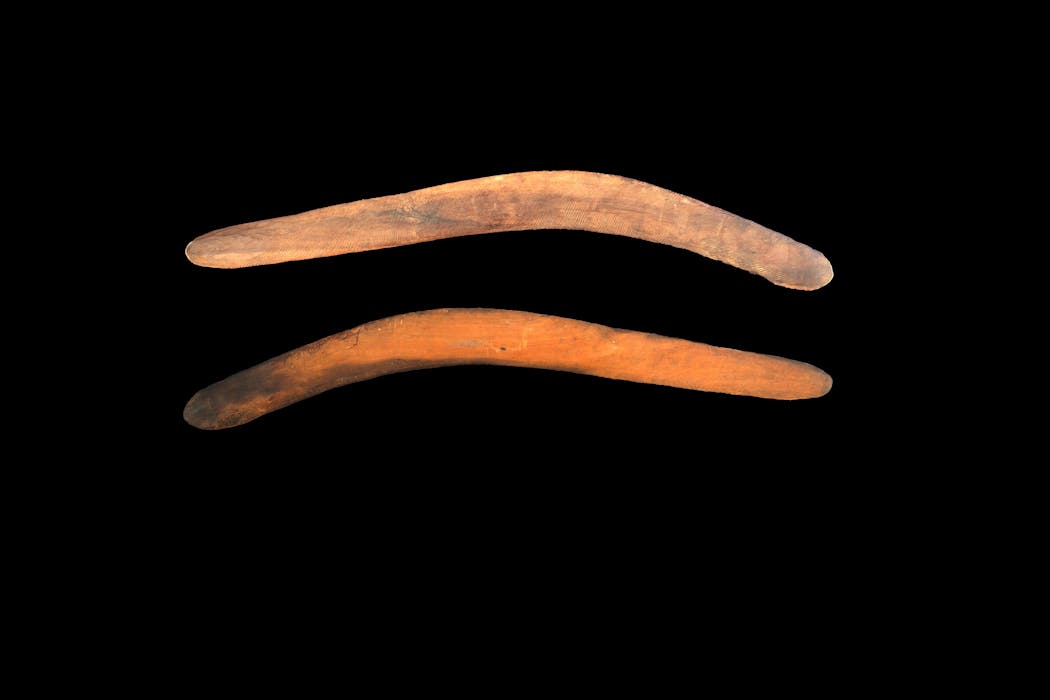
Boomerangs are an iconic symbol of Australia. Known internationally for their unique curved shape and ability to return when thrown, they are an example of the remarkable engineering skills of Australia’s First Peoples.
In new research, we have for the first time combined Traditional cultural knowledge with Western scientific analysis of a wangim (boomerang) from a reported burial located on the outskirts of Melbourne, on Wurundjeri Woi-wurrung Country, southeastern Australia.
Throwing sticks with a legacy
Throwing sticks that are either straight or curved are ingenious instruments, and can be found on several continents. The oldest returning boomerangs were made in Australia at least 10,000 years ago.
Australian boomerangs come in a variety of shapes and sizes. The classic symmetrical boomerang is designed to return in a u-shape when thrown. Returning boomerangs were used traditionally for hunting birds, and for sport and play.
Less widely known are non-symmetrical boomerangs, which do not return when thrown. Non-returning boomerangs were used traditionally during hunting, fighting, digging and ceremony – for example as clapping sticks.
Discovery of a unique boomerang
In 2021, a local resident repatriated a non-returning wangim (boomerang) to Wurundjeri Woi-wurrung Cultural Heritage Aboriginal Corporation, the Traditional Custodians of a large swathe of greater Melbourne and beyond. The resident recalled how they found the wangim eroding out of what they interpreted to be an Aboriginal burial mound when playing in the bush at Yarra Junction during the late twentieth century.
The resident cared for the wangim over several decades, before reconnecting it with the Wurundjeri Woi-wurrung people. Unfortunately, the original location of the reported burial has since been developed.

Traditional cultural knowledge
Wurundjeri Woi-wurrung Elder Bob Mullins makes traditional stone and wooden items, including shields, axes and boomerangs. When Elder Bob inspected the wangim, he made a series of observations about how it was probably made.
First, a liwik (ancestor) probably collected a piece of wood with a natural bend in it. Elder Bob collects wood for boomerangs from the roots of trees near rivers and creeks.
Second, the liwik would have fashioned the rough shape of the boomerang. For dry wood (as opposed to green wood), the liwik probably soaked it in water to make it more malleable. Wet wood was usually dried out by slowly moving it backwards and forwards over a campfire to create and set the desired shape.
Third, the liwik would have used a series of metal tools to refine the boomerang. This suggests the wangim was made some time following colonisation, after the early to mid-nineteenth century. However, Elder Bob notes that the wangim has a rougher finish. He would have sanded the wangim as a final step to create a smoother finish.
Residues and wear patterns
Investigation of the wangim using a microscope revealed clues about how it was made and used. The wangim contains residues, or traces of materials with which it came into contact. It also bears wear patterns – physical alterations to its surfaces and edges from contact with other materials.
The wear patterns indicate grip marks by a right-handed liwik. They also reveal impact traces from when the wangim was thrown and came into contact with other (hard) items. Blood on the wangim highlights its role during hunting. Charcoal and fire marks may have resulted from using the boomerang to stoke a campfire, or from boomerang repair activities.
Significance
The Yarra Junction wangim is unusual in terms of its size and shape compared with other examples held in Museums Victoria collections. It has a wider elbow (curved section), and rounder but less elongated extremities, among other differences.
The wangim was clearly an item of great personal attachment, as evidenced by its continued repair and use, and burial with its owner.
For Wurundjeri Woi-wurrung Elders Aunty Di Kerr, Bob Mullins, Ron Jones and Allan Wandin, the wangim is significant as a tangible link to their liwik. Wooden items that belonged to liwik have a limited lifespan compared to other artefacts made of stone, shell and bone. Repatriated items also provide a connection to a cultural landscape that may have been developed or destroyed since colonisation.
Information shared by Elder Bob attests to the continuation of boomerang traditions by Aboriginal and Torres Strait Islander peoples today. Boomerangs were, and continue to be, an important part of First Peoples’ history and identity.
The authors wish to acknowledge all Wurundjeri Woi-wurrung Elders, community and staff, Clint Cooper, the Ancestral Remains Unit at First Peoples-State Relations, Museums Victoria, John Duggan and the following co-authors of the original study published in Australian Archaeology: Luc Bordes, Richard Fullagar, Zara Lasky-Davison, Wendy Morrison, Lauren Modra, Lauren Gribble, Maria Daikos, Anna Alcorn and Wurundjeri Woi-wurrung Cultural Heritage Aboriginal Corporation.
Authors: Caroline Spry, Adjunct Senior Research Fellow, Department of Archaeology and History, La Trobe University


 Daily Bulletin


