

COP30: Pacific leaders now have world court backing to call countries to account over climate risk
- Written by: John Sibanda, Research Assistant in Law, Te Herenga Waka — Victoria University of Wellington
At the COP30 climate summit in Brazil, Pacific Island states are making a familiar plea to keep warming at 1.5°C. But now they have the backing of a legal opinion that has transformed climate action from a moral and political aspiration into an obligation under international law.
Earlier this year, the International Court of Justice (ICJ) issued an advisory opinion rejecting the narrow view that only specific treaties such as the Paris Agreement govern state conduct on climate change.
Instead, it presented a framework based on human rights law, the law of the sea, environmental treaties, customary international law and general principles of law to reinforce that states have a legal duty to adopt and maintain ambitious climate measures.
For small island states, which contribute a fraction of global emissions yet face the gravest threats from rising seas, the opinion offers both vindication and leverage. It strengthens the shift from moral persuasion toward legal accountability.
For decades, climate diplomacy has operated in an ambiguous space between moral appeals and political compromises. With this opinion, the court has signalled the end of the age of discretionary climate governance.
States now face legal obligations that are substantive, enforceable and global in scope. The implications for Aotearoa New Zealand are particularly acute.
From diplomacy to due diligence
Days after the opinion was handed down, parliament passed the Crown Minerals Amendment Act, reopening the door to offshore oil and gas exploration.
Since then, the government has announced a new energy policy that relies on imports of liquefied natural gas, a weakened climate-related financial disclosure regime and a suite of changes to New Zealand’s landmark climate law.
Under the ICJ’s reasoning, such decisions may now carry legal consequences. For example, the repeal of the offshore oil and gas ban can no longer be seen merely as a domestic policy shift but as a move inconsistent with legal obligations.
States that issue fossil fuel licences, subsidise emissions-intensive industries or fail to adopt adequate mitigation targets could face claims of internationally wrongful acts.
Without a rigorous emissions reduction pathway reflecting “highest possible ambition” or a credible plan for a just transition, such actions risk undermining New Zealand’s international credibility and may place it in breach of emerging international legal norms.
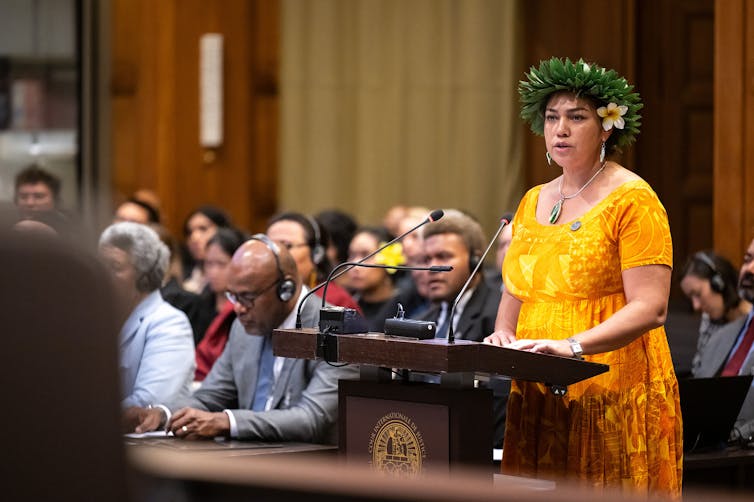
For Pacific nations, the ICJ’s opinion holds more than symbolic significance. It gives them new leverage.
In negotiations such as the annual climate summits and climate financing forums, these states can now point to the ICJ’s conclusions to press for more decisive action, greater accountability and reparations for loss and damage.
Pacific leaders have long insisted that climate obligations are real. The challenge ahead is not only to implement these obligations, but also to utilise them strategically and courageously. Without careful legal and political strategising, the full significance of this judgement may go unrealised.
What the court said
The campaign for an ICJ advisory opinion emerged from mounting frustration in the Pacific over the failure of multilateral climate diplomacy and the treaty system to deliver tangible results.
Led by Vanuatu, it gained momentum in 2019 when Pacific Island Students Fighting Climate Change took it to the ICJ. By 2020, the growing disconnect between international climate diplomacy and the day-to-day experiences of Pacific nations had become impossible to ignore.
The court’s opinion delivers clarity on several fronts. It confirms that states have binding obligations to prevent and mitigate climate harm under a range of international legal frameworks.
In light of the scientific consensus, these duties require urgent and decisive action. This includes not only setting and regularly updating robust national climate plans under the Paris Agreement but also regulating private actors.
While some states argued their pledges (known as Nationally Determined Contributions) under the Paris Agreement fall entirely within their discretion, the court disagreed. It held they must exercise due diligence when formulating pledges to ensure that, collectively, they contribute to the 1.5°C temperature goal.
The court confirmed that the obligation to prevent significant environmental harm — a principle of customary international law — applies to the climate system and binds all states, including those not party to or planning to exit climate treaties.
As part of their due diligence duty, states are expected to adopt effective laws and policies that support rapid and sustained reductions in greenhouse gas emissions.
Scientific uncertainty can no longer be used as a justification for delay. Instead, precautionary measures are required, including thorough environmental risk assessments for proposed activities with potential climate impacts.
Failure to act decisively, whether through inaction or inadequate regulation, may breach international law and result in legal consequences.
This can trigger a range of consequences under the law of state responsibility, including the obligation to cease the harmful conduct, to offer assurances of non-repetition and to provide full reparation.
The ICJ also confirmed that sea level rise, even to the extent of complete submergence, does not automatically strip a country of its rights under international law. This means Pacific Island nations can retain sovereignty over their exclusive economic zones, including access to marine resources, even if their land territory becomes uninhabitable.
Authors: John Sibanda, Research Assistant in Law, Te Herenga Waka — Victoria University of Wellington


 Daily Bulletin


