

‘Good neighbours are essential’: the history behind the landmark Indonesia-Australia defence treaty
- Written by: Greg Barton, Chair in Global Islamic Politics, Alfred Deakin Institute for Citizenship and Globalisation, Deakin University
Prime Minister Anthony Albanese was expansive in his sentiments about the “watershed” bilateral security treaty announced with Indonesia this week:
Australia’s relationship with Indonesia is based on friendship, trust, mutual respect and a shared commitment to peace and stability in our region. This treaty is a recognition from both our nations that the best way to secure that peace and stability is by acting together.
From the outset, Australia has enjoyed warm relations with its giant neighbour. Eighty years ago, when Indonesia declared independence in the wake of Japan’s surrender at the end of the Second World War, Dutch troops rushed back in to seize control of their former colony.
As a result, Australian wharfies launched a boycott of Dutch ships to Indonesia.
Australia’s early support for its neighbour is fondly remembered in Indonesia. However, in the decades since the war, the relationship has been marked by periods of mistrust and suspicion on both sides.
Prime Minister Robert Menzies made the country a cornerstone of his 1963 election campaign pledge to acquire long-range supersonic F-111 bombers to counter what he declared to be a growing threat from Indonesia.
The bombers came into service a decade later and, of course, were never used in anger. Nor was there ever any concrete threat from Indonesia to justify deploying them.
But Menzies’ fear campaign did come out of a genuinely dark moment during the Cold War. In the mid-1960s, President Sukarno’s Indonesia was tipping into the “year of living dangerously”, when the CIA and British intelligence backed a bloody push against the Indonesian Communist Party and the increasingly bombastic Sukarno. This saw General Soeharto replace Sukarno as president.
But even through the three decades of a right-leaning, military-backed government under Soeharto, Indonesia continued to hold fast to its foreign policy of bebas dan aktif – or, “free and active”.
From the outset, Indonesia saw itself, in the evocative words of Prime Minister Mohammad Hatta, as “sailing between two reefs”.
Becoming independent just as the Cold War commenced, the new republic was determined not to run aground on the dangerous shoal of aligning with the US-led “first world”, or side with the Soviet-led “second world”.
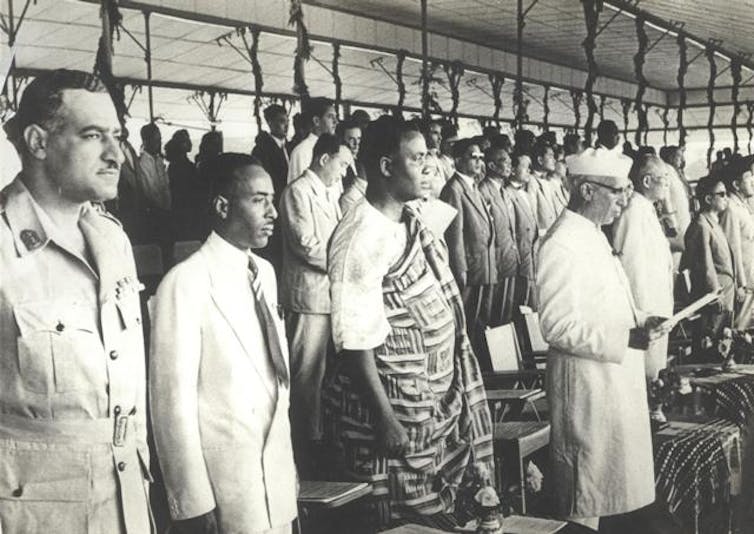
In the historic 1955 Asia-Africa Conference in Bandung, Indonesia led the Global South in articulating a framework of mutual cooperation while remain firmly unaligned with global powers. Indonesia has remained resolutely unaligned ever since.
‘No relationship is more important’
When Albanese visited Indonesia after his federal election win in May this year, it was striking the extent to which he chose to echo the words used by his predecessor Paul Keating when he made his historic visit in 1994:
I am here in Indonesia because no relationship is more important to Australia than this one.
The new treaty, too, is modelled closely on another agreement signed by Keating and Soeharto in 1995.
This groundbreaking treaty ran aground four years later when violence broke out in East Timor in the wake of the independence referendum called by President BJ Habibie, at the encouragement of Prime Minister John Howard.
But even in the dark months that followed, when Australian troops landed in East Timor to lead a peacekeeping mission, conflict between Australia and Indonesia was avoided. This was in no small measure because of the personal relationships and level of trust between the individual commanders on the ground.
The broader relationship recovered to a large extent under President Abdurrahman Wahid, who made an official state visit to Australia in mid-2001 – the first by an Indonesian leader since 1975.
When the region was rocked by the Bali bombings in 2002, the Australian Federal Police were able to lead the investigation in partnership with their Indonesia counterparts. Again, this was made possible because of existing relationships of cooperation and trust.
This success paved the way for the establishment of the Jakarta Centre for International Law Enforcement Cooperation to build Indonesian capacity in police counterterrorism operations. And this led to a flourishing relationship between both police forces and the establishment of Detachment 88. With Australian and international help, the counterterrorism unit quickly grew to become one of the most effective in the world.
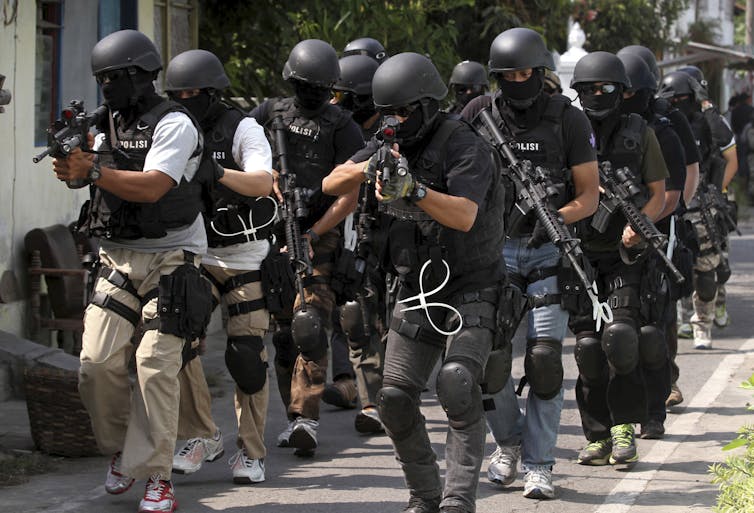
Two decades of successful cooperation in countering the security threat posed by terrorism has done much to build trust and confidence between the two neighbours.
At a time when the Trump administration has ended eight decades of global confidence in predictable American leadership, the importance of finding security in regional cooperation has never been clearer.
Good neighbours are essential
This is not a case of Indonesia and Australia choosing between the United States and China.
Australia is not stepping away from its long-standing security alliance with the US, even if confidence in it has never been lower. And Indonesian President Prabowo Subianto has gone out his way to build relations with the Trump administration under difficult circumstances.
Yet, Chinese trade and investment is vitally important to both Indonesia and Australia, and any rupture with China could have devastating consequences.
But this is not to say that there are no concerns about China. ASIO chief Mike Burgess warned this week of an escalating campaign by China to penetrate critical networks in Australia.
It is fair to assume this, too, will be a key area of quiet security cooperation between Australia and Indonesia.
At its base, the agreement is about continuing to be good neighbours to one another. As Prabowo said while signing the treaty this week,
“Good neighbours are essential. […] In Indonesian culture, we have a saying: when we face an emergency, it is our neighbour that will help us. Maybe our relatives will remain far away, but our neighbours are the closest to us and only good neighbours will help us.
Authors: Greg Barton, Chair in Global Islamic Politics, Alfred Deakin Institute for Citizenship and Globalisation, Deakin University


 Daily Bulletin


