

Aussie’s are taking recycling seriously
- Written by: Budget Direct
We’re not just talking about it – we’re tackling it. Aussie’s are taking recycling seriously
The average Australian generates 540kg of household waste every year which equates to roughly 1.5kg of waste a day. From 2016-2017 Australia accumulated around 67 million tonnes of waste, but sadly only a third of this waste was recycled.
Now those are some pretty scary facts, so here’s the good news! More and more Australians are making efforts to reduce their household waste and recycle their old stuff such as their clothes and phones. Budget Direct Home Insurance surveyed over 1000 Aussies about their recycling practices and the results are in, the yellow bins are going out.
Have you done anything in the last 12 months to reduce your household waste?
Total
Yes - 62%
No - 38%
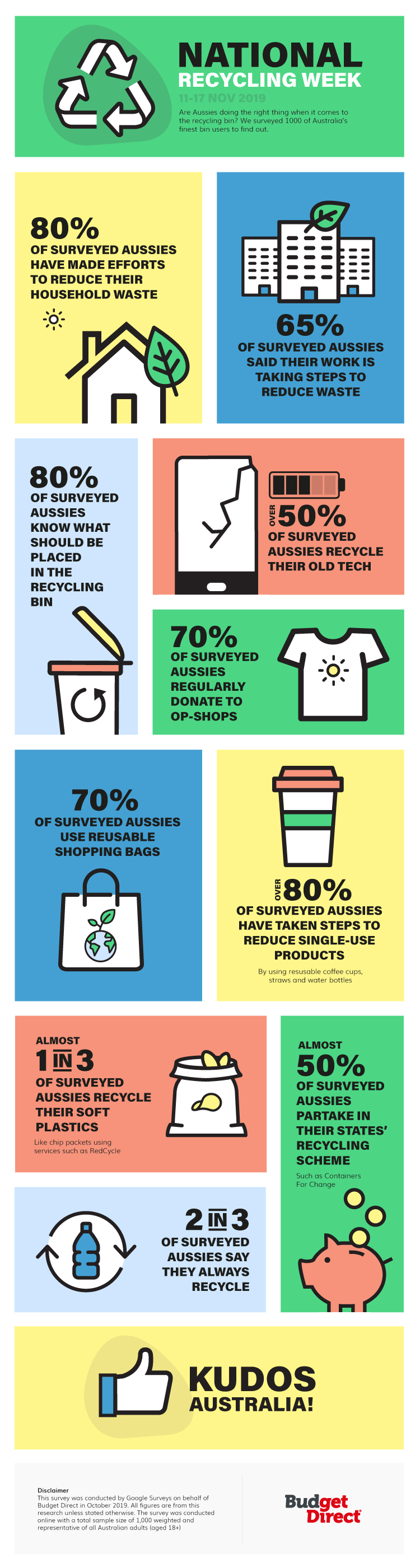
Over half of Australians (62%) have made an effort to reduce the amount of waste in their homes. Three quarters of people aged 65 or over had made efforts to reduce their waste while only 55% of 18-24 year olds had made similar efforts.
Age
18-24 - 55%
25-34 - 62%
35-44 - 67%
45-54 - 61%
55-64 - 62%
65+ - 75%
Female respondents were 15% more likely to have made efforts to reduce their household waste in the last 12 months then male respondents.
Gender
Female - 70%
Male - 55%
Tasmanians came in first with their recycling efforts in the last 12 months with three quarters of respondents saying they reduced their household waste, closely followed by respondents in the Australian Capital Territory at 72%. Respondents from New South Wales, Victoria and South Australia were the least likely to have made an effort to reduce their household waste,
State
NSW - 61%
QLD - 63%
VIC - 61%
SA - 61%
WA - 65%
TAS - 75%
NT - 70%
ACT - 72%
Has your workplace done anything in the last 12 months to reduce waste?
Total
Yes - 65%
No - 35%
Australian companies are doing their part too. 65% of workplaces around Australian have been working to reduce their waste. Leading the way was workplaces located in the Northern Territory with an outstanding 100% of respondents saying their workplaces were making efforts to reduce their waste. Tasmanian workplaces were the least likely to have made an effort in the last year with only 53% of respondents saying their workplaces were making efforts to reduce their waste.
State
NSW - 62%
QLD - 65%
VIC - 66%
SA - 59%
WA - 67%
TAS - 53%
NT - 100%
ACT - 71%
Are you confused about which items should/shouldn’t be placed in the recycling bin?
Only 20% of Australians aren’t confident they know what items go where when it comes to rubbish and recycling. People aged 18-24 were the least confident they knew which items should and shouldn’t be recycled at 31%. People who were the most confident in understanding proper recycling practices were aged 45-54.
Age
18-24 - 31%
25-34 - 20%
35-44 - 17%
45-54 - 13%
55-64 - 17%
65+ - 20%
The state taking the cake for understanding what goes where for recycling was the Northern Territory, with 100% of respondents replying that they were confident in their recycling know-how. Victorians were the most unsure, with 26% of respondents claiming they weren’t 100% on which items should and shouldn’t be recycled.
State
NSW - 17%
QLD - 22%
VIC - 26%
SA - 16%
WA - 16%
TAS - 22%
NT - 0%
ACT - 11%
Do you recycle old/obsolete technology? (Mobile, phone, tablets, laptops)
Over half of Australians (57%) are recycling their unused technological items. People aged 45 and over were the most likely to recycle their old technology, with 69% of people aged 65 and over recycling things like mobiles, phones, tablets and laptops. People aged under 45 were less likely to recycle their old technology, with only 43% of 18-24 year olds recycling their obsolete tech.
Age
18-24 - 43%
25-34 - 55%
35-44 - 58%
45-54 - 61%
55-64 - 63%
65+ - 69%
Tasmanian respondents were the biggest on recycling their old tech at 78% while people from the Northern Territory were the least likely to recycle their obsolete technology at 26%.
State
NSW - 59%
QLD - 55%
VIC - 51%
SA - 61%
WA - 61%
TAS - 78%
NT - 26%
ACT - 61%
Do you donate used clothes to opportunity/charity shops regularly?
71% of Aussies are donating their used clothes to charity shops when they’re done with them. People aged 65 and over were the most likely to donate their used clothes to opportunity/charity shops with 80% of respondents saying they donated regularly.
Age
18-24 - 70%
25-34 - 70%
35-44 - 71%
45-54 - 70%
55-64 - 73%
65+ - 80%
Females were by far more likely to donate their used clothes than male respondents by almost 20%. Whether they are donating the clothes of just themselves or for the whole family is unknown.
Gender
Female - 81%
Male - 62%
Do you use reusable shopping bags?
85% of Aussies are using reusable shopping bags. With the introduction of the ban on single use plastic bags at the two major grocery stores in July 2018 in most states, the majority of Australians needed to make the switch to reusable plastic bags. Females however were still more likely to remember to bring their reusable shopping bags than male respondents, with 92% of females versus 78% of males.
Gender
Female - 92%
Male - 78%
Which of these reusable products do you use regularly?
84% of Australians are using reusable products to reduce their impact on the environment. The most commonly used reusable item was a water bottle, with 64% of respondents saying they owned one.
64% use a reusable water bottle.
63% use reusable containers/tupperware
52% use reusable produce bags
48% use reusable coffee cups
29.5% use non-plastic straws
14% use reusable beeswax wrap
People aged 18-24 were the most likely to use non-plastic straws, with 38% of respondents that age using them. People aged 65 and over were the most likely to use reusable produce bags, with 61% of respondents saying they used them. Females were much more likely to use reusable water bottle at 74% and reusable container/tupperware at 74% of respondents.
Only 16% of respondents said they didn’t use any reusable products, however there were some states who made more of an effort to use reusable products than others. Respondents from the Australian Capital Territory were ahead with only 9% of those surveyed saying they didn’t own any reusable items. People from the Northern Territory were the most likely to not own any reusable items, with 26% saying they owned none of the above items.
State (no items)
NSW - 14%
QLD - 16%
VIC - 16%
SA - 20%
WA - 22%
TAS - 31%
NT - 26% ( well below average reusable water bottle 25%
ACT - 9%
Do you use plastic recycling services such as RedCycle to recycle your soft plastics?
29% of people use RedCycle and other recycling services to recycle their soft plastics (such as bread bags, chip packets, glad wrap etc). People aged 65 and over were the most likely to use recycling services for the soft plastics with 39% saying they used RedCycle and other programs like it. People aged 45-54 were the least likely to use them at 25%.
Age
18-24 - 28%
25-34 - 26%
35-44 - 35%
45-54 - 25%
55-64 - 27%
65+ - 39%
Coming in well below the national average, the Northern Territory respondents were the least likely to use recycling services, with 0% saying they used programs such as RedCycle and others like it. New South Wales respondents were the most likely to partake in these programs with 31% of those surveyed saying they used RedCycle and others like it.
State
NSW - 31%
QLD - 30%
VIC - 27%
SA - 28%
WA - 28%
TAS - 26%
NT - 0%
ACT - 28%
Do you partake in your states’ waste reduction incentives?
Just under half (48.5%) partake in the waste reduction incentives in their states and territories. People aged over 65 were the most likely to take part in their states waste reduction incentive schemes with 65% of them saying yes. People aged between 18-24 were the least likely to take part in the programs with only 44% of respondents saying they used the incentive programs.
Age
18-24 - 44%
25-34 - 46%
35-44 - 48%
45-54 - 48%
55-64 - 49%
65+ - 65%
Respondents from Victoria were the least likely to take part in their state’s waste reduction incentive with only 35% saying they used the incentive schemes. People from the Northern Territory were much more likely to take part in their Territory’s incentive scheme, with 100% of those surveyed saying they used the incentive programs. One potential reason for this is a result of the fact that the Northern Territory’s container deposit scheme was introduced in 2012, while states like Queensland only had their container deposit scheme introduced in 2018.
State
NSW - 50%
QLD - 59%
VIC - 35%
SA - 62%
WA - 36%
TAS - 55%
NT - 100%
ACT - 64%
What prevents you from recycling?
66.3% of respondents always recycle
13.9% forget
11.3% are not bothered
8.4% don’t understand how to recycle properly
People aged between 18-24 were the most likely respondents to say that they weren’t bothered about recycling, with 16% of those surveyed saying they didn’t bother to recycle. People aged between 25 and 44 were the most interested in recycling, with only 9% of respondents saying they weren’t bothered to recycle,
Age (not bothered)
18-24 - 16%
25-34 - 9%
35-44 - 9%
45-54 - 12%
55-64 - 12%
65+ - 10%
One conclusion the survey results suggest is that further education and resources are needed to help the Australian public understand the importance of recycling and the best and different ways everyone can contribute to the national recycling effort. While 14% of Australians just aren’t remembering to recycle, for the 20% of Australians that are just not bothered to recycle or who don’t understand how to recycle properly, further education is the best means of encouraging more and better recycling practises.
https://www.cleanup.org.au/clean-up-our-waste

 Daily Bulletin


