Sea level rise is real – which is why we need to retreat from unrealistic advice
- Written by: The Conversation Contributor
 In the aftermath of 2012's deadly Hurricane Sandy, New York launched a US$20 billion plan to defend the city against future storms as well as rising sea levels.David Shankbone/Flickr, CC BY
Coastal communities around the world are being increasingly exposed to the hazards of rising sea levels, with global sea levels found to be rising faster over the past two decades than for the bulk of the 20th century.
But managing the impacts of rising seas for some communities is being made more difficult by the actions of governments, homeowners – and even some well-intentioned climate adaptation practitioners.
Coastal adaptation policies usually carry political risk. One of the main risks is when communities end up divided between those wanting a response to the growing risks of coastal flooding, and those more concerned about how their own property values or insurance premiums might be hit in the short-term by such action. For some, the biggest threat is seen to be from sea level rise adaptation policies rather than sea level rise itself.
Some organisations and governments have side-stepped the political risk by commissioning or preparing adaptation plans – but then not implementing them.
A colleague of mine describes this as the “plan and forget” approach to coastal adaptation. It’s all too common, not only here in Australia but internationally. And it can be worse than completely ignoring the risk, because local communities are given the impression that the risk is being managed, when in fact it is not.
The Australian Broadcasting Corporation’s Catalyst program examines past and future sea level rise.
‘The road to hell is paved with good intentions’
Coastal adaptation researchers and practitioners (and I’m one of them) must reconsider some of the common recommendations typically contained in coastal adaptation studies.
In my experience, well-intentioned but poorly considered recommendations – such as advocating for highly urbanised city centres to be relocated inland – prevent many adaptation studies being implemented.
Relocating buildings and other built infrastructure further away from the coast to reduce or eliminate the risk of flooding might sound like a sensible, long-term option, and indeed it is in some cases.
But too often, the advice given to “retreat” or relocate established, highly built-up city blocks makes little economic or practical sense. Such advice can be inconsistent with well-established engineering disaster risk reduction frameworks such as Engineers Australia’s Climate Change Adaptation Guidelines in Coastal Management and Planning.
Much to the chagrin of many in the coastal adaptation science community, cities and owners of major coastal facilities around the world are voting with their feet – largely rejecting coastal retreat recommendations in favour of coastal protection.
Major cities choosing defence, not retreat
New York is perhaps the best example of governments and individuals alike choosing protection rather than retreat.
In October 2012, Hurricane Sandy left behind a trail of destruction of more than US$71 billion in the United States. In New York alone, 43 people were killed.
In June 2013, then Mayor Mike Bloomberg said rising temperatures and sea levels were only making it harder to defend New York, warning:
We expect that by mid-century up to one-quarter of all of New York City’s land area, where 800,000 residents live today, will be in the floodplain. If we do nothing, more than 40 miles of our waterfront could see flooding on a regular basis, just during normal high tides.
Yet even after acknowledging that threat, New York’s response wasn’t to retreat. Instead, the mayor launched a US$20 billion plan to protect the city with more flood walls, stronger infrastructure and renovated buildings. As that “Stronger, More Resilient New York” plan declared:
We can fight for and rebuild what was lost, fortify the shoreline, and develop waterfront areas for the benefit of all New Yorkers. The city cannot, and will not, retreat.
Similarly, none of the winners of Rebuild By Design – an international competition to make New York and surrounding regions more resilient to coastal inundation – focused on retreat strategies. In fact, some involve intensifying urban areas that were under water during Hurricane Sandy.
In the worst hit areas, even when given the choice of a state buy-out scheme relatively few New Yorkers chose to leave.
PBS Newshour looks at how New York and other world cities can better protect against rising seas and storm surges.
Although not directly related to climate change, the Japanese response to the devastating 2011 tsunami is another telling example.
There, some residents did choose to relocate to higher ground. However, the government did not relocate major facilities inland, including the Fukushima nuclear facility. Instead, Japan will spend US$6.8 billion to form a 400-kilometre-long chain of sea walls, towering up to four storeys high in some places.
In Melbourne, Australia, four local councils from the Association of Bayside Municipalities worked on the science-based Port Phillip Bay Coastal Adaptation Pathways Project to systematically identify the most effective adaptation responses. That project highlighted the effectiveness of accommodating and reducing flooding through established engineering approaches.
For example, the project concluded that while the popular Southbank waterfront in the City of Melbourne is likely to see even more common and extreme flooding in the coming decades, “retreat is not necessary”.
 The Yarra River flows through the heart of Melbourne, in Australia, with Southbank on the left.R Reeve/Flicker, CC BY-ND
More practical advice is crucial for greater action
Coastal adaptation studies and plans need to be based on practical, defensible and implementable recommendations.
That means climate adaptation practitioners need to refrain from recommending that major urbanised coastal centres be relocated further inland in coming decades, unless that really is the only viable option.
Instead, I think we can achieve more by concentrating more on how lower- and medium-density coastal communities can adapt to higher sea levels. This is a more challenging problem, as economic analyses can produce very different recommendations depending on which so-called “externalities” are included or left out in the analysis.
On the same note, adaptation studies that make recommendations without considering the impacts to present-day home-owners, or how adaptation plans are financed, can also be unhelpful.
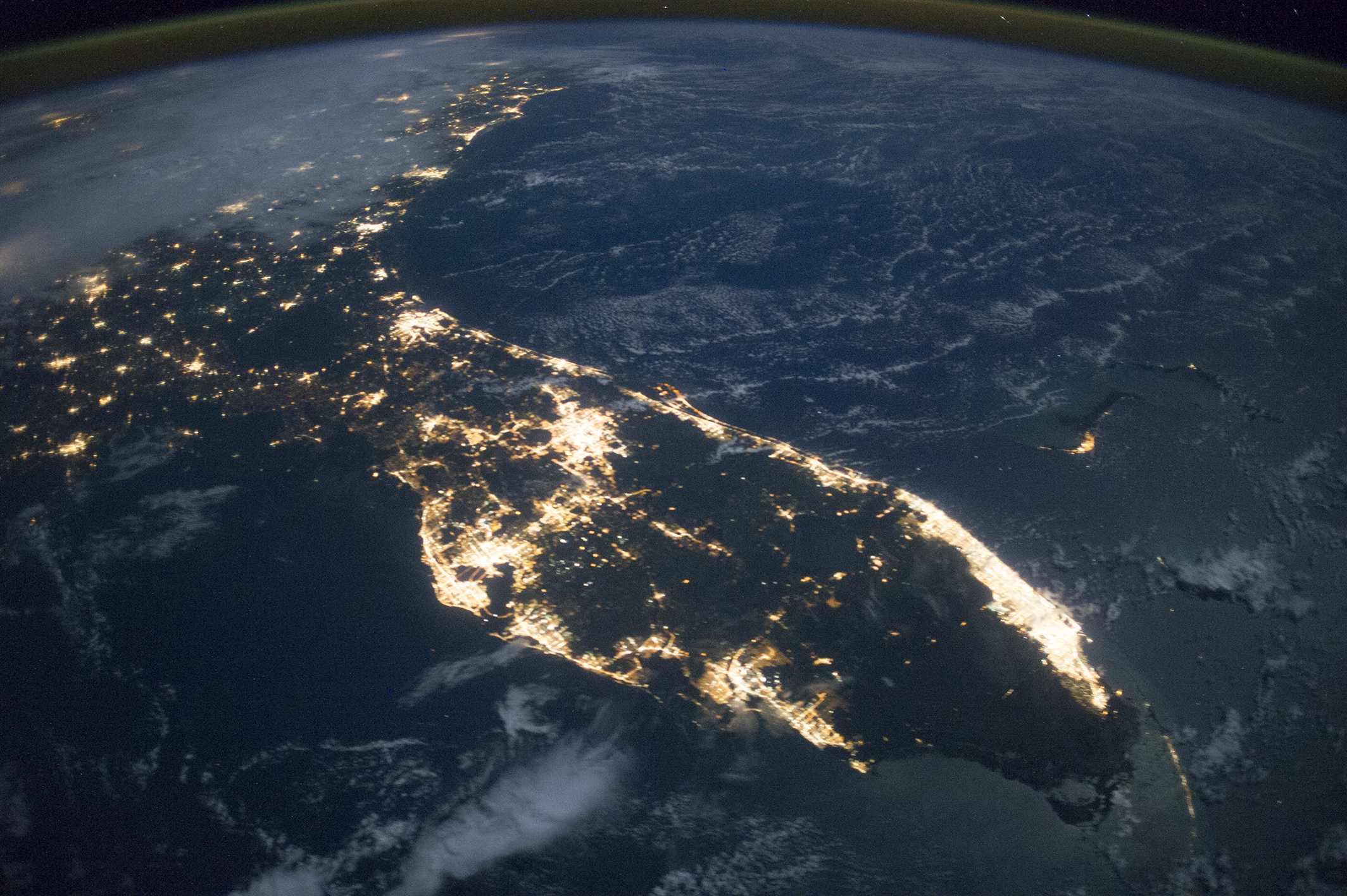
 Florida, USA, photographed from space – one of many highly urbanised coastal areas around the world needing to adapt to rising seas.NASA
Good adaptation strategies need to acknowledge the real political risks involved with any change involving people and property. Along with making recommendations, they also need to lay out an implementation plan showing how individual and community concerns will be taken into account.
So far the climate models have done a good job in estimating the likely future sea levels. The same cannot be said for our adaptation responses.
But if you’re looking for examples of how we can be better prepared for growing sea level risks, initiatives such as the Port Phillip Bay Coastal Adaptation Pathways Project and the Queensland Climate Adaptation Strategy (currently under development) seem to be heading in the right direction.
* Do you have a question about how we can plan for or learn to live with rising sea levels? Mark Gibbs will be answering your questions at 1-2pm AEDT/12pm-1pm AEST today (Friday December 4).
Dr Gibbs receives funding from multiple state and local government sources and private industry to provide advice and expert witness services on coastal management including climate adaptation. Mark is also a Non-Executive Director of Green Cross Australia, and an Adjunct Professor at the Griffith Centre for Coastal Management. This article was not commissioned by any entity, and solely reflects the individual views of the author.
Authors: The Conversation Contributor


 Daily Bulletin