

Why the housing shortage exacerbates scabies in Indigenous communities
- Written by: Simon Quilty, General and Acute Care Physician and Senior Lecturer, Flinders University, Katherine Hospital campus, Flinders University
Scabies is a disease of antiquity, one of the scourges of those on the First Fleet but no longer known for most in Australian society. However, in the far remote Northern Territory, scabies infection remains endemic, and in some regions almost 70% of Aboriginal children in remote areas had been infected within their first year of life.
Recent research in the Medical Journal of Australia estimates that as many as one in 100 Aboriginal people in the Katherine region suffers from the highly virulent infection, crusted scabies, and links this with homelessness and remote living. A person with crusted scabies has the potential to infect hundreds if not thousands of others, and these cases drive ongoing extreme rates of infection in Aboriginal communities.
What is scabies?
Scabies is a tiny mite the size of a pin head. When a person is initially infected (usually by only a dozen or so of the mites), it takes a few weeks for the immune system to recognise these unwanted arthropods burrowing through the dermis (the inner layer of skin).
When the immune system kicks in, the extreme itch begins and the body fights back against the bugs. If a person’s immune system is working properly, the population of bugs on an individual never expands beyond a few dozen at most, and they remain relatively noncontagious. But the scratch marks from the cursed itch often cause streptococcal infections that can result in other conditions such as rheumatic heart disease.
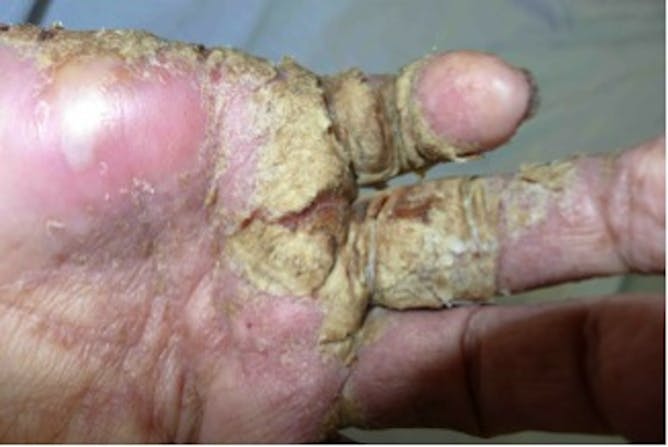 Crusted scabies infection of the hand.
Bart Currie, Menzies School of Health Research., Author provided
Crusted scabies infection of the hand.
Bart Currie, Menzies School of Health Research., Author provided
However, if an infected individual’s immune system does not work, the bugs breed prolifically in the skin and the numbers reach the many tens of thousands. At the same time, they erode the skin, making it “crusted” – a term that only makes sense when you see the crusts that constantly shed off, landing wherever the person moves.
These crusts are highly contagious, and thus the person infects everyone who crosses their path - on bus seats, in the cinema, on mattresses, lounge chairs and footpaths.
What has scabies got to do with housing?
In the Katherine region, it’s estimated as many as one in four Aboriginal people is homeless, either literally (living as fringe-dwellers in makeshift riverside camps), or technically (the ABS defines homelessness as a situation in which a person has no alternatives to their current inadequate dwelling, has no tenure, and cannot control space for social relations).
As many Aboriginal people in Katherine can’t afford the private rental market, public housing is the only alternative. Currently in Katherine there is a five year wait, and to be on the wait list a person needs to have a postal address for the Department of Housing to communicate with them. Rules, regulations and bureaucracy around the wait list change all of the time. It is a challenge to ensure that a name stays on the wait list for the five years until a house is available.
 Microscopic view of a small crust showing heavy infestation with scabies mites.
Bart Currie, Menzies School of Health Research., Author provided
Microscopic view of a small crust showing heavy infestation with scabies mites.
Bart Currie, Menzies School of Health Research., Author provided
Young people are forced to stay at home, even when they have children of their own. Many houses in the Katherine region have four generations under the one roof. The dream of starting a family and living in a house of their own is a distant prospect for many Aboriginal people living in Northern Australia.
Remote-living people have limited options to relocate to bigger centres like Katherine or Darwin without having to embrace homelessness for at least a temporary period. Many of these people’s temporary situations become permanent in bush and riverside fringe dwelling camps where there is no sanitation, running water or secure shelter.
Because most houses are overcrowded, visiting family members often stay in houses already on the brink of bursting. An uncle comes to town. Ashamed of his skin condition and not knowing what is causing the crusting, he hides his deformed and ugly skin under long sleeves and jeans. But the crusts drop to the floor. Everyone in the house is infected.
And if he is lucky enough to endure the gruelling hospital treatment to get rid of the scabies, he is likely to move back into circles of living where scabies rates are high, and the reason his immune system does not work will probably still be there. He will be reinfected within a week or so, and his infection will become crusted again within the next six months.
What can be done?
Crusted scabies was added to the list of notifiable diseases in the Northern Territory in 2016. This will ensure identified cases of crusted scabies will be treated in a systematic way that includes ensuring household contacts are followed up properly.
The Northern Territory Department of Health Centre for Disease Control is working closely with the philanthropic organisation One Disease. They are learning from the strong successes this organisation has already achieved over the past five years in Arnhem Land, in an effort to replicate this success with other vulnerable populations in the NT.
 A scabies mite.
Bart Currie, Menzies School of Health Research., Author provided
A scabies mite.
Bart Currie, Menzies School of Health Research., Author provided
Australia is at the forefront of scabies research, and there are exciting developments in understanding how to tackle the challenge of scabies in areas like remote Northern Australia where great distances, tropical weather and mobile populations create challenges in eradicating the disease.
And the underlying problem of homelessness is far from solved. This fundamental inequality, with homelessness rates being 31 times the national average in regions like Katherine, has its roots in the process of colonisation and the earliest narratives of our nation’s psyche.
Aboriginal fringe dwellers like Bennelong still exist in Australia. Many Aboriginal people and their ancestors have never had a safe “home” since their society was ruptured by the arrival of the colonisers. In towns like Katherine, the concept of “home” for many people is still undergoing great transformation.
The problem of homelessness for remote Aboriginal people is arguably one of the strongest drivers of poor social and health outcomes. While homelessness may result in poor health outcomes, the fundamental solution to homelessness cannot be driven by the health care sector. Instead, more could be done by engagement between Aboriginal communities and local councils, architects, economists, social anthropologists, builders and plumbers.
Scabies, rheumatic heart disease, kidney disease, diabetes, and smoking all contribute to a life expectancy more than ten years below the national average. If we want to live in a country where Aboriginal people can expect to live as long as non-Aboriginal people, medical research can go only so far.
Authors: Simon Quilty, General and Acute Care Physician and Senior Lecturer, Flinders University, Katherine Hospital campus, Flinders University


 Daily Bulletin


