

The detective work behind the Budj Bim eel traps World Heritage bid
- Written by: Ian J. McNiven, Professor of Indigenous Archaeology, Monash University
Last month, Prime Minister Malcom Turnbull visited the Gunditjmara community of southwest Victoria to announce that the federal government had included the Budj Bim cultural landscape on its World Heritage Tentative List. It was, he said,
the first area [in Australia] exclusively listed for its Aboriginal culture and heritage and it is absolutely an appropriate recognition of its significance and its values.
So what warrants the area’s inclusion on UNESCO’s esteemed World Heritage list? At its core, this is a story about the Gunditjmara and their continuing relationship with the Budj Bim cultural landscape. It is also a story about how the Gunditjmara have successfully fought to overturn European misunderstandings of the complexity and sophistication of their culture and history.
This story of misunderstandings begins with an 1841 expedition to southwest Victoria by the Chief Protector of Aborigines, George Augustus Robinson.
On 9th July 1841, to the north of Gunditjmara country at a swamp near Mt William, Robinson reported
an immense piece of ground trenched and banked, resembling the work of civilized man but which on inspection I found to be the work of the Aboriginal natives, purposefully constructed for catching eels.
 GA Robinson.
Tasmanian State Library/wikimedia commons
GA Robinson.
Tasmanian State Library/wikimedia commons
Robinson estimated that the system of channels measured “some thousands of yards” (2 km) in length and covered an area of “at least 15 acres” (6 hectares).
His findings were not what early settlers of the colony wanted to hear. Colonial settlement was about removing nomadic savages, not tillers of the land. The evidence was either ignored as an inconvenient truth or dismissed as evidence of “irrigation” by a superior race of cultivators living in Australia prior to the coming of the Aborigines.
It took another 135 years for more appreciative European eyes to examine the scale and complexity of western Victoria’s Aboriginal fishery.
Investigations in the 1970s
In the 1970s, Dr Peter Coutts of the Victoria Archaeological Survey carried out site surveys at Lake Condah (Tae Rak), the centerpiece of the Budj Bim cultural landscape. Lake Condah is very different to the marshy plains near Mt William. It is a rugged lava flow terrain of basalt rises, swampy depressions, and waterways formed as a result of the eruption of Mt Eccles (Budj Bim) at least 30,000 years ago.
Coutts and his team found what local Gunditjmara people had long known about – extensive Aboriginal fish trapping systems comprising hundreds of metres of excavated channels and dozens of basalt block dam walls constructed over innumerable generations before European contact. Coutts estimated that the volume of basalt blocks moved measured in “the many hundreds of tonnes”.
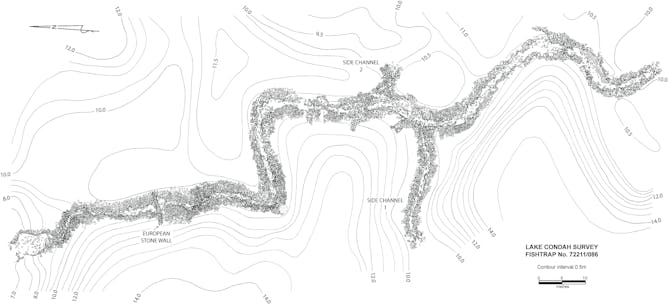 A 200 metre long fish trap channel mapped by Peter Coutts’s team at Lake Condah.
Victoria Archaeological Survey
A 200 metre long fish trap channel mapped by Peter Coutts’s team at Lake Condah.
Victoria Archaeological Survey
Determining how the Budj Bim traps operated was made difficult after European alteration of Lake Condah’s water flows through installation of drainage channels in the 1880s and 1950s. Luckily, heavy winter rains in 1977 revealed how some Aboriginal-made channels fed water and eels into natural depressions that Coutts termed “holding ponds”. In addition, numerous C-shaped basalt block structures, averaging around 3-4 metres across, and representing house foundations – possibly clustered into villages – were recorded in the same area as the fish traps.
Coutts hypothesised that the fishing facilities were up to 3500 years old, based on radiocarbon dating of habitation sites in the region such as earthen mounds and shell middens. Reconstruction of ancient water levels in Lake Condah by pollen expert Leslie Head revealed that while some traps could have operated 8000 years ago, most traps corresponded to water levels of the past 2000 years.
Working at the same time as Coutts was Harry Lourandos, a PhD researcher from the University of Sydney. Lourandos examined Robinson’s journals in detail and investigated a huge Aboriginal fish trap at Toolondo, 110 km north of Lake Condah.
Here again was further evidence of Aboriginal people digging an earthen channel (some 3 km long) to move eels into a swamp to dramatically increase their range and availability. Lourandos’ excavations revealed that it was up to 2.5 m wide and over one metre deep. A “lump” of redwood buried within infill sediments at the base of the channel was radiocarbon dated to 200 years, indicating a minimum date for last use of the site. An original construction date for the channel has yet to be determined.
Aware of Coutts’ Lake Condah holding ponds, Lourandos had the intellectual foresight to call the Toolondo and Mt William facilities for what they were – eel “farms” associated with eel traps.
3D computer maps
In the 1990s and 2000s, Heather Builth, a PhD researcher from Flinders University, worked closely with the Gunditjmara to create sophisticated 3D computer maps of channels and basalt block dam walls and fish traps along Darlot Creek (Killara) at the southern end of the Budj Bim cultural landscape.
Builth computer modelled water levels and revealed that these stone features were constructed across the lava flow to form a complex system of artificial ponds to hold flood waters and eels at different stages of growth.
These holding ponds allowed eels to grow in a restricted and protected area and be available to the Gunditjmara for much of the year. Critically, increasing the availability of the eels centred on improving eel survival given that the eels breed in the Coral Sea. Builth described this complex network of ponds as “aquaculture”.
 The funnel shaped start of Muldoons trap system, Lake Condah.
Ian McNiven
The funnel shaped start of Muldoons trap system, Lake Condah.
Ian McNiven
The most recent insights into the Budj Bim fishing facilities concern their antiquity. Over the past decade, myself and students from Monash University, in collaboration with the Gunditjmara, have excavated Muldoons trap system at Lake Condah, which had been partly buried over the years by flood sediments.
Radiocarbon dating of tiny charcoal fragments within these sediments produced surprising results. One channel was built at least 6600 years ago, while a dam wall was added 500 years ago. Not only had we discovered the world’s oldest known stone walled fish trap, but also the longest used fish trap in the world.
3D computer modelling by Tom Richards as part of this PhD research at Monash indicated that the Muldoons dam was used to pond water and fish. This pond provides the earliest available date for Gunditjmara aquaculture.
Not simply hunter gatherers
These large-scale fishing facilities and associated aquaculture ponds rupture traditional representations of Aboriginal people as simply hunter gatherers.
 Lake Condah with its rugged basalt lava flow features in the Budj Bim cultural landscape.
AAP
Lake Condah with its rugged basalt lava flow features in the Budj Bim cultural landscape.
AAP
Rather than living passively off whatever nature provided, the Gunditjmara actively and deliberately manipulated local water flows and ecologies to engineer a landscape focused on increasing the availability and reliability of eels.
Manipulation of the landscape involved stone structures (such as traps and channels) dating back at least 6600 years with eel aquaculture facilities (ponds and dam walls) pre-dating contact with Europeans by many hundreds (and possibly thousands) of years.
As Lourandos pointed out more than three decades ago, and Bruce Pascoe reveals in his recent award-winning book Dark Emu, differences between hunter gatherers and cultivators, and foragers and farmers, are far more complex and blurred than we once thought.
The Budj Bim cultural landscape provides an outstanding example on a world stage of the scale, complexity, and antiquity of a well preserved Aboriginal fishery that continues into the present. And it is an exceptional example of Aboriginal environmental manipulation and management that blurs the distinction between foragers and farmers. Over the next year or so, a formal World Heritage nomination will be prepared by the Victorian government spearheaded by the Gunditjmara for submission to UNESCO’s World Heritage Committee.
 Denis Rose.
Ian McNiven
The evaluation of the nomination by the committee will be thorough. It will compare Budj Bim to similar types of places around the world. The case is strong but it will be a number of years before the committee makes a final decision.
Denis Rose.
Ian McNiven
The evaluation of the nomination by the committee will be thorough. It will compare Budj Bim to similar types of places around the world. The case is strong but it will be a number of years before the committee makes a final decision.
Budj Bim is a living cultural landscape and a strong focus for Gunditjmara heritage, identity, and spiritual well-being. It is now time for this remarkable heritage to be shared with the world. As senior Gunditjmara elder and longtime Budj Bim World Heritage listing advocate Denis Rose has said:
It’s one of those secrets that are a bit too well kept, I suppose. But we are involved in tourism and we do want to get people out on country a bit more and have access to properties to get a better understanding of Gunditjmara culture.
So what will you see if you go there? Hundreds of Gunditjmara stone-walled fishing facilities and stone house foundations are located along the 30 km length of the area. However in many cases, these low-lying sites are on private land and are hard to see through the long grass that covers much of the lava flow.
To experience these sites firsthand, visit the Tyrendarra Indigenous Protected Area for a self-guided tour. Or for a Gunditjmara guided tour of the area and access to the large and clearly defined fishing facilities at Lake Condah, contact Budj Bim Tours. (And if smoked eels take your fancy, the Gunditjmara have plans to augment their eel fishery to commercial levels.)
Australia has come a long way since GA Robinson’s recordings of Aboriginal social and technological complexity were sidelined.
Authors: Ian J. McNiven, Professor of Indigenous Archaeology, Monash University
Read more http://theconversation.com/the-detective-work-behind-the-budj-bim-eel-traps-world-heritage-bid-71800


 Daily Bulletin


