

The search for extraterrestrial life in the water worlds close to home
- Written by: Andrew Martin, Sea ice microbial physiologist, University of Tasmania
The discovery of seven exoplanets around a star 40 light years from our Sun has raised the possibility that they could harbour life.
Why? Because the astronomers who made the discovery believe some of the planets may have liquid water. And on Earth, wherever there is liquid water, there is life.
But we believe we can look much closer to Earth for potential candidates for evidence of extraterrestrial life, as we state this month in the International Journal of Astrobiology.
Recent discoveries by the NASA Voyager and Cassini space missions infer the presence of liquid oceans beneath a sea ice crust on some of the moons of Jupiter and Saturn.
These provide the most likely sites for finding extraterrestial life in our solar system.
Just like on Earth
The independent scientist James Lovelock, best known for developing the Gaia hypothesis, was contracted to NASA in the 1960s to develop atmospheric and planetary sensors for the Viking probes subsequently deployed to Mars in 1975.
Following a precursory Earth-based assessment, Lovelock theorised that the red planet was likely devoid of life because of atmospheric chemical equilibrium. In contrast, Earth’s atmosphere is in dynamic flux due to the biological activity that takes place on the surface.
Notwithstanding the continued ambiguity as to whether or not life is, or ever has been, present on Mars, Lovelock set a powerful precedent for the emerging field of astrobiology – the comparative approach with Earth in the search for extra-terrestrial life.
Energy and life
In our endeavour to answer the question of whether we are alone in the Universe, we have a solitary clue: “follow the energy”.
Earth is our only point of reference, and life on Earth requires energy – thermal energy for melting water and chemical energy for maintaining life. That’s it. Just two forms of energy define the cosmic imperative for life as we know it.
But ironically, we do not know when, where or how life originated on Earth.
What we do know is that the oldest and most abundant life forms on the planet are microorganisms. Biological adaptation is not restricted by structural simplicity, because microbes occupy every conceivable ecological niche on Earth.
If we accept the simple prokaryotic cell as being life’s universal blueprint, then ET is either an amalgamation of microbes or is still a microbe.
Follow the energy = follow the water
The mandate to “follow the energy” is synonymous with “follow the water”. The recent discovery of evidence of liquid water on the surface of Mars is therefore intriguing, but there is a lot more of it on Jupiter’s Europa and Saturn’s Enceladus.
These moons are compelling targets for astrobiology because of the inferred presence of oceans beneath a sea ice crust that have persisted over geological time scales.
A new interpretation of data collected by the Cassini spacecraft suggests that the ocean beneath the ice on Enceladus is not just confined to the south polar region. Like Europa, it is global.
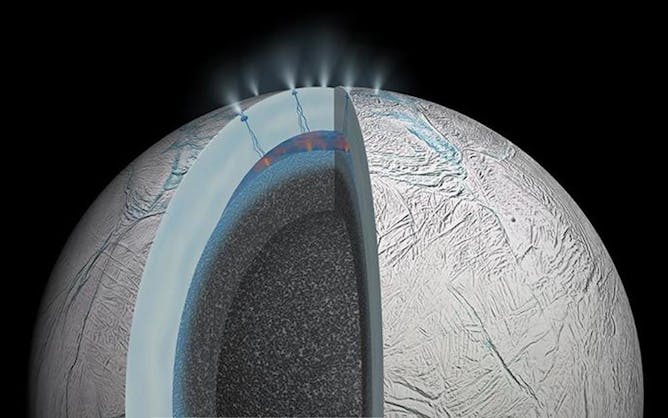 An artist’s rendering of Saturn’s moon Enceladus shows possible hydrothermal activity that may take place on and under the seafloor of the moon’s subsurface ocean.
NASA/JPL-Caltech
An artist’s rendering of Saturn’s moon Enceladus shows possible hydrothermal activity that may take place on and under the seafloor of the moon’s subsurface ocean.
NASA/JPL-Caltech
It now also appears that Europa’s ice shell comprises a mobile, plate tectonic-like system that overlies warm convecting ice and a salty seawater reservoir that is 30-35 times the volume of Earth’s ocean.
Should more water equate to more life? Not necessarily. There are many biological constraints on habitability in extreme environments.
Life as we know it appears to be absent on the surface of Europa and Enceladus because of ionising radiation and extremely low temperatures. Photosynthesis as we know it is also very unlikely to occur under ice that is kilometres thick.
Hydrothermal vents, a habitat for deep-sea ecosystems on Earth, may or may not exist on the moons.
So is this the end of comparison with Earth and end of story? Actually no, because it’s feasible that microorganisms that currently inhabit sea ice on Earth could also inhabit the ice water-interface and ice fissures on Europa or Enceladus.
Life in extreme conditions
The molecular basis for adaptation is not completely understood, but extremophiles (organisms that live in extreme conditions) must tolerate steep gradients in temperature, salinity, acidity and inorganic nutrients, as well as dissolved gas and light signatures.
Stress-related fissures in the ice shells of Europa and Enceladus are complex, and our understanding of their topography is based on theoretical modelling. But fissures appear to actively exchange liquid from the subsurface oceans to the ice exteriors.
The physiological demands on any microbial organisms would be exceptional, but these features could harbour small-scale, biologically permissive domains. Even brief periods of photosynthesis might be possible.
Extremophiles are relevant reference organisms because they adapt to multiple stressors in ways we don’t completely understand.
Life on these moons may be possible, but how likely is it? The comparative approach calls for an understanding of how these microbes respond to multiple stressors and the limits to which they can be pushed.
But the search for extra-terrestrial life is impeded because we lack a framework linking the capacity for adaptation with environmental variability. Future research and exploration to these moons will benefit from experimental work that defines life’s limits in the sea ice ecosystem.
Ultimately, we need to characterise theoretical biological limits that are distinct from the limits imposed on Earth-based analogues.
Authors: Andrew Martin, Sea ice microbial physiologist, University of Tasmania


 Daily Bulletin


