

Our gas market hits the red zone , as predicted
- Written by: Mike Sandiford, Chair of Geology & Redmond Barry Distinguished Professor, University of Melbourne
The Sichuan basin is one of China’s premier shale gas plays, and when it comes to developing Chinese resources, state-owned enterprises like Sinopec have the inside running.
I met with Sinopec geologists earlier this week in Beijing to discuss collaborations and asked how their Sichuan Basin gas plays were shaping up. I was curious, having been told some years back by a senior Shell shale-gas engineer his view was “too deep and too tight”. After some initial interest, in 2016 Shell announced it was getting out of the Sichuan.
Somewhat to my surprise, my Sinopec colleagues were very upbeat claiming their shale gas production was on target. With a production schedule targeting some 8000 terajolues per day I wondered aloud, how long they thought they would need our LNG exports. They must have sensed some concern and quickly said not to worry. The cost of production from their Sichuan plays was well above the price they were paying for our gas. They wouldn’t be leaving us stranded any time soon, they assured me.
I then told them about the domestic prices here in Australia, where spot prices regularly sit at around $12 per petajoule and where future contracts are reputedly now being offered at up to $20 petajoule. Their reaction, in a word, “flabbergasted”. How could it be that we paid more for our own gas than they did to import it? For reference, Henry Hub spot prices in the US are currently settling at around AUD$3.4 per petajoule, just 30% of the Australian price (AUD$11.4) at the time of writing.
And importing our gas, the Chinese are. Back in 2015, BP reported that China imported around 50 million tonnes in barrels of oil equivalent (BOE) in energy terms, representing about 6000 terajolues per day.
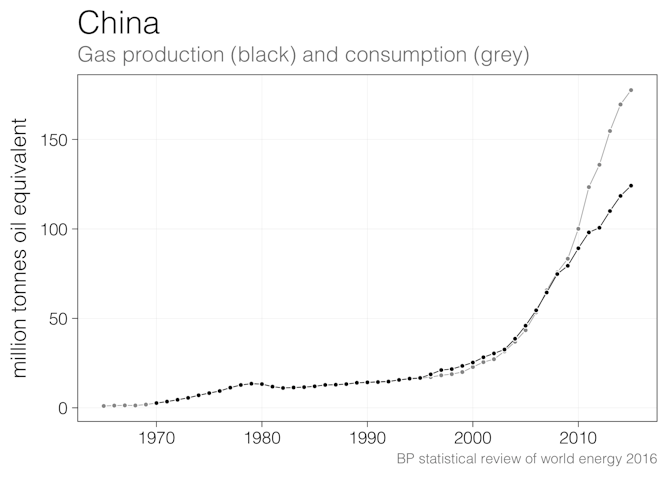 Chinese gas production and consumption figures as terms of Million of barrels of oil equivalent per year, until end of 2015. Data from the BP Statistical Review of World Energy, 2016. While production has risen sharply, more than doubling in the last decade, consumption has risen much faster with a separation occurred around 2008. Consumption outstripped production by about 50 million tonnes in 2015, the equivalent of 7000 terajolues per day. Eastern Australian gas exported via the Gladstone ports will make a significant contribution to Chinese imports into the future, because the marginal cost of production in China’s frontier unconventional basins such as the Sichuan is above the price they pay to import.
The Gladstone Port Authority reported a touch under one million tonnes of LNG left Curtis Island in Queensland bound for China last December. That amounts to a daily rate of about 1600 terajolues. In total, Curtis island shipped 1.7 million tonnes in 27 cargoes in December, equating to about 3000 terajolues per day. That represented around 70% of the total production of 4200 terajolues per day from all the gas fields across eastern and southern Australia that are physically connected to the export facilities. The exports outstripped our domestic consumption in the eastern states by a factor of about 2.5.
The point is worth reiterating. In December last year more gas was shipped to China from Queensland than was used locally across the four eastern sea- board states and South Australia. That wouldn’t be a problem if there was enough gas to go round. But there is not, and instead we have entered the “red zone”.
With the first shipments leaving Gladstone just a touch over two years ago, in January 2015, it is hardly surprising that the gas market is causing ructions here in Australia. In fact it shouldn’t surprise anyone as problems were anticipated as far back as 2013, as I discussed in a post mid last year titled “We really must talk about gas”.
And so it would seem we are now really talking about gas.
As illustrated in the figure below, the last few years have witnessed an unprecedented change in our eastern gas market. Production has risen 250% in just two years, from an average of 1800 terajolues per day in the last half of 2014 through to 4600 terajolues per day in last half of 2016.
 Total production from the gas fields serving the eastern Australian gas market, coloured by producing region, along with the monthly averaged exports from Gladstone. Production data from AEO, export data from Gladstone Port Authority.
Also shown is exported gas, and the amount of gas used to deliver gas from the producing fields to the export facilities. The amount of additional gas needed for processing is a somewhat uncertain number but is likely to be more than 10%. In the figure above I assume 12%. Finally, I also show the contracted position of our LNG exporters who are ramping up to around 24 million tonnes of LNG exports per year (CLE), with an assumed additional load of almost 3 million tonnes needed to deliver that to the cargo (marked as “CLE+proc”).
So how does the figure above help us understand what has happened to so dramatically upset our gas markets here in Australia.
Firstly, note how our exports have tracked upwards more steeply than the production from our developing coal-seam gas fields in Queensland from the production region of Roma (shown in green). In the last few months the combination of exports plus the new processing load has begun to outstrip the total production from the new CSG-fields. Production from our older, conventional gas fields such as the Gippsland Basin in Victoria (in red) and the Cooper Basin in South Australia (in dark blue) is being partially used to fill the export cargoes. In short, we are short on gas, having entered the “red zone”.
In a previous postI have discussed the recent dynamics of gas pricing and availability in the National electricity market and its impact on prices, showing how quick we have switched from the “ramp-gas phase”. That is the stage when CSG fields were being developed prior to the completion of the export facilities, providing abundant flows of cheap gas for the local market. Now we are in the “scarce-gas” phase, or the “red-zone” as I like to call it. It is one of the key reasons for the recent doubling of spot electricity prices (another is the extra electricity demand from the LNG processing themselves, providing a double whammy for electricity users, as explained here). But scarcity pricing in the gas market is affecting all users, not just electricity generators.
And the reality is that now we are in the “red-zone” scarcity pricing is here to stay. In the medium-term it only seems likely to get worse. If no new production is bought to market, exports rise to meet contracts, and around 12% of additional gas is needed for export processing, then we we will be excising conventional resources to the export market at a rate of about 400 terajolues per day or about 30% of what would otherwise have been available for domestic use. While there remain many “ifs” in that scenario, it is a hugely worrying shift in the balance of demand and supply.
With politicians now scurrying to address the situation it is worth reflecting why has it taken so long to do so. It is not as though it wasn’t predicted. To quote from that earlier piece of mine - developing the new CSG fields at such scale was always going to risk that production would fall short of targets. As much was acknowledged by the 2013 Department of Industry and Bureau of Resources and Energy Economics study into Eastern Australian gas markets
The current development of LNG in eastern Australia and the expected tripling of gas demand are creating conditions that are in stark contrast to those in the previously isolated domestic gas market. The timely development of gas resources will be important to ensure that supply is available for domestic gas users and to meet LNG export commitments. Such is the scale of the LNG projects that even small deviations from the CSG reserve development schedule could result in significant volumes of gas being sourced from traditional domestic market supplies
That was some 2 years before the first LNG exports. Now some four years on and it is patently clear that Eastern Australia is short on gas, given the existing export contracts. While new conventional fields such as Kipper in the Gipplsand Basin are coming on stream (often with a hefty load of CO2 to complicate matters), existing fields are depleting.
To remedy the situation, there will be predictable calls such as for gas reservation (including by myself), and new exploration, including the lifting of on-shore moratoriums. All should be considered from a rational perspective, since the situation is urgent. But it should be eyes-wide-open, as all have problems.
No doubt, new production from unconventional resources such as shale and tight gas might alleviate the scarcity pricing events we are witnessing as we now enter the “red zone”, but it will not return us to the halcyon days to times past. Developing new unconventional gas fields is generally proving expensive. Just ask the Chinese. It is after all why they will continue to import our gas. The exception is the US, and that’s because US shale gas rides on the back of the US shale oil. Unconventional gas with liquids is a whole different ball-game.
Authors: Mike Sandiford, Chair of Geology & Redmond Barry Distinguished Professor, University of Melbourne
Read more http://theconversation.com/our-gas-market-hits-the-red-zone-as-predicted-74314


 Daily Bulletin


