

The lengthy childhood of endangered orangutans is written in their teeth
- Written by: Tanya M. Smith, Associate Professor in the Australian Research Centre for Human Evolution, Griffith University
Orangutan populations in the wild are critically endangered, and one of the things that may hamper their survival is the time they take to rear new offspring.
An orangutan mother will not give birth again until she’s finished providing milk to her previous offspring. Nursing can take a long time and vary across seasons, as we found in research published today in Science Advances.
Primate mothers, including humans, raise only a few slow-growing offspring during their reproductive years.
Differences in infant development have a profound effect on how many children a female can have over the course of her life – the key marker of success from an evolutionary vantage point.
Great apes have a high-stakes strategy. Chimpanzee mothers nurse their offspring for five years on average, twice as long as humans in traditional small-scaled societies.
Orangutans have been suspected of having even longer periods of infant dependency, although determining just how long has been a particular challenge for field biologists.
Wild orangutan from Gunung Palung National Park, Borneo, Indonesia with her one month old infant. (Gunung Palung Orangutan Project)Living high up in dwindling Southeast Asian forests, these apes are adept at evading observers. Their nursing behaviour is often concealed, particularly while juveniles cling to their mother or rest together in night nests.
Maintaining continuous field studies to track their development is expensive, and efforts are hindered by frequent forest fires and devastating deforestation for palm oil plantations.
Teeth tell the story
I have spent the past few decades studying how orangutans and other primates form their teeth. Amazingly, every day of childhood is captured during tooth formation, a record that begins before birth and lasts for millions of years.
Teeth also contain detailed dietary, health and behavioural histories, allowing biological anthropologists an unprecedented window into the human past.
I’ve also teamed up with researchers Manish Arora and Christine Austin, at Icahn School of Medicine at Mt Sinai in New York, who have pioneered methods to map the fine-scaled elemental composition of teeth, as well as primate lactation expert Katie Hinde at Arizona State University.
We have shown in a previous study that tiny amounts of the element barium are an accurate marker of mother’s milk consumption. Like calcium, barium is sourced from the mother’s skeleton, concentrated in milk, and ultimately written into the bones and teeth of her offspring.
 Tooth growth creates daily lines (indicated by short white lines), as well as a neonatal line (NL) at birth. Growth starts at the junction between enamel and dentine, and progresses away from the junction and towards the root (arrows).
Christine Austin and Tanya Smith
Tooth growth creates daily lines (indicated by short white lines), as well as a neonatal line (NL) at birth. Growth starts at the junction between enamel and dentine, and progresses away from the junction and towards the root (arrows).
Christine Austin and Tanya Smith
Once animals start nursing after birth, their teeth show increases in barium values, which begin to decrease when solid food is added to the diet. These values drop further to pre-birth levels when primates stop nursing and are weaned.
We’ve recently used this approach to explore the nursing histories of wild orangutans in collaboration with orangutan expert Erin Vogel at Rutgers University. In order to do so, I borrowed teeth housed in natural history museums from individuals that had been shot many years ago during collection expeditions.
 Wild Bornean orangutan mother and suckling 19-month old infant.
Paige Prentice, Author provided
Wild Bornean orangutan mother and suckling 19-month old infant.
Paige Prentice, Author provided
Orangutan teeth show a gradual increase in barium values from birth through their first year of life, a time of increasing consumption of their mother’s milk. After 12-18 months, values decrease as infants begin eating solid foods consistently.
But surprisingly, barium levels then begin to fluctuate on an approximately annual basis. We suspect that this is due to seasonal changes in food availability. When fruit is in short supply, infants appear to rely more on their mother’s milk to meet their nutritional needs.
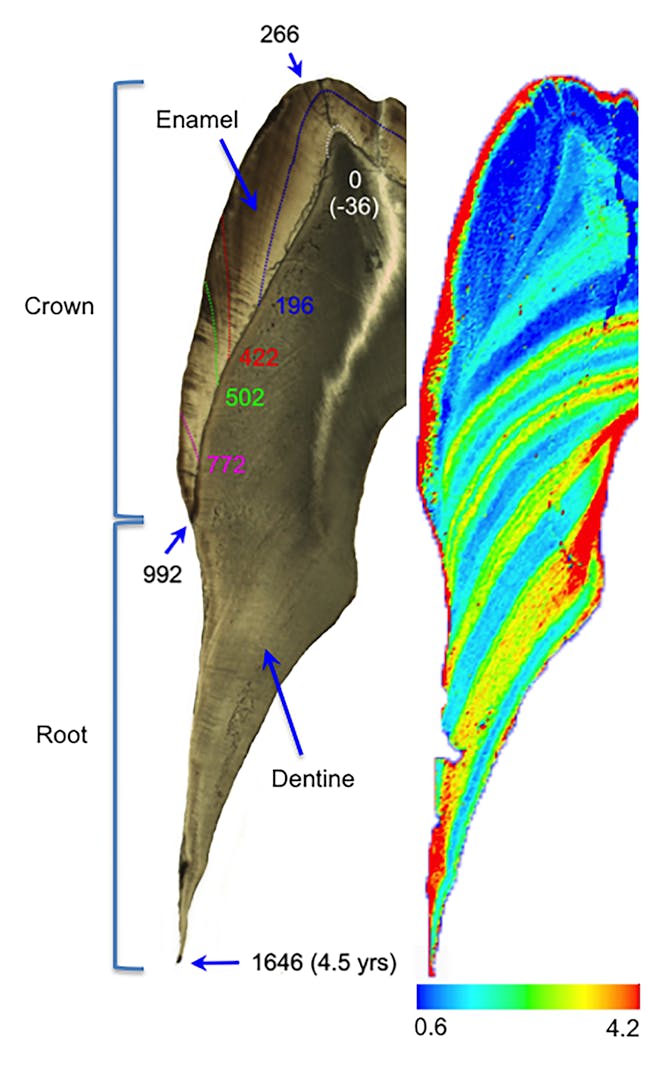 Light microscope image (left) of a wild orangutan molar contrasted with an elemental map of the same tooth (right) showing the distribution of barium. The timing of barium incorporation was determined from accentuated lines (in days of age on the left), which form during enamel and dentine secretion. Approximately annual bands of enriched barium are apparent in the dentine after the first year, likely due to seasonal increases in mother’s milk intake.
Smith et al. (2017) Science Advances
Light microscope image (left) of a wild orangutan molar contrasted with an elemental map of the same tooth (right) showing the distribution of barium. The timing of barium incorporation was determined from accentuated lines (in days of age on the left), which form during enamel and dentine secretion. Approximately annual bands of enriched barium are apparent in the dentine after the first year, likely due to seasonal increases in mother’s milk intake.
Smith et al. (2017) Science Advances
Hanging around
Another surprising finding is that nursing may continue for more than eight years, longer than any other wild animal.
This information is the first of its kind for wild Sumatran orangutans, as they have been especially difficult to study in their native habitat. Previous estimates from two wild Bornean orangutans suggested that juveniles nurse until about six to eight years of age.
Rather than spending so much time and energy breastfeeding their children, human mothers in traditional societies transition their infants onto soft weaning foods around six months of age, tapering them off milk a few years later.
Humans also benefit from having help such as older siblings and grandparents who lend a hand with childcare and enable women to energetically prepare for having their next child.
Orangutan mothers have it hard by comparison. They live alone in unpredictable environments with limited nutritional resources. In order to survive they use less energy than other great apes, raising their young more slowly.
 Wild orangutan mother and 11-month old infant.
Tim Laman, Author provided
Wild orangutan mother and 11-month old infant.
Tim Laman, Author provided
Vulnerable orangutans
Female orangutans begin reproducing around age 15 and can live until 50 years old in the most favourable of circumstances. They bear new offspring every six to nine years, producing no more than six or seven descendents over their lifetime.
Having a long nursing period and slow maturation makes orangutan populations especially vulnerable to environmental perturbations.
Recent work has also implicated poor habitat quality and the pet trade as additional factors in their rapidly declining numbers, which is underscored by their critically endangered status.
Research on collections housed in natural history museums provides timely evidence of how remarkable orangutans are, how much information we can retrieve from their teeth, and why conservation efforts informed by evolutionary biology are critical.
Authors: Tanya M. Smith, Associate Professor in the Australian Research Centre for Human Evolution, Griffith University


 Daily Bulletin


