

Armpits and melons: an olfactory reading of James Joyce
- Written by: Frances Devlin-Glass, Associate Professor, Literary Studies, Deakin University
Smell is the Cinderella of the senses in Anglophone literature. The Europeans do it differently from English writers. The Naturalists, with their anti-romantic, hyper realist commitment to scientific rigour, treated bodily smells with high seriousness.
One of their number, the French novelist, J-K Huysmans, wrote a famous essay (Le Gousset, 1874) comparing the natural armpit odours of blondes (“heady as sugared wines”), redheads (“sharp and fierce”) and raven-haired women (“audacious and fatiguing”), and had disparaging things to say about the odours of city women (“ammoniated valerian”, “prussic acid” and “chlorinated urine”), compared with their country kin (“wild duck” and “olives”). All this with a straight face.
James Joyce’s capturing of smell intensified in the course of his long writing career. Dubliners (1904-1914) barely registers smell – even the Misses Morkan’s Christmas feast in his celebrated short story “The Dead” is an aromatics-free zone, with the visuals dominating. Similarly in “Grace”, the collapsed inebriate’s bloody face after his fall is detailed. His stench is not. If the air is “musty” or “fragrant”, the notice is in passing, a decorative descriptive flourish while he concentrates on the conflicted mindscapes of his paralysed and self-contradicting Dubliners.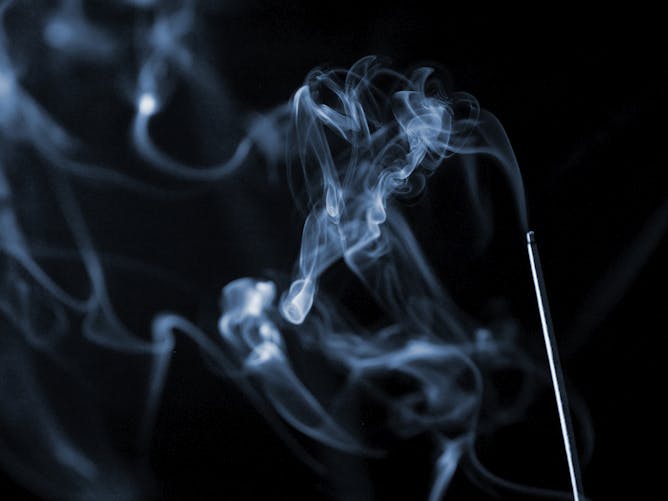 Scents can ignite memories.
BüniD/flickr, CC BY-NC-ND
Scents can ignite memories.
BüniD/flickr, CC BY-NC-ND
In A Portrait of the Artist as a Young Man (1916), smells become more insistent, but they tend to be highly conventional, and morally toned, or ignite memories. The religious zealot’s prayers rise up to God in wafts of “spikenard and myrrh and frankincense” while the hell Joyce creates to terrorise the sinner reeks of the sewer, offal and decaying corpses, itemised with comic hyperbole, as well as of more conventional smells - “sulfurous brimstone” and “pestilential odours”. Purity and defilement are the symbolic modus operandi.
There are hints in Portrait of the direction to be taken later in Ulysses (1922), when Stephen, in the spirit of mortifying his body, seeks out particularly disgusting smells. Lacking an “instinctive repugnance” to smells that repel others, he subjects his body to one that does revolt him: “a certain stale fishy stink like that of longstanding urine”. It is the experimental quality of this penitential programme that suggests a methodology that is systematically implemented in Ulysses, and subsequently abandoned in his dreamscape novel, Finnegans Wake (1939). Perhaps Joyce didn’t have olfactory dreams?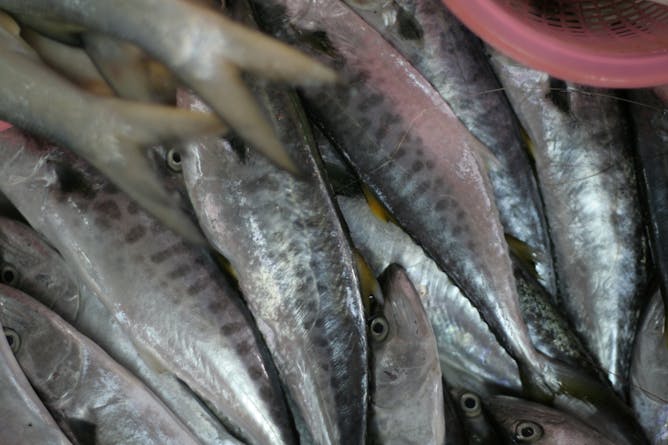 In Portrait of the Artist as a Young Man, the protagonist seeks out particularly disgusting smells.
lets.book/flickr, CC BY-NC-ND
In Portrait of the Artist as a Young Man, the protagonist seeks out particularly disgusting smells.
lets.book/flickr, CC BY-NC-ND
There is a palpable gear-change, however, in representing the olfactory in Ulysses (composed 1914-22). It is well known that the novel is encyclopaedic in design – a “book of the world”, as Marilyn French styles it. It is crammed with allusions to his literary rivals (the Bible, Homer, Dante, Shakespeare, Yeats, among many), to organs of the body, and their excretory functions (not one is omitted), to music from opera to street rhymes, and with real persons, streets, workplaces and Dublin marginalia.
Only two critics have noted its catalogue of smells, both detailed and implied. Still, a working database of smells in the book, compiled by Melbourne scriptwriters who were writing a play about Joyce and smell, runs to 41 pages. And the tenor of how Joyce deploys smells also undergoes a sea-change. His focus is steadily on the everyday smells of living – in a house, on the streets, or in a body, especially an eroticized one.
There are many reasons Joyce’s take on the ordinary, everyday smells of bodies was revolutionary in his day and is still so in ours. The iconoclast in Joyce by the time he was writing Ulysses presents odoriferous bodies matter-of-factly, to raise many questions, some quite philosophical in tendency.
Do rich bodies smell differently from poor ones? What is to be learned from one’s “toe-jam” about the continuity of life? And from one’s excrement about one’s well-being? Is man-smell different from woman-smell? Are women attractive to men olfactorily when menstruating? Do smells cling to black fabrics more than other kinds and why? Where do body odours come from – from ingested food, from nether parts, armpits or neck? Does one fall in love at first smell? Why do humans get pleasure from perfumes? Might they get pleasure from undeodorised bodily smells? Are they perhaps not very different from animals in the role smelling plays in erotic encounters? Can the nose sabotage the brain? How much impact does our nose have on our brain?
from www.shutterstock.com
How much impact does our nose have on our brain?
from www.shutterstock.com
In detailing the smells public and private of his world, Joyce takes on a newly emerging medical research machine – the sexologists of the decades abutting the turn of the 20th century. He certainly knew his Freud, and Jung treated Joyce’s daughter Lucia.
Joyce actively and transgressively has fun in Ulysses with the adjudicator of deviance, the German psychiatrist Richard von Krafft-Ebing and his catalogue of sexual deviance, Psychopathia Sexualis (1886), the raciest parts of which are written in Latin, to deter the non-medically trained.
He even more productively puts to good use the findings of the more liberal Havelock Ellis who devoted a lengthy chapter to smell in his multi-volume Studies in the Psychology of Sex (1897-1928).
But, being Joyce, his treatment of what these medical/psychological luminaries have to say about smell is joco-serious, and astonishingly prescient. He is curious about the perfume culture, and more radically about natural body odours, the impulse to disguise them, and their links to eroticism. He’s aware of the function of the aprocrine glands of the axillae in sexual arousal (and way ahead of the science in being so). He’s not bothered by the divide between human and animal, and does not fear to venture into the murky intersection of art and pornography, finding both moments of transcendence mingling with what is ridiculous in human behavior.
The smell journey in Ulysses is mainly its protagonist Leopold Bloom’s, and in the second half of “Nausicaa”, a chapter devoted to eye and nose, Joyce gives us Bloom trying to sort out what “mansmell” and “womansmell” might be, and where it comes from:
Tell you what it is. It’s like a fine veil or web they have all over the skin, fine like what do you call it gossamer and they’re always spinning it out of them, fine as anything, rainbow colours without knowing it. Clings to everything she takes off. Vamp of her stockings. Warm shoe, Stays. Drawers. …. Know her [Molly’s] smell in a thousand…. Bathwater too. …. wonder where it is really. There or the armpits or under the neck. Because you get it out of all holes and corners.
But Bloom’s wife Molly is also a connoisseur, if potty-tongued. She is deeply offended that her husband Leopold Bloom has not put barriers in the way of his rival, Blazes Boylan, and smell is a way to taunt her husband (like a hunting dog, she erroneously believes she can discern the perfume of another woman on his clothes). In detailing the smells - public and private - of his world, Joyce takes on a newly emerging medical research machine.
lilszeto/flickr, CC BY-ND
In detailing the smells - public and private - of his world, Joyce takes on a newly emerging medical research machine.
lilszeto/flickr, CC BY-ND
What Joyce does with smell at the height of Bloom’s epiphany at the end of Ch.17 (Ithaca) is nothing short of resignifying the most abject part of the anatomy and smell is the lure. Bloom, having gone through an inventory of his moral and legal options in relation to his wife’s adultery, enters the traduced marital bed fully conscious of his rival’s smells and traces of the picnic the adulterers had enjoyed in it, and is overwhelmed by the smell and cosmic shape of his wife’s posterior:
He kissed the plump mellow yellow smellow melons of her rump, on each plump melonous hemisphere, in their mellow yellow furrow, with obscure prolonged provocative melonsmellonous osculation.
Just as on the Hill of Howth, Bloom had fallen in love with Molly at first smell, Joyce makes it clear that in this moment, his limbic brain has sabotaged his thinking brain. Her “adipose anterior and posterior female hemispheres” undergo a metamorphosis, becoming heavenly:
islands of the blessed, the isles of Greece, the land of promise … redolent of milk and honey.
For some, this would be blasphemy. For Joyce, I would argue, it was to modernize and secularise the notion of the body, in all its moral frailty and compromises, as a temple.
Authors: Frances Devlin-Glass, Associate Professor, Literary Studies, Deakin University
Read more http://theconversation.com/armpits-and-melons-an-olfactory-reading-of-james-joyce-78832


 Daily Bulletin


