

How parenting advice assumes you're white and middle class
- Written by: Mark Nielsen, Associate Professor, School of Psychology, The University of Queensland
Whose advice do you trust when it comes to raising children? For many, the answer is to ask health professionals who can draw on years of experience, and who have access to, and can make sense of, research.
But our new study found the research basis of much of our parenting advice from health professionals is biased.
The advice is based mostly on studies conducted on children growing up in the US, with a large chunk of the rest carried out in other English-speaking countries. All up, these studies mainly represent research conducted in Western, educated, industrialised, rich and democratic countries.
This could mean the research, and the parenting advice based on it, might not apply to everyone who receives it.
What we did and what we found
We surveyed every study (in over 1,500 papers) appearing in three top-ranking developmental psychology journals from 2006 to 2010.
These journals publish studies about how children make sense of and interact with their world – how children feel, behave and develop psychologically as they grow.
It’s the type of research that becomes entrenched in textbooks and is translated into the knowledge used to advise parents on a wide range of topics. These range from how children acquire language, how they recognise the perspectives of others and develop friendships, through to understanding moral concepts.
More than half of the papers (57.65%) relied on research conducted with children growing up in the US, and another 18% only included children from other English-speaking backgrounds.
Fewer than 3% of study participants contributing to our contemporary knowledge of children’s psychological development came from all of Central and South America, Africa, Asia, the Middle East and Israel combined. These areas contain roughly 85% of the world’s population.
Though we didn’t report it in the paper, we also collated the participants’ reported socio-economic status. Most (80%) of papers reporting socio-economic detail said their participants came from middle- to high-socio-economic backgrounds.
Why might this be a problem?
This might not be a problem if you and your children are from the same background as the research participants. But what if you aren’t? Does it really matter?
Let’s take the example of understanding children of divorced parents. There is research suggesting adolescents have fewer psychological problems if their parents have joint custody rather than if they are solely in the care of one parent.
So joint custody might seem the way to go. However, all children in this study were from Sweden. Are children in Sweden similar enough to children in Australia to make this relevant? What if your children are growing up in Australia but you’re originally from Nigeria? Are the study findings still relevant?
The reality is we don’t actually know, as research involving different cultural groups is rare. This issue is particularly relevant in a multicultural Australia where Australians identify with more than 270 ancestries and one in four Australians was born overseas.
Critically, most Australians were not born in the US where most published child development research is conducted.
Further reading: Snowplow, helicopter – medieval? Parenting advice for the ages
Lack of cultural diversity in psychological research is not new. It’s an issue that’s been discussed among psychologists and the public.
What we revealed is there’s been little change in the cultural bias of study participants over time. For instance, we found little difference in the backgrounds of participants when we compared studies published in 2008 to those published in 2015.
This is not just a parenting issue
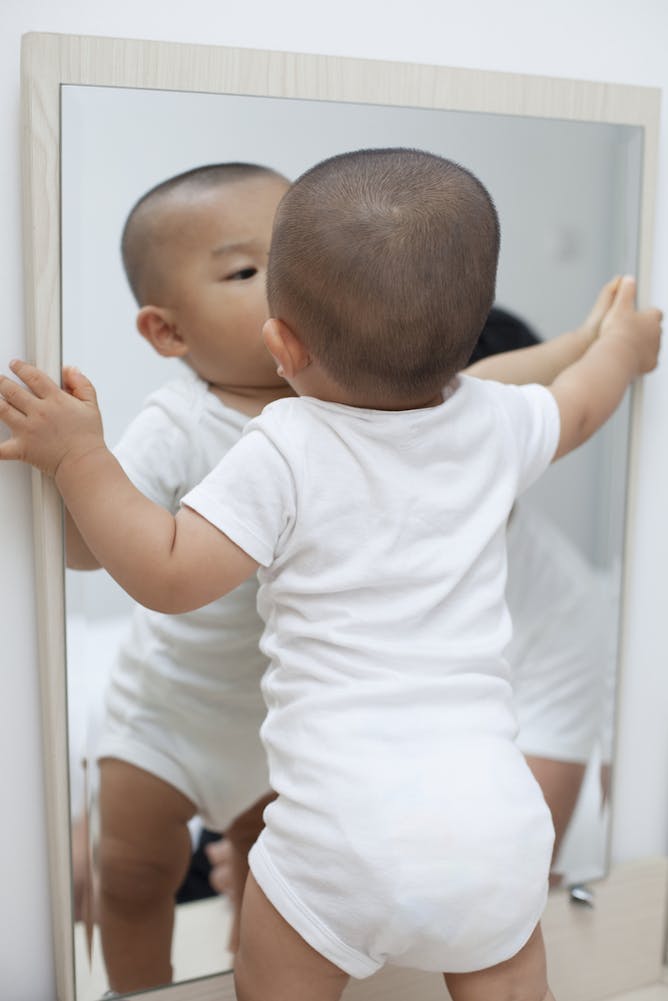 Expectations about when toddlers can recognise themselves in the mirror are based on Western children and that’s not always relevant.
from www.shutterstock.com
Expectations about when toddlers can recognise themselves in the mirror are based on Western children and that’s not always relevant.
from www.shutterstock.com
This is not just a problem for parents trying to work out how to best raise their children, but a broader issue for a science as we try to chart how the human mind works.
Typically, researchers will draw conclusions that are framed in general terms, using phrases like “children at X age will do Y in situation Z”, without mentioning the environment those children grow up in.
Researchers fail to acknowledge the findings might be different if the study were conducted with children in different circumstances.
For example, based on a standard test children from non-Western backgrounds do not recognise their mirror image as themselves before the end of their second year. But children in Western populations typically make this connection from around 18 months of age.
Yet when writing about Western children researchers typically state something like “at least by 24 months of age, toddlers … know what they look like”. But “toddlers” don’t, just mainly white, middle-class toddlers, from English-speaking families.
Further reading: What’s in a milestone? Understanding your child’s development
So, what we think we are discovering about the way all children develop may only apply to a small portion of the world’s population. We may know a whole lot less about the way children develop than we think we do.
How do you judge parenting advice?
Next time you find yourself in a position of seeking advice, giving advice or developing policy relating to children’s development based on sound research, be vigilant about where the research was conducted and the cultural origin of the study participants.
It might be wholly relevant. But it might not be.
We need to do a better job of encouraging researchers to broaden their sampling to better reflect the communities that might benefit from their research. And funding bodies must now prioritise research that draws upon broader samples of people.
Scientific journals need to advocate for studies that do not just include participants from Western, English-speaking backgrounds. And the public needs to be aware of where research is coming from and what it really tells them.
Only then will we move more assuredly towards a reliable science of the human mind that yields research we can apply to parents across the global community.
Authors: Mark Nielsen, Associate Professor, School of Psychology, The University of Queensland
Read more http://theconversation.com/how-parenting-advice-assumes-youre-white-and-middle-class-79333


 Daily Bulletin


