

Suburbs 'swamped' by Asians and Muslims? The data show a different story
- Written by: James Forrest, Associate Professor of Geography and Planning, Macquarie University
Population growth has profound impacts on Australian life, and sorting myths from facts can be difficult. This article is part of our series, Is Australia Full?, which aims to help inform a wide-ranging and often emotive debate.
In her maiden speech to federal parliament in 1996, Pauline Hanson claimed Australia was in danger of being “swamped by Asians”. At her re-election to the Senate on 2016, Hanson expanded her claim to also being “swamped by Muslims”. But is this factually correct?
Using data from the 2011 Census, we analysed the distribution of Asians and Muslims at four spatial scales (neighbourhood, suburb, district, and region) within Australia’s 11 largest urban areas. We found no evidence of any “swamping” by Muslims, or of ultra-segregation into “ghettos”.
There are concentrations of Asians, mainly in Sydney and Melbourne. But they are mostly neighbourhoods and suburbs where they form only a small minority of local populations.
The geography of Asians and Muslims
Asians form small minorities in about half of the more than 33,000 local neighbourhoods (average population of 430) across Australia’s 11 cities.
In another 40% of neighbourhoods, Asians comprise between 10% and 25% of local populations. In only 2% overall do they make up more than half the local population.
The geography of Muslims is very different, and much less segregated. They are a much smaller proportion of Australia’s 11 metropolitan and major urban areas. But they are almost entirely absent from many neighbourhoods and suburbs.
In only 82 of the 33,337 neighbourhoods and in just one suburb – all in Sydney and Melbourne – do Muslims constitute half the local population. This amounts to 0.025%.
In only four Sydney neighbourhoods and one in Melbourne (0.015% combined) is the Muslim population as high as 70%.
A figure of 70% or more is regarded in the international literature on Western cities as indicating a ghetto situation.
Which cities stand out?
So, one point stands out: local neighbourhoods where Asians and Muslims form a majority are almost entirely concentrated in Australia’s two major cities – Sydney and Melbourne. Brisbane and, less so, Perth also have very small pockets where Asians form half of neighbourhood populations.
In none of the other nine places is there even a single neighbourhood where Muslims form a majority of local neighbourhood populations.
In three of them – Newcastle, Geelong and Darwin – there are no neighbourhoods where Asians are a majority.
In Sydney, just under 8% of neighbourhoods contain one-quarter of the city’s Asian population. In Melbourne there are fewer Asian neighbourhoods, with 12% of the city’s Asian population.
The Sydney suburb of Hurstville, which Hanson has identified as somewhere “swamped by Asians”, has 63% of its population Asian. And nine other Sydney neighbourhoods are home to 13% of the city’s total Asian population.
But such a concentration is rare elsewhere. Melbourne has four districts (groups of suburbs) with Asian majorities.
 Asian populations in Sydney, 2011.
Australian Geographer/James Forrest, Ron Johnston, Frank Siciliano, David Manley, Kelvyn Jones, Author provided (No reuse)
Asian populations in Sydney, 2011.
Australian Geographer/James Forrest, Ron Johnston, Frank Siciliano, David Manley, Kelvyn Jones, Author provided (No reuse)
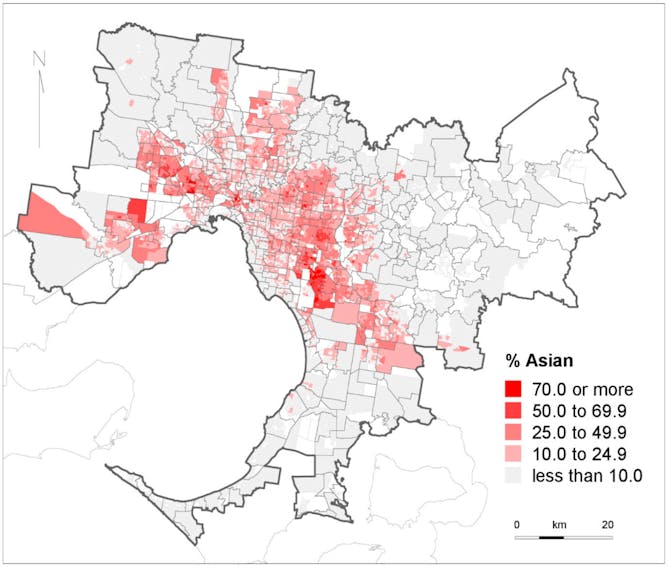 Asian populations in Melbourne, 2011.
Australian Geographer/James Forrest, Ron Johnston, Frank Siciliano, David Manley, Kelvyn Jones, Author provided (No reuse)
Asian populations in Melbourne, 2011.
Australian Geographer/James Forrest, Ron Johnston, Frank Siciliano, David Manley, Kelvyn Jones, Author provided (No reuse)
Sydney and Melbourne also have the largest Muslim populations. But few are concentrated in areas – even at the smallest, neighbourhood level, where they form as much as half of local populations.
In only one suburb, Sydney’s Lakemba, is more than half the population Muslim (predominantly Lebanese). But even in a suburb like Lakemba, these concentrations are scattered across different neighbourhoods.
 Muslim populations in Sydney, 2011.
Australian Geographer/James Forrest, Ron Johnston, Frank Siciliano, David Manley, Kelvyn Jones, Author provided (No reuse)
Muslim populations in Sydney, 2011.
Australian Geographer/James Forrest, Ron Johnston, Frank Siciliano, David Manley, Kelvyn Jones, Author provided (No reuse)
 Muslim populations in Melbourne, 2011.
Australian Geographer/James Forrest, Ron Johnston, Frank Siciliano, David Manley, Kelvyn Jones, Author provided (No reuse)
Muslim populations in Melbourne, 2011.
Australian Geographer/James Forrest, Ron Johnston, Frank Siciliano, David Manley, Kelvyn Jones, Author provided (No reuse)
Why the moral panic?
Polish sociologist Zygmunt Bauman argued that populist political parties like One Nation promote their causes by creating “moral panics”, or fears of:
… some evil [that] threatens the wellbeing of society.
In this situation, multiculturalism is presented as creating such fears where many of the immigrants are seen as “strangers”, culturally different from everybody else.
For some, known as “mixophiles”, the presence of such strangers in their midst is a positive aspect of city life. But not so among “mixophobes”, whom Bauman saw as concentrated among those who:
… lack the capacity to cut themselves off from [what they see as] … all too often unfriendly, distrustful and hostile urban environments.
This latter situation provides “highly fertile and nourishing meadows tempting many a political vote-gatherer to graze on them”. This, Bauman argues, is an opportunity:
… a growing number of politicians [not to mention certain media elements] would be loath to miss.
Authors: James Forrest, Associate Professor of Geography and Planning, Macquarie University


 Daily Bulletin


