

How we change the organisms that infect us
- Written by: Ian Mackay, The University of Queensland
This is part of our four-part package looking at infectious diseases and how they’ve influenced our culture and evolution. Read the other articles here.
Humans play host to many little passengers. Right now, you’re incubating, shedding or have already been colonised by viral, bacterial, parasitic or fungal microorganisms - perhaps all of them! Are you sick? Maybe, maybe not.
That’s partly because you have effective natural weapons and barriers that obliterate or keep your microscopic passengers contained. These immunological defences maintain a balance between us being a host and being healthy, but microorganisms are expert at confusing or escaping our cells’ defences.
Life and death at the speed of viruses
Humans can live for 80 years and may produce two offspring. Compare that to the influenza virus. A virus-infected host cell can produce a thousand new particles every replication-cycle which spans hours. Viruses replicate rapidly and adapt constantly; all without any grand plan.
The replication of different viruses is affected by many factors and forces, all fine-tuned through genetic change. Random mistakes, or mutations, are thrown up during each viral replication cycle and while mostly unhelpful, sometimes they are beneficial.
A new virus with a mutation that protects it from a drug or immune defence may become the dominant (most common) virus of the thousands of newly replicated viruses in the host. These are the better adapted viruses, and are most likely to be transmitted to other people.
Humans increase the chance new viruses will emerge in us by simply being in the right place at the right time. We do this by travelling into once isolated forests, expanding our desire for exotic tastes and flavours, trading in live animals, through cultural practices that expose us to rare pathogens, and by incompletely or incorrectly treating infections.
How viruses are forced to adapt to their hosts
For an avian influenza or “bird flu” virus to become a pandemic human threat, it needs to become better at infecting and spreading from the new human host. After a human is infected by a bird virus, the virus comes under pressure from the human’s immune response, which is hell-bent on destroying it.
Each new generation of viruses contains more of those variants that have adapted best to attach to and enter human cells.
New mutant viruses that get passed on most effectively are those that also replicate in the upper respiratory tract, because they can most easily infect new people through coughing and sneezing.
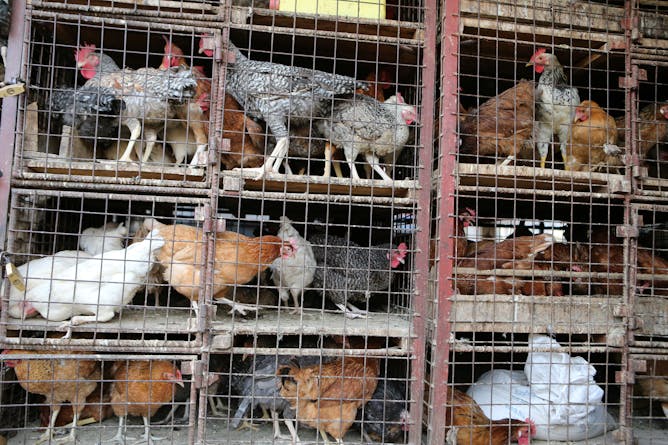 Viruses need to be adaptable to be able to infect different hosts - such as birds and humans.
James Akena/Reuterspics
Viruses need to be adaptable to be able to infect different hosts - such as birds and humans.
James Akena/Reuterspics
The severe acute respiratory syndrome coronavirus (SARS-CoV) is no longer detected in humans but from 2002 to 2004 it spread among us, probably having spilled over from bat-infected civet cats.
SARS-CoV gained abilities to infect and better transmit between humans and this virus caused severe human disease. But these new abilities still weren’t enough for this event to become sustained human-to-human transmission. Influenza viruses have regularly achieved such a stable place among humans.
How bacteria cope with the pressure
Unlike most viral infections, for which we have no effective treatments, bacterial infections can be treated with antibiotics. But humans have grown complacent, overusing antibiotics and prescribing them to inappropriately treat viral infections or improve animal growth.
Because of us, champion bacteria have appeared that have evolved antibiotic resistance by mutating and swapping genetic elements, allowing them to avoid the effects of antibiotics and to thrive in their new environments.
The bacteria that cause tuberculosis have followed this path, as have those that cause gonorrhoea. Entire classes of once useful antibiotics are failing as more super-resistant bacteria emerge.
Parasites duck and weave our killer cells
Parasites have evolved alongside humans and developed a balance between our body’s ability to remove them and the damage they do to us as they multiply and pass to new hosts.
The malarial parasite, Plasmodium, grows and hides in our red blood cells. Once our immune cells identify the intruder, this microorganism can suddenly change to avoid detection. Our bodies then must start work all over again to distinguish the foreign bits from our own cells.
But it’s not all bad
Not all our tiny passengers are harmful. The human microbiome comprises all the microorganisms in and on our body. Our gut microbiome includes many types of bacteria that maintain a biological balance. But when the balance is tipped, the upset has been linked to changes in sleep, mood, immunity and the development of chronic disease.
Similar balance exists on the skin, in the airways and in the reproductive tract. We can upset this balance when antibiotic treatment targeting one species of bacteria leads to increased growth of another, and may also inadvertently deplete helpful bacteria.
Many tiny passengers have evolved the abilities to grow and spread, using us as hosts. These microorganisms keep thriving because they have adapted to work around our conscious and unconscious attempts to contain or destroy them. But microorganisms can also be helpful to us in ways we’ve yet to fully understand or harness.
Read the first two instalments in the series:
Four of the most lethal infectious diseases of our time and how we’re overcoming them
Authors: Ian Mackay, The University of Queensland
Read more http://theconversation.com/how-we-change-the-organisms-that-infect-us-74625


 Daily Bulletin


