

Latest research shows surgery for early stage prostate cancer doesn't save lives
- Written by: Ian Haines, Adjunct Clinical Associate Professor, AMREP Department of Medicine, Alfred Hospital, Melbourne & Senior Medical Oncologist and Palliative Care Physician, Melbourne Oncology Group, Cabrini Haematology and Oncology Centre, Wattletree Road, M
From the 1980s, when prostate screening became available, many men over 40 were diagnosed with early stage prostate cancer even though they may not have had any symptoms. The word cancer understandably strikes fear into the hearts of many, and most would assume the best course of action would be to have the cancer removed, whatever the side effects may be.
But impotence and incontinence are no small side effects, especially when you consider, as two new studies have done, removing the cancer isn’t necessarily the best option, and the cancer may not in fact require treatment at all.
Most prostate cancers take decades to exit the prostate, and most men will usually die with, but not from, prostate cancer. Autopsy studies reveal prostate cancer in up to 40% of men in their forties and 65% in their sixties, but a much smaller figure of 3-4% of Australian men actually die of prostate cancer at a median age of 82.
Two recent clinical trials undermine the categorisation of prostate cancer as a death sentence. They are unambiguous in their findings and seismic in their implications. Both found men with early stage abnormalities of the prostate who do not undergo surgery or radiation treatment, but whose condition is monitored for any progression of the cancer, live just as long as men who opted for complete removal of the prostate and now live with its immediate consequences, including incontinence, intimacy issues, bowel problems and intervention regret.
The hard evidence
In a UK trial, three groups of men were assigned to either surgical removal of the prostate (553 men), radiation treatment (545 men) or active monitoring (545 men). After ten years, the total number of deaths due to any cause was 55, 55 and 59, respectively in each group.
Thus 90% of men were still alive after ten years, including those who did not receive any radical intervention. Although surgery delayed the development of metastases (or secondary cancers) in a small number of men, the number of deaths definitively attributable to prostate cancer in each of the groups was low, only three, four and seven deaths respectively. So the odds of dying specifically from prostate cancer in the first ten years is of the order of 1%.
In a second study from the US published last week, two groups of men were assigned to either surgical removal of the prostate (364 men) or active monitoring (367 men). After nearly 20 years of follow up, the number of deaths due to any cause was 223 and 245 respectively in each group. So once again nearly the same number of men in each group were still alive after 20 years.
Surgery did not prevent death any more than active monitoring. Strikingly, the number of deaths definitively attributable to prostate cancer in the two groups was only 18 and 22 respectively. This means the odds of dying specifically from prostate cancer in the first 20 years after a cancer diagnosis from a prostate-specific antigen (PSA) test was about 5% for the surgical group and 6% for the active monitoring group.
The survival from prostate cancer is so high it’s not a question of deciding which treatment is best, but whether any early radical treatment is required at all. The current position has been clearly articulated by the Chief Medical Officer of the American Cancer Society Dr Otis Brawley, an expert on prostate cancer screening. He points out aggressive PSA screening and treatment has resulted in more than one million American men undergoing needless treatment.
This is not to mention that patients who have undergone surgery are four times more likely to require absorbent pads for incontinence and three times more likely to have erectile dysfunction. These are not issues that are routinely highlighted.
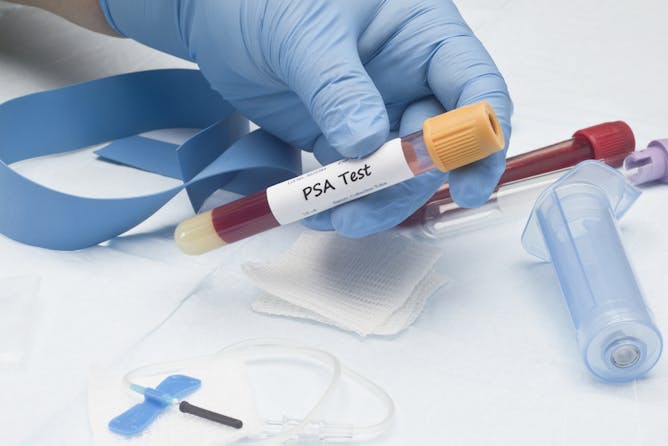 Experts have condemned screening for prompting unnecessary interventions.
from www.shutterstock.com
Experts have condemned screening for prompting unnecessary interventions.
from www.shutterstock.com
The future
The latest DNA research has had minimal impact on how to tell whether an early stage prostate cancer will grow slowly or whether it will become aggressive and spread outside the prostate, and lead to death. The current evidence is the future behaviour of any cancer is determined very early, and diagnosing it early and actively monitoring its progress will have no effect on the outcome.
The key problem in searching for genetic and DNA based markers is that most pre-clinical studies focus on human prostate cancer cells in dishes, or in mice. This is far removed from cells growing in a patient. Mice are not small humans and their prostates, hormonal balances, diet and genetics are quite different from our own.
Similarly, while MRI scanning means we can find sites in a prostate gland that are abnormal, we can’t yet distinguish between the potentially dangerous and the indolent cell populations. More research is needed to develop better screening techniques.
The current implications
For the moment, the first step must be to educate doctors so they can provide full disclosure to any patient of the results of these two trials. The second step is that in speaking to their own doctors about possible treatment options, patients should be active in asking them about the most up-to-date evidence. Surgery is a big step to take for any condition.
Similar to countless past treatments which the evidence has made redundant – such as lobotomy for mental illness and stomach surgery for ulcers – it’s now clear radical surgery removing the prostate should not be the go-to option.
I’m pleased to acknowledge my trusted scientific colleague George L Gabor Miklos, Founder of Atomic Oncology, for his invaluable advice and input.
Authors: Ian Haines, Adjunct Clinical Associate Professor, AMREP Department of Medicine, Alfred Hospital, Melbourne & Senior Medical Oncologist and Palliative Care Physician, Melbourne Oncology Group, Cabrini Haematology and Oncology Centre, Wattletree Road, Malvern, Monash University


 Daily Bulletin


