

Blood tests and diagnosing illness: what can blood tell us about what's happening in our body?
- Written by: Karen Dwyer, Deputy Head, School of Medicine, Deakin University
This week we’re running a series in collaboration with the Australian Red Cross Blood Service looking at blood: what it actually does, why we need it, and what happens when something goes wrong. Read other articles in the series here.
Doctors have continually sought better ways of determining what is wrong with a patient. When you visit a GP’s office or emergency department with an unknown illness, a doctor will commonly draw some blood to gain a better idea of what’s going on inside your body. Blood is perhaps the most important window through which we can peer into a person’s health or illness.
About 7% of our body weight is our blood, and our heart spits out about five litres of blood every minute. Oxygenated blood leaves the left side of the heart via the aorta and the arteries - which permeate every tissue in the body - and returns to the right side of the heart via the veins. From the right side of the heart, blood is pumped into the lungs where it is oxygenated, returning to the left side of the heart.
In about two tablespoons of blood there’s a lot we can tell about our health.
What blood can tell us
When someone presents at an emergency department, the initial panel of tests will include a full blood count. This details the red blood cell count, white blood cell count and platelets; electrolytes (the substance in our blood that carries an electric charge that is vital for life) to measure kidney function; liver function tests and “C-reactive protein” which can tell us if there is inflammation somewhere in the body.
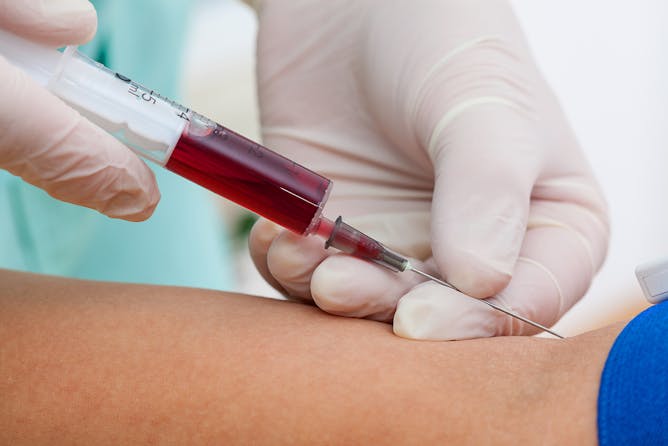 Our blood can tell us how many of our organs are functioning.
from www.shutterstock.com
Our blood can tell us how many of our organs are functioning.
from www.shutterstock.com
From these tests we can determine things like the presence of anaemia (low red blood cells from various causes), infection, kidney failure and liver disease. Often the results of these tests will trigger further testing. For example, the presence of anaemia will usually lead to testing for iron deficiency, possibly vitamin B12 and folate, screening for haemolysis (destruction of red blood cells) and a measure of how well the bone marrow, which makes red blood cells, is responding.
If infection is suspected, blood will be drawn and transferred into a bottle that enables bacteria to grow. Bacteria in the blood is called septicaemia. The identification of the bacteria responsible significantly helps in the management, meaning the right antibiotics can be delivered to the patient.
Bruising or excessive bleeding will prompt assessment of platelets and clotting. Platelets are the first responders to injury, and if they are low or not functioning properly, they will allow bleeding to proceed unchecked. To tell if blood is clotting normally we need an additional teaspoon of blood. These clotting factors are synthesised in the liver, so they can also give us a warning about liver disease.
As a kidney specialist, my personal favourite are the electrolytes. Together with a urine test, blood electrolytes can measure someone’s kidney disease from stage one through to five. As kidney function declines, potassium levels increase in the blood and can reach dangerous levels. A high potassium count can cause a potentially fatal heart arrhythmia.
Liver function tests provide information on what the liver is producing and excreting - abnormalities of liver function could mean gall stones or hepatitis. Viral causes of hepatitis, such as Hepatitis B and C, can quickly be checked in the blood. We can also find out how recently the infection was acquired and whether chronic infection persists.
Cardiac enzymes in the blood tell us if a patient has had a heart attack. The enzymes are proteins released from damaged heart muscle, so the higher the level, the greater the damage to the heart.
 Blood is an incredible window into the workings of the human body.
Blood on Silk / Buy Sell by Fiona Davies (AUS) Courtesy of the artist as part of Science Gallery Melbourne’s BLOOD exhibition
Blood is an incredible window into the workings of the human body.
Blood on Silk / Buy Sell by Fiona Davies (AUS) Courtesy of the artist as part of Science Gallery Melbourne’s BLOOD exhibition
What can’t blood tell us?
The repertoire of blood tests available to the treating doctor is vast. Other blood tests include screening for autoimmune disease, monitoring the response of cancers to treatment with tumour markers, assessing reproductive function, screening for genetic disorders during pregnancy and diagnosing pregnancy itself.
Despite this, sometimes a diagnosis remains elusive – frustrating for the patient and doctor alike. Neurological disease such as stroke, motor neurone disease, Alzheimer’s and multiple sclerosis aren’t diagnosable from blood tests. Similarly, the diagnoses of depression, schizophrenia, ADHD and autism lack a specific blood diagnostic marker.
The huge array of blood tests available to the clinician aid in a rapid diagnosis in many instances. But the choice and the interpretation of the test needs to be considered in light of the patient and their presenting symptoms. As the old adage in medicine says: treat the person and not the numbers.
Read other articles in the series:
Essays on blood: why do we actually have it?
From animal experiments to saving lives: a history of blood transfusions
Explainer: what’s actually in our blood?
Blood groups beyond A, B and O: what are they and do they matter?
What can go wrong in the blood? A brief overview of bleeding, clotting and cancer
Authors: Karen Dwyer, Deputy Head, School of Medicine, Deakin University


 Daily Bulletin


