

We’ve got to stop meeting like this
- Written by: Marc Hudson, PhD Candidate, Sustainable Consumption Institute, University of Manchester
The Arctic is melting, the Antarctic slowly cracking up. Even 1.5℃ of warming will mean serious problems for Australia, and that target has probably already been blown. I think it’s really important, therefore that we talk about… meetings.
Yeah, I know. As the humorist Dave Barry has quipped, “meetings are an addictive, highly self-indulgent activity that corporations and other large organisations habitually engage in only because they cannot actually masturbate,” while Oscar Wilde had little doubt that they were a waste of time. But bear with me on this.
Pretty much any article on climate change ends with an exhortation that governments and corporations must behave differently, and that social movements must force them to do so. But as the former coal executive turned climate author Ian Dunlop recently asked: “What is to be done if our leaders are incapable of rising to the task?”
Social movements have traditionally been a laboratory, a pathfinder for new ways of doing things. Recycling, for instance, sprang from citizens’ efforts. But how can social movements exert pressure and set an example to be followed, if they do not grow in size and skill? And how are they to grow in size and skill if they do not retain more of the people who come to meetings, rallies and marches?
To me, that is the key question that often goes unanswered in the regular parade of “what is to be done” articles. The growth of social movements in response to crisis is taken as a given, or a trifling matter. But surely if the past ten years of climate politics have shown us anything it is that there is no linear relationship between scientists’ alarm and the number of people who are willing and able get involved in creating political pressure.
Which brings us to meetings.
Organisers of events may not realise it, but it’s quite a big deal for someone to make time to go to a meeting, especially one in the evening. We have children to look after (well, not me), as well as jobs, commitments, interests, hobbies. Besides, walking into a room full of strangers can sometimes be intimidating.
And yet so many of the meetings I have been to in Australia and the UK are intensely alienating to a newcomer. You turn up and are often ignored while people who know each other cluster in groups. You are usually invited to sit in rows (although circles are not automatically better). The speaker speaks (often overrunning) and then the question-and-answer session is dominated by confident and/or doctrinaire people who typically give speeches rather than ask questions, so as to show off how informed they already are.
The energy gradually leaks out of the room, and at the end the new faces drift out, most likely never to be seen again. They have become what I call “ego-fodder” for the organisers and dominant types. Rather than being true participants, they are extras in the background. These are meetings where you don’t meet anyone.
From cannon-fodder to ego-fodder.This is the standard “information deficit model” style of meeting. It is a tragic waste of potential, and the question organisers have to ask themselves is – if our current methods of movement-building are fit for purpose, where is the resulting movement? We seem capable of mobilising people for two or three years, and then becoming demobilised either by success or, more recently, by failure.
What is to be done?
It doesn’t have to be this way. But to change, we need to invent some new rituals, new “institutions” (which is what academics call the rules – formal and informal – by which society reproduces itself).
For one thing, organisers could think about how they will welcome new people (without being too culty). Are name badges good or bad? Could you have your most personable old hand standing under a sign saying “Unsure what’s going on? New? Talk to me if you like.”
Perhaps the chair could invite people to turn to the person next to them, say hello, and spend two minutes finding out why they came to the meeting. Could you find funny ways of keeping the speaker to time (like the “clap clinic” – see below).
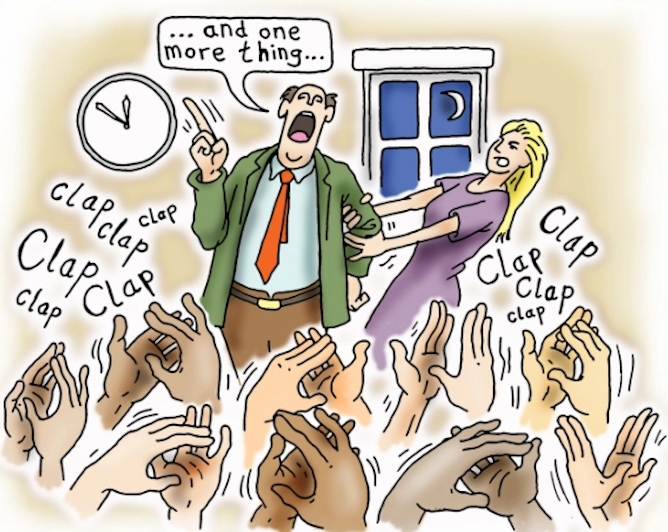 The clap clinic: if the evening’s guest speaker reaches the end of their time slot but won’t stop, just start loudly applauding anyway.
Hudson and Roberts, Author provided
The clap clinic: if the evening’s guest speaker reaches the end of their time slot but won’t stop, just start loudly applauding anyway.
Hudson and Roberts, Author provided
Questioning the Q&A
“Wonderful presentation from our guest speaker. Now, any questions?” says the chair of the meeting, usually about 15 minutes later than they should have. Up shoot some hands. Those who’ve been to more than one or two meetings know what to expect next: prepared “questions” that are thinly-or-not-at-all-disguised speeches and hectoring points. These “questions” are asked by the usual suspects, who are typically male.
As the clock runs out (and people drift out), a few female hands tentatively go up. Their owners have realised that their question – the one they’d told themselves wasn’t up to scratch – is actually better than what’s gone before. But alas, it’s too late; only one or two get asked, and dealt with too quickly. The meeting finishes, and with it the opportunity for something different.
Instead we could have the chair say something like this:
Right. Let’s all turn to someone nearby you – ideally someone you don’t know. Introduce yourself and exchange impressions of the speech. If you have a question you are wondering whether to ask, find out if the other person thinks it’s a good ‘un. With their help, refine it, hone it and – please – for everyone’s sake, make it shorter. Women especially, your questions are just as good and welcome as men’s. You have two minutes…_
Measuring success is crucial. The current metric seems to be how many people came, how happy was the invited guest speaker about how long they got to talk for, rather than how many connections were facilitated, how many people were inspired to lend a shoulder to the grindstone. In my opinion we need to be able to treat this as a marathon, not a sprint.
That means keeping people engaged, not for a week or a month or a march, but in the long term. That means groups of people that grow, learn, organise and win, are aware of the skills and knowledge and relationships of individual members, and have habits in place to help each of those people to learn skills, share knowledge, and grow relationships.
In the next column I’ll explore how we might get to know each other’s strengths, weaknesses and hopes for the future, and do what academics call “asset mapping” without destroying everyone’s will to live.
For now, readers: What are your positive and negative experiences of attending meetings? What has “worked” to involve you in the activities of a group? What has kept you involved? What un-recruited you?
Authors: Marc Hudson, PhD Candidate, Sustainable Consumption Institute, University of Manchester
Read more http://theconversation.com/weve-got-to-stop-meeting-like-this-81615


 Daily Bulletin


