

Pace of renewable energy shift leaves city planners struggling to keep up
- Written by: Tony Matthews, Lecturer in Urban & Environmental Planning, Griffith University
Renewable energy is driving profound changes in cities. It’s happening much more quickly than was expected even five years ago. Responding to climate change, networks of decision-makers, such as the C40 collective of major cities, have begun adopting strategies to promote the uptake of renewable energy. Yet land use planning has seemingly begun to lag behind.
As an example, few, if any, planning codes in Australia prevent overshadowing of rooftop solar systems (photovoltaic and hot water). Instead, disputes are being decided in the courts.
Effective guidance on the retrofitting and redesign of built environment energy systems must occur across scales, from rooftops to wider electricity grids. We need reliable institutional and policy guidelines to improve investment certainty and limit negative outcomes.
So what is the role of planning? What challenges and actions must planners consider for the renewable energy transition to be effective?
Renewable are proliferating
Historically, cities have been built on fossil fuels. These power buildings, lighting, transport, air conditioning, water supply systems, sewage treatment and more.
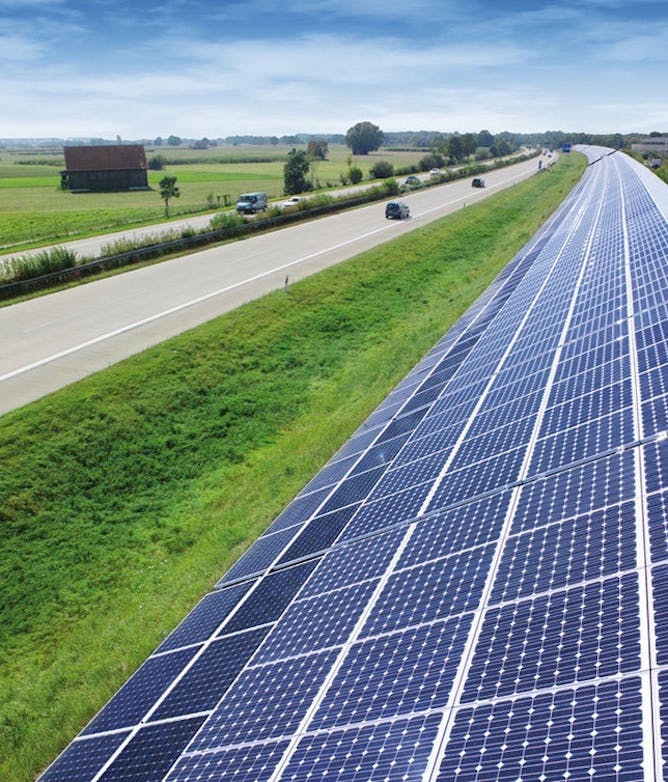 A roadside PV solar farm in Germany with 338kWp of installed capacity doubles as a sound barrier.
Isofoton.es/Wikimedia, CC BY
A roadside PV solar farm in Germany with 338kWp of installed capacity doubles as a sound barrier.
Isofoton.es/Wikimedia, CC BY
Technological change and concerns about climate change threats, energy security, air pollution reduction and fossil fuel power costs have recently driven huge advancements in renewable energy options for cities. As renewables rapidly gain market traction, the costs are falling dramatically relative to fossil fuel options.
Many different types of renewable energy have the potential to radically transform built environments. These include solar (both photovoltaic and molten salt), wind, tidal, biogas, biofuel, pumped hydro and potentially even nuclear fusion – though the latter may still be some time away.
At present, this technological growth appears to be outpacing land-use planning systems, and many planners seem to be fighting a rear-guard action.
What role can planners play?
Traditionally, planners have assessed the acceptability, or otherwise, of different types of development. Land uses that were deemed incompatible were separated into different zones.
Infrastructural and technological provisions associated with developments are usually strategically planned in advance. Site-specific issues are then assessed through development approval processes.
There are, however, still relatively few land use planning policies and guidelines for engaging effectively with renewable energy. This is a global problem, though some jurisdictions are ahead of others.
A front-runner is the UK, where the Department for Communities and Local Government issued planning practice guidance for renewable and low-carbon energy in 2013. This was a welcome early response. And perhaps surprising, given the comparative lack of sunlight in the UK.
Conversely, Ireland still lacks a strategic plan for solar farm development. This seems remiss given Ireland has an almost identical planning system and roughly the same amount of sunlight as the UK.
In sunnier Australia, the signs are that things are beginning to change. For example, the New South Wales government recently issued guidelines on the approval of solar and wind farms. Queensland has a wind farm state code and guidelines. The City of Melbourne now provides planning guidance for solar energy.
California is forging ahead with solar leasing and is experimenting with mandatory solar for new buildings. The state is also making strides in wind energy.
How should planning systems adapt?
We urgently need more renewable-friendly planning systems to capture its potential benefits and avoid overshooting the 2°C target for global warming. This will mean finding ways to “fast-track” energy generation deemed to be low risk with manageable impacts.
As well as developing practical guidance, planners need to ask some key questions. Are these technologies safe? Might they disrupt other land uses? Does large-scale uptake potentially have unintended consequences?
An easy win for planners is to devise codes and planning scheme provisions to protect rooftop solar installations from overshadowing. Rooftop solar is becoming an integral part of the energy mix in many areas, with surplus production often feeding back into the grid.
A failure of planning to manage a simple issue like overshadowing will result in a loss of potential electricity production, with negative implications for householders and grids.
Medium-scale commercial solar PV farms, providing 1-10MW generating capacity, are likely soon to be a common feature of many suburbs and communities. However, these facilities can present challenges when placed in urban areas. Again, clear planning guidance is needed.
The planning implications of these solar PV farms are only beginning to be understood. The issues include, but are not limited to, site selection, (re)zoning, stakeholder engagement, visual impact minimisation and mediating social, economic and/or ecological constraints.
 Suburbs could increasingly be home to medium-scale solar farms like this.
Grand Canyon NPS/flickr, CC BY
Suburbs could increasingly be home to medium-scale solar farms like this.
Grand Canyon NPS/flickr, CC BY
Even as planners begin to engage with the issues of current renewable technologies, newer technologies are quickly encroaching. This adds to the urgency of the planning challenges; constant reappraisal is needed.
Where to next?
Soon we will likely have to better consider emerging technologies such as solar windows, integrated solar roofs, backyard biogas generators and even algae biofuel farming.
For example, could using backyard waste-to-biogas systems create issues with hygiene and infectious disease? What about maintenance? Will microgrids, which can help transitions to a grid with significant volumes of renewable energy, be able to handle demand?
We’ll need effective land use planning to answer these questions and many more. In times of intense transformation, planners will have to provide clear guidance. They must not let themselves fall behind the pace of urban energy transitions.
Authors: Tony Matthews, Lecturer in Urban & Environmental Planning, Griffith University


 Daily Bulletin


