

On brand: how Australia's apartment frenzy echoes the 1870s cattle boom
- Written by: Stephen Banham, Lecturer in Typography, RMIT University
Imagine in the years ahead that you were to come across a photograph of the Melbourne streetscape from 2017. Two things would immediately signify it as being from today – the number of cranes across the skyline and at street level, the construction hoardings glistening with glamourous promise.
Melbourne is now experiencing the most dramatic real estate boom in living history – this feverish development has seen 13,000 new apartments constructed each year for the past two years with plans for another 22,000 over the next few years.
And like that photograph of the 2017 streetscape, one can also take another kind of record, a typographic snapshot. Fonts can tell us something about a time and a place. Within the real estate industry, this is centred around branding – and more specifically those ubiquitous logos weaved throughout our urban landscape.
In an age when each individual building demands a logo as much as an address, and often these congeal (8 Breese, 85 Spring Street) or fill us with an aspiration to be somewhere else (West Village, Haus), the end result is a seemingly never-ending array of marks all jostling to dazzle us with their glamour and aspiration. But is this massive explosion of logos a new thing?
The clearest way to see any of these connections is to look across other periods of economic boom. The oversupply of livestock in the 1870s is one such time. During this period the plentiful supply of cattle necessitated that the ownership of herds be strongly signified and differentiated in the marketplace. At that time the most effective way to do this was through branding – quite literally, a hot iron branded seared into the rumps of the livestock.
 Cattle branding, 1864.
S. T. G./State Library of Victoria
Cattle branding, 1864.
S. T. G./State Library of Victoria
By the latter half of the 19th century the simpler alphabetical brands had all been used up so the designs became increasingly complex and idiosyncratic. These plentiful livestock brands began to do odd things – letters would be turned upside down or flipped, there would be strange little icons of hats, anchors, fish, shields, glasses and other even more abstract shapes.
When placed alongside the embellished brands extolling the contemporary real estate boom, some strong design similarities become clear. It seems that the imperative to produce a distinct identity seems to bridge 140 years with ease. These design similarities hint at the underlying economic cycle, boom followed by bust.
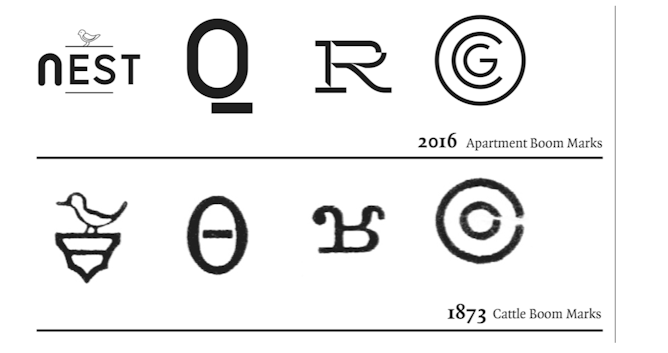 The top line are real estate brands from 2016 whilst the bottom line are cattle brands from 1870. Apartment brands from left to right: Nest at the Hill (Doncaster); Queens Place (CBD); Reflections (North Melbourne); Capital Grand (South Yarra)
Author provided
The top line are real estate brands from 2016 whilst the bottom line are cattle brands from 1870. Apartment brands from left to right: Nest at the Hill (Doncaster); Queens Place (CBD); Reflections (North Melbourne); Capital Grand (South Yarra)
Author provided
The logos that festoon the hoardings across our streets tell us a great deal about who we are, and more specifically, what we want. Script typefaces (those based on handwriting) tell us that we are in an age where people yearn for the authentic, the handmade, a personal connection. The use of fonts, patterns and symbols as well as specific colours may offer us an insight into what cultural shorthand is being used to speak to many prospective buyers.
It is that supreme marker of modernity – sans serif fonts - that above all others expresses our shared contemporary notions of style and urbane aspiration. These fonts, such as “helvetica”, do not use the ornamental ends of letters that serif fonts, like the one you are reading on, include. We take in and process all of these factors in the split second that we consume a logo.
Logos, and the typefaces from which they are composed, have always spoken of the times we live in – including the reflection of economic and social patterns. The mechanised efficiencies of the early 20th century were met by a geometric simplicity in letterforms, whilst the 1970s sexual revolution coincidentally saw spacing between letterforms become very intimate, coupled as it was with the advent of phototypesetting, a process soon superseded by computers.
Booms have a habit of producing an oversupply. And this oversupply calls for some kind of unique differentiation. Differentiation calls for creativity. This is where branding comes in. Trying to tell a herd of cows apart in the 1870s is perhaps no easier than trying to differentiate the often generic architectural forms of apartment developments built today.
 Brands of the cattle boom (black) contrasted with contemporary real estate (white)
Author provided
Brands of the cattle boom (black) contrasted with contemporary real estate (white)
Author provided
The old marketing adage “the more generic the product, the more you differentiate by brand” certainly appears to be at work here. This is but one comparison across two localised economic booms but the same pattern could be expected to appear whenever there is an “over stimulation” in a highly crowded marketplace.
What this frenzy of logos does show us is that despite the world of brands being fixated on the “now” it too has a “then” – one that I am sure we will see again some time soon.
Authors: Stephen Banham, Lecturer in Typography, RMIT University


 Daily Bulletin


