

Two centuries of continuous volcanic eruption may have triggered the end of the ice age
- Written by: Joe McConnell, Research Professor, and Director of the Ultra-Trace Chemistry Laboratory, Desert Research Institute
Around 25,000 years ago, during a period known as the Last Glacial Maximum, ice covered much of the world’s landmasses. Comparatively weaker sunlight, large continental ice sheets, and very low amounts of carbon dioxide in the air created the right conditions for an ice age. During the next 15,000 years the global climate shifted from glacial to warm, interglacial conditions as sunlight strengthened.
But the Southern Hemisphere’s climate changed abruptly roughly 18,000 years ago. Rather than the gradual decline you might expect as Earth’s orbit slowly drew nearer to the Sun, something triggered a widespread and simultaneous abrupt change in climate across many continents.
In research published today in Proceedings of the National Academy of Sciences, an international group of researchers and I discovered that a unique, 192-year series of massive volcanic eruptions coincided exactly with the onset of this period of rapid, widespread Southern Hemisphere climate change.
Read more: Volcanoes under the ice: melting Antarctic ice could fight climate change
These abrupt climate changes included the pronounced retreat of glaciers in Patagonia and New Zealand and reduced aridity in southern Australia. Lakes rapidly expanded in the Bolivian Andes, and summertime rain in subtropical Brazil increased. Atmospheric dust, recorded in ocean sediment and Antarctic ice cores, was sharply reduced.
Many of these changes have been attributed to a sudden poleward shift in westerly winds encircling Antarctica. The shifting winds changed ocean circulation and ventilation in the deep ocean, affecting glaciers across the southern hemisphere.
What our research explains for the first time is why the winds suddenly changed, and why there was a simultaneous climate transformation across the whole Southern Hemisphere.
Clues within the ice
Antarctica has always been home to globally significant volcanoes. However, 17,700 years ago a unique event began: nearly continuous volcanic eruptions over 192 years that spewed huge amounts of chemicals known as halogens into the Antarctic atmosphere.
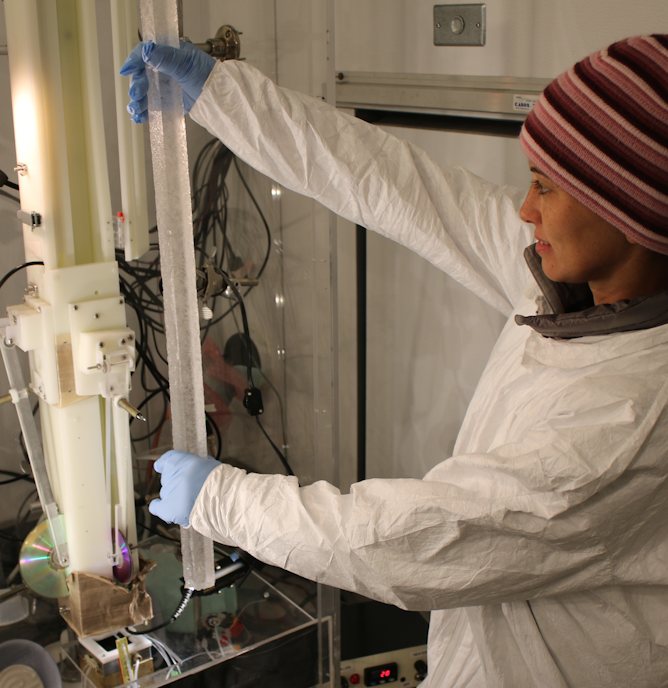 A researcher loads 18,000-year-old Antarctic ice for continuous analysis.
PNAS, CC BY
A researcher loads 18,000-year-old Antarctic ice for continuous analysis.
PNAS, CC BY
These halogens – including powerful ozone destroyers bromine, chloride and iodine – created a hole in the ozone layer, which was in many ways similar to the modern hole triggered by humans’ use of halogen-containing compounds called CFCs. This led to large-scale changes in atmospheric circulation and initiated the shift away from a glacial climate state.
These findings are based on detailed chemical measurements of a broad range of elements and chemical traces in Antarctic ice cores. Most of these came from the West Antarctic Ice Sheet Divide (WAIS), a 3,405 metre deep drilling site that provides highly precise climate records over the past 68,000 years.
Read more: Explainer: what are ice cores?
Our research included the broadest suite of chemical and elemental analysis ever attempted on a deep ice core, and the most precise breakdown of time. This record of the eruptions was precisely duplicated in replicate samples from the same ice core, and in ice cores taken from near Byrd Station in West Antarctica, and Taylor Glacier in Antartica’s Dry Valleys.
The ice core records showed a very unusual, 192-year chemical anomaly from 17,748 to 17,556 years before present.
We augmented the high resolution ice core analyses with a host of lower resolution measurements of interplanetary dust, rock fragments ejected during volcanic eruptions, and sulphur isotopes. Together, they clearly showed the chemical anomaly was the result of a series of massive volcanic eruptions from Mt Takahe, about 350km north of our main drill site.
Other characteristics of the chemical record – including anomalies in sulfur isotopes and near complete bromine depletion in the ice during the event – were consistent with increased ultraviolet radiation at Earth’s surface. It suggests that halogens (chlorine, bromine, and iodine) and other material from the Mt Takahe eruptions reached the Antarctic stratosphere where they destroyed ozone.
 The massive, halogen-rich eruptions of Mt. Takahe coincided with the onset of abrupt and widespread climate change in the southern hemisphere, and increasing greenhouse gas concentrations during the end of the last ice age.
Author provided
The massive, halogen-rich eruptions of Mt. Takahe coincided with the onset of abrupt and widespread climate change in the southern hemisphere, and increasing greenhouse gas concentrations during the end of the last ice age.
Author provided
These eruptions and their chemical signature are unique in the 68,000-year WAIS Divide record. Fallout containing elevated levels of hydrofluoric and hydrochloric acid, as well as toxic heavy metals, extended at least 2,800km from Mt Takahe and may have reached southern South America.
Correlation vs causation
The Southern Hemisphere’s glaciers took 10,000 years to fully retreat. But these unique volcanic eruptions occurred just before (or possibly during) the most significant period of rapid climate change in the Southern Hemisphere, and global greenhouse gas concentrations increased during this time.
The fundamental question is: “did these two events occur at the same time by coincidence or were they causally linked?” The probability that these two events coincided simply by chance is negligible. Based on the evidence we found in Antartica’s ice cores, the depletion of the ozone layer may be the crucial linking factor.
We can bolster this link by comparing the climate change of 17,700 years ago to observable climate change today attributed to the modern Antarctic ozone hole. We can also look to climate models that simulate the behaviour of an ozone hole under glacial conditions. Overall, the widespread climate change observed in many paleoclimate records can best be explained by this singular and dramatic event in western Antarctica.
Authors: Joe McConnell, Research Professor, and Director of the Ultra-Trace Chemistry Laboratory, Desert Research Institute


 Daily Bulletin


