

The beauty and mystery of Saturn's rings revealed by the Cassini mission
- Written by: Tanya Hill, Honorary Fellow of the University of Melbourne and Senior Curator (Astronomy), Museum Victoria
What would Saturn be without its beautiful system of rings? Over the past 13 years, the Cassini space probe has shown us just how complex and dynamic the rings truly are.
The 20-year mission is coming to an end later this month when the probe makes its final destructive plunge into Saturn.
As part of its grand finale, Cassini has flown closer to the rings than ever before, first grazing the outermost edges of the rings before taking the risky leap of diving through the gap between the rings and Saturn.
Read more: A look back at Cassini’s incredible mission to Saturn before its final plunge into the planet
Saturn’s big empty
One of the surprises was that it’s quite empty in this gap. This is very different to when Cassini was bombarded by hundreds of dust particles per second as it moved past the outer rings late last year.
The sound of outer ring particles hitting the Cassini spacecraft.But it meant good news for the mission as this final stage had a better chance for success if there was less material in the way.
During a recent ring dive in August, instead of orientating Cassini so that it flew antenna-first through the gap (offering it more protection), the spacecraft was turned around allowing it to capture a fantastic view of the rings as it dived past.
Cassini’s four-minute dive through the ring gap on August 20, 2017.Know your ring ABCs
Over the centuries, as Saturn’s rings have been observed in finer detail, they have been broken into discrete sections. They are named alphabetically in order of discovery, which means from innermost to outermost the order is D, C, B, A, F, G and E.
The ring labels by discovery.Saturn’s innermost ring D is much less dense and therefore fainter than its neighbouring ring C.
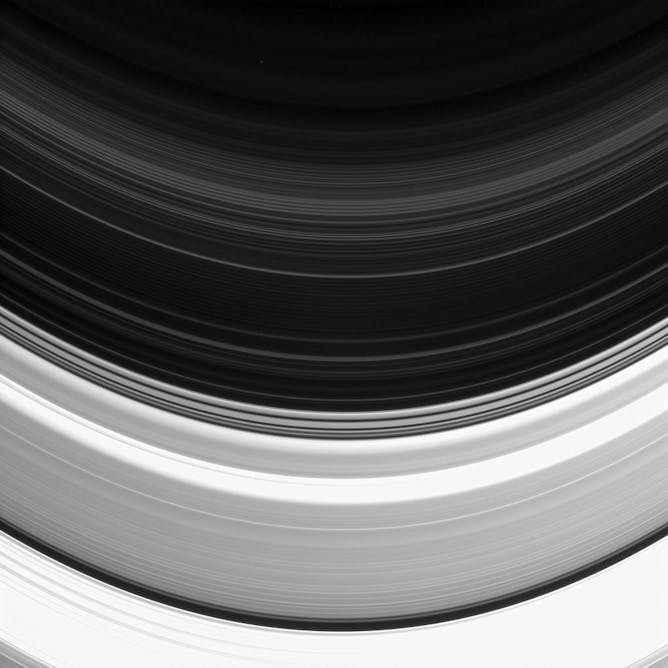 Observing the rings close to Saturn - the D ring is faint while in the lower part of the image the C ring is overexposed.
NASA/JPL-Caltech/Space Science Institute
Observing the rings close to Saturn - the D ring is faint while in the lower part of the image the C ring is overexposed.
NASA/JPL-Caltech/Space Science Institute
By comparing new Cassini images of the D ring with its original discovery image from Voyager in 1980, it’s possible to see changes in the ring over a relatively short period of time.
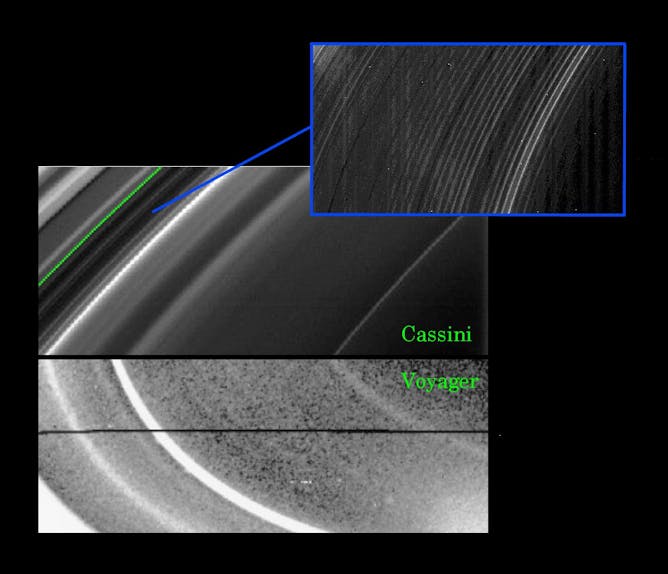 Comparing images of the D ring taken 25 years apart. The inset shows the fine detail achieved by Cassini.
NASA/JPL/Space Science Institute
Comparing images of the D ring taken 25 years apart. The inset shows the fine detail achieved by Cassini.
NASA/JPL/Space Science Institute
In the Voyager image, three relatively bright arcs can be seen in the D ring (the bright arc in the lower left of frame is the C ring). Most dramatically, the central and brightest arc has faded markedly and moved 200km closer to Saturn (the arc no longer lines up with the Voyager image).
Origin of the rings
We know that the rings are mostly made of water ice, but it’s not clear how they formed or even how old they are.
The fact that they are still bright, rather than coated in dust, suggests a young age – perhaps just 100 million years old, placing their formation in the time of the dinosaurs.
This is consistent with Cassini data, but this theory also presents a problem: it means that a previous collection of moons had a fairly recent and mighty smash-up, creating the rings and five of Saturn’s current-day moons.
 A true colour image of Saturn’s rings. The bright dot above and to the right of centre is the planet Venus.
NASA/JPL-Caltech/Space Science Institute
A true colour image of Saturn’s rings. The bright dot above and to the right of centre is the planet Venus.
NASA/JPL-Caltech/Space Science Institute
Alternatively, Cassini has also shown that there is a lot less dust entering the Saturn system than was originally expected. This makes it possible for the rings to be both ancient and bright, having formed early in the life of the Solar System. Furthermore, interactions within the rings might dust them off and keep them looking young.
Finger on the source
For Saturn’s outermost E ring the source is pretty clear. The moon Enceladus orbits within this ring and Cassini observations have directly traced features in the ring back to geysers erupting from Enceladus’s surface.
 Direct observations are well-matched with computer simulations that model the trajectories of tiny icy grains ejected from Enceladus’s geysers.
NASA/JPL-Caltech/Space Science Institute
Direct observations are well-matched with computer simulations that model the trajectories of tiny icy grains ejected from Enceladus’s geysers.
NASA/JPL-Caltech/Space Science Institute
While in the faint F ring, the moon Prometheus creates streamer-channels, drawing material out of the ring.
Prometheus interacts with the ring once every orbit, when it reaches the point that takes it furthest away from Saturn and closest to the F ring. As Prometheus orbits faster than the ring material, a new streamer is created that is ahead of the old one with every orbit.
 A series of streamer-channels drawn out by the moon Prometheus.
NASA/JPL/Space Science Institute
A series of streamer-channels drawn out by the moon Prometheus.
NASA/JPL/Space Science Institute
Bulging waistlines
Several of Saturn’s smaller moons reside within and carve out gaps in the rings, and Cassini has shown them to have bulges around their middles.
The moon Pan was responsible for clearing the A ring’s large Encke Gap. As it collects the ring material, Pan’s gravity is not strong enough to spread the accumulated matter across its surface, and instead a striking ridge develops.
 Gorging on material from Saturn’s rings these moons have grown round around the middle.
NASA/JPL-Caltech/Space Science Institute
Gorging on material from Saturn’s rings these moons have grown round around the middle.
NASA/JPL-Caltech/Space Science Institute
The tiny moon Daphnis is one of seven moons newly discovered by Cassini. It is just 8km across and as it orbits inside the A ring’s small Keeler Gap, it pulls on the ring particles leaving waves in its wake.
 Daphnis raises waves in Saturn’s rings as it passes by.
NASA/JPL-Caltech/Space Science Institute
Daphnis raises waves in Saturn’s rings as it passes by.
NASA/JPL-Caltech/Space Science Institute
Turning rings into moons
Cassini has spotted signs of a potential new moonlet forming on the very edge of Saturn’s bright A ring.
 Caught in action: Saturn’s rings giving birth to a new tiny moon, see the disturbance visible at the outer edge of the planet’s A ring.
NASA/JPL-Caltech/Space Science Institute
Caught in action: Saturn’s rings giving birth to a new tiny moon, see the disturbance visible at the outer edge of the planet’s A ring.
NASA/JPL-Caltech/Space Science Institute
The newly formed object is probably less than a kilometre across but being able to see such a process in action was a complete surprise for Cassini scientists.
Read more: What Cassini’s mission revealed about Saturn’s known and newly discovered moons
It supports the theory that long ago, Saturn’s rings could have been much more massive and capable of producing some of the moons that exist today.
It also potentially provides insight into how the planets of the solar system formed, emerging out of the accretion disk that once orbited the young Sun.
Cassini has certainly achieved its mission objectives to explore Saturn, its atmosphere, magnetosphere and rings and to study Saturn’s moons, particularly Titan. So much has been learned, including the ability to gaze with wonder and awe at the amazing Solar System we are part of.
 Looking back: The pale blue dot of the Earth can be seen below Saturn’s rings in this image Cassini captured on July 19, 2013.
NASA/JPL-Caltech/Space Science Institute
Looking back: The pale blue dot of the Earth can be seen below Saturn’s rings in this image Cassini captured on July 19, 2013.
NASA/JPL-Caltech/Space Science Institute
Authors: Tanya Hill, Honorary Fellow of the University of Melbourne and Senior Curator (Astronomy), Museum Victoria


 Daily Bulletin


