

A home for everyone? Property ownership has been about status and wealth since our convict days
- Written by: Imogen Wegman, PhD candidate, History and Classics, University of Tasmania
While Australia has an egalitarian mythology, where everyone has a chance, the roots of problems with access to housing lie in our history. The first land grants were given to former convicts as a way to control an unfenced prison colony. As free settlers arrived in Australia, priorities changed, land ownership gained prestige, and smaller landholders were pushed out of the market.
When Governor Phillip stepped onto Australian soil for the first time, in 1788, he carried with him a set of instructions to guide him through the early days of the newest British colony. Included was some authority to grant land, and the number of acres each male convict could receive at the end of his sentence. Eighteen months later, the colony received further instructions from Home Secretary William Grenville, permitting soldiers and free settlers to receive parcels of land if they chose to stay in the colony.
 Grants given to former convicts at Norfolk Plains, northern Tasmania, 1814.
G.W. Evans, held by Tasmanian Archives and Heritage Office, AF 396/1/1325
Grants given to former convicts at Norfolk Plains, northern Tasmania, 1814.
G.W. Evans, held by Tasmanian Archives and Heritage Office, AF 396/1/1325
Grenville’s instructions also set out the pattern of land granting that would dominate the colony for the next two decades. Groups of grants were to be placed at the edge of a waterway, with each individual property stretching back into the land rather than along the bank. These rules had a long history; the American colony of Georgia received almost identical phrasing in 1754, but other versions had been in place since the early 18th century.
The rules had two specific purposes in Australia: to foster productivity; and to maintain surveillance over the landholding population, which consisted largely of former convicts.
Initially, all land grants were required to conform to these instructions, and status was shown by the amount of land received. Former convicts started at 30 acres, while free settlers got at least 100 acres.
Under this scheme everyone would receive a mixture of good and bad soils, access to a navigable river and the safety of a surrounding community – important in an unfamiliar land. These grants would reduce the colony’s reliance on imported provisions. Instead, it could feed excess produce into the ports that restocked passing ships.
Colonial exploration and expansion could then continue to stretch to the furthest parts of the globe. But the rules also kept the grantees contained and within a dayʼs travel of a centre of governance (Hobart or Launceston, for example).
In 1817, the Colonial Office began to encourage voluntary emigration to the Australian colonies, and ambitious free settlers arrived. People complained about the failings of the former convicts, as they practised a rough agriculture that did not fit British ideals.
At the same time the management of convicts in Van Diemen’s Land (Tasmania) moved towards the harsh penitentiary system today associated with convicts. Using land grants to pin the former convict population to specific locations, while permitting them the freedom to live their lives, conflicted with free settlersʼ aspirations for the colony.
It is no accident that Bothwell, in Tasmania’s Derwent Valley, was not directly connected to Hobart by river and was dominated by free settlers. The spread of Europeans across the land resulted from the mix of an expanding overland road network and the reduced need to keep these higher-status settlers within armʼs reach.
 Grants at Bothwell were given primarily to free settlers.
Surveyor and date unknown, Tasmanian Archives and Heritage Office, AF 396/1/338
Grants at Bothwell were given primarily to free settlers.
Surveyor and date unknown, Tasmanian Archives and Heritage Office, AF 396/1/338
Land granting policies that excluded poorer settlers (most of whom were former convicts or the children of convicts) were introduced. Only those people with £500 capital and assets (roughly A$80,000) would be eligible. The minimum grant would be 320 acres.
One writer, the colonial surveyor G.W. Evans, asked at the time whether this was intended to drive those without means to the United States of America instead. Even if they scraped together the money, the sheer quantity of land would be beyond their ability to cultivate.
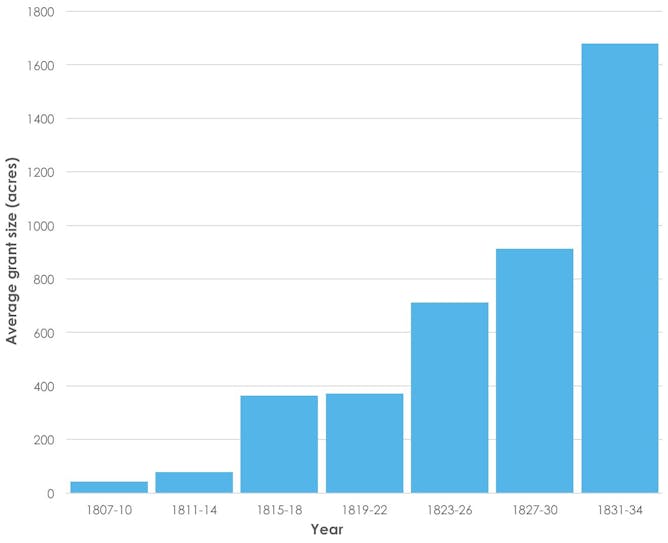 Average grant sizes, taken from specific representative regions to eliminate duplicates in the records.
Author, 2017
Average grant sizes, taken from specific representative regions to eliminate duplicates in the records.
Author, 2017
Locating former convicts on the rivers ensured productivity and the reliable transportation of goods, but these grants also kept them under close observation. As the penal system became more punitive convicts lost the hope of gaining a small piece of land after their sentence.
But before this, far from being intended as any kind of reward or enticement, the first land grants given in Australia represented ongoing control over the lowest class of settlers – those who had been “transported beyond the seas”. Since the beginning of our colonial history, land ownership in Australia has been intricately connected with role and status.
Authors: Imogen Wegman, PhD candidate, History and Classics, University of Tasmania


 Daily Bulletin


