

Dastyari saga shows the need for donations reform, and for politicians to take more care
- Written by: Tony Walker, Adjunct Professor, School of Communications, La Trobe University
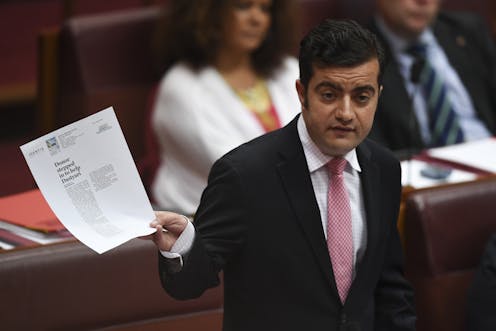
New South Wales Senator Sam Dastyari has been appropriately disciplined by Labor leader Bill Shorten for exercising poor judgement in his interactions with a Chinese businessman who is not an Australian citizen.
Dastyari has been sacked from his position as deputy whip. He will now return to the backbench for the second time in little more than a year, after having fallen foul of acceptable standards of political conduct.
Read more: Dastyari demoted again – but government demands he leave parliament
On that first occasion – confirmed by the released this week of a tape recording – the senator contradicted his own party’s policy that is critical of China’s activities in the South China Sea.
Compounding his difficulties, he had also accepted a A$5,000 donation from the Chinese businessman mentioned above to meet personal legal obligations.
On this latest occasion, it’s alleged that Dastyari went to the businessman’s house and advised him that conversations between the two needed to be conducted beyond the range of their mobile phones, so as to avoid eavesdropping by Australia’s intelligence services.
Dastyari insists that he was not passing on classified information, but the very fact he was alerting a foreign businessman to the possibility of his phone being tapped by the security agencies justifies his sacking.
This was an act of stupidity, if not disloyalty, for an elected representative who claims he has nothing to hide.
The episode also calls Shorten’s management into question. Dastyari should not have been returned to a leadership role so quickly after his first display of poor judgement.
After his earlier demotion he spent just five months on the backbench. He should now remain there for a long time.
Need for clarity
In all of this there is a much bigger issue, and one that requires urgent attention. This is especially so given China’s continued rise, and its persistent efforts to influence politics among its neighbours.
As an important regional player, Australia is far from immune from Chinese “money” politics.
What is required as a matter of urgency is legislation that bans all foreign political donations, along with a separate register of lobbyists who are operating on behalf of foreign entities.
The Dastyari episode should have brought home to the government of the day the need for clear-cut protocols to preclude the possibility of foreign money tainting the political process.
Labor and the Greens have proposed legislation that would ban all foreign political donations. The government is now saying – belatedly – that it will advance legislation in the new year to bring this about. No reasonable argument exists to delay this process.
At the same time, government and opposition should prioritise the establishment of a National Integrity Commission – similar to state-based independent commissions against corruption – to bolster public confidence in the political process, now at a low ebb.
In a research paper – Foreign Political Donations, the Parliamentary Library points out that Australia is “one of the few countries where donations from foreign interest political parties or candidates is not prohibited”.
In defining “foreign interests”, the International Institute for Democracy and Electoral Assistance (International IDEA) includes entities that “contribute directly or indirectly [and who] are governments, corporations, organisations or individuals who are not citizens; that do not reside in the country or have a large share of foreign ownership”.
That wording would seem to be a reasonable model for Australian legislation.
Of English-speaking democracies, only New Zealand allows overseas donations to parties, but these are capped at NZ$1,500.
Foreign influence
The Dastyari episode underscores the need for clear-cut rules to prevent those with links to foreign governments from using money to influence the political process.
The Chinese businessman in question, Huang Xiangmo, recently stepped down as chairman of the Australian Council for the Promotion of the Peaceful Reunification of China (ACPPRC), a front organisation for the United Work Department of the Chinese State.
The billionaire Huang, whose applications for Australian citizenship have been blocked by the Australian Security Intelligence Agency, has deep connections in China’s ruling Communist Party.
None of this should be viewed as surprising, or necessarily cause for alarm, but what should be regarded as completely unacceptable is the use of money by foreign donors to influence policy in the service of a foreign government.
In Huang’s case, he withdrew a A$400,000 funding pledge after Labor’s then defence spokesman Stephen Conroy sharply criticised China’s territorial encroachments in the South China Sea.
What is required is clarity around foreign political donations. Politics and self-interest should not be allowed to stand in the way of reasonable steps to put in place regulations that ban all such donations.
In the Senate today, in several personal explanations, Dastyari insisted that he had not passed classified information to Huang, and that indeed he had never received briefings about relations with China that would have enabled him to do so.
That may well be the case, but perceptions in this case are fairly devastating.
Questions remain, such as:
- Why did Dastyari need to go to the Chinese businessman’s house in the first place?
- What did he need to tell Huang out of range of their mobile phones?
- Who leaked the information about the encounter to Fairfax media?
- Was it leaked by a government agency for political purposes?
The point is this story has, potentially, some way to run, and may yet result in unexpected further developments.
What the whole unfortunate episode demonstrates is that public officials need to avoid carelessness in their interactions with anyone who might represent a foreign government. This is especially so in the case of a country whose methods of doing business politically are not aligned with those of Australia.
Finally, in his interactions with Huang, Dastyari may have served his interests better if he had familiarised himself with the example of the former Labor National Secretary during the Gough Whitlam era.
David Combe served in the contentious period 1973-81, during which, it is alleged, he had sought financial assistance from Iraq for Labor’s losing 1975 election campaign. That support did not materialise, but revelations that it had been canvassed at all severely embarrassed Labor.
Read more: What is soft power? Hint: it’s not footing Sam Dastyari’s bills
After he relinquished his role as National Secretary, Combe developed a lobbying business and in the process was befriended by a Soviet embassy official in Canberra whom it later emerged was a KGB agent.
In 1983, Prime Minister Bob Hawke expelled the Soviet official. A cloud descended on Combe who was later found by the Hope Royal Commission not to have compromised Australia’s security.
However, if there is a lesson in the Combe and Dastyari episodes it is that those in positions of public trust cannot be too careful in the company they keep.
Authors: Tony Walker, Adjunct Professor, School of Communications, La Trobe University


 Daily Bulletin


