

Friday essay: monsters in my closet – how a geographer began mining myths
- Written by: Patrick D. Nunn, Professor of Geography, Sustainability Research Centre, University of the Sunshine Coast
So you think the Loch Ness Monster never existed? That the story is a cunningly cobbled-together fiction intended to boost tourist interest in an otherwise unrelentingly dull (only to some) part of mid-Scotland? Think again.
The embryonic science of geomythology is breathing new life into such stories, legitimising the essence of some and opening up the possibility that other such folk tales might not be pure fiction but actually based on memories of events our ancestors once observed.
Lacking the scientific understanding available to us today, people in the past contextualised such observations in ways that made sense to them. Keen that their descendants should know what had happened, not least should it happen again, many such stories were passed on (commonly orally) from one generation to the next. Invariably cloaked in multiple layers of embellishment, some stories have survived until today.
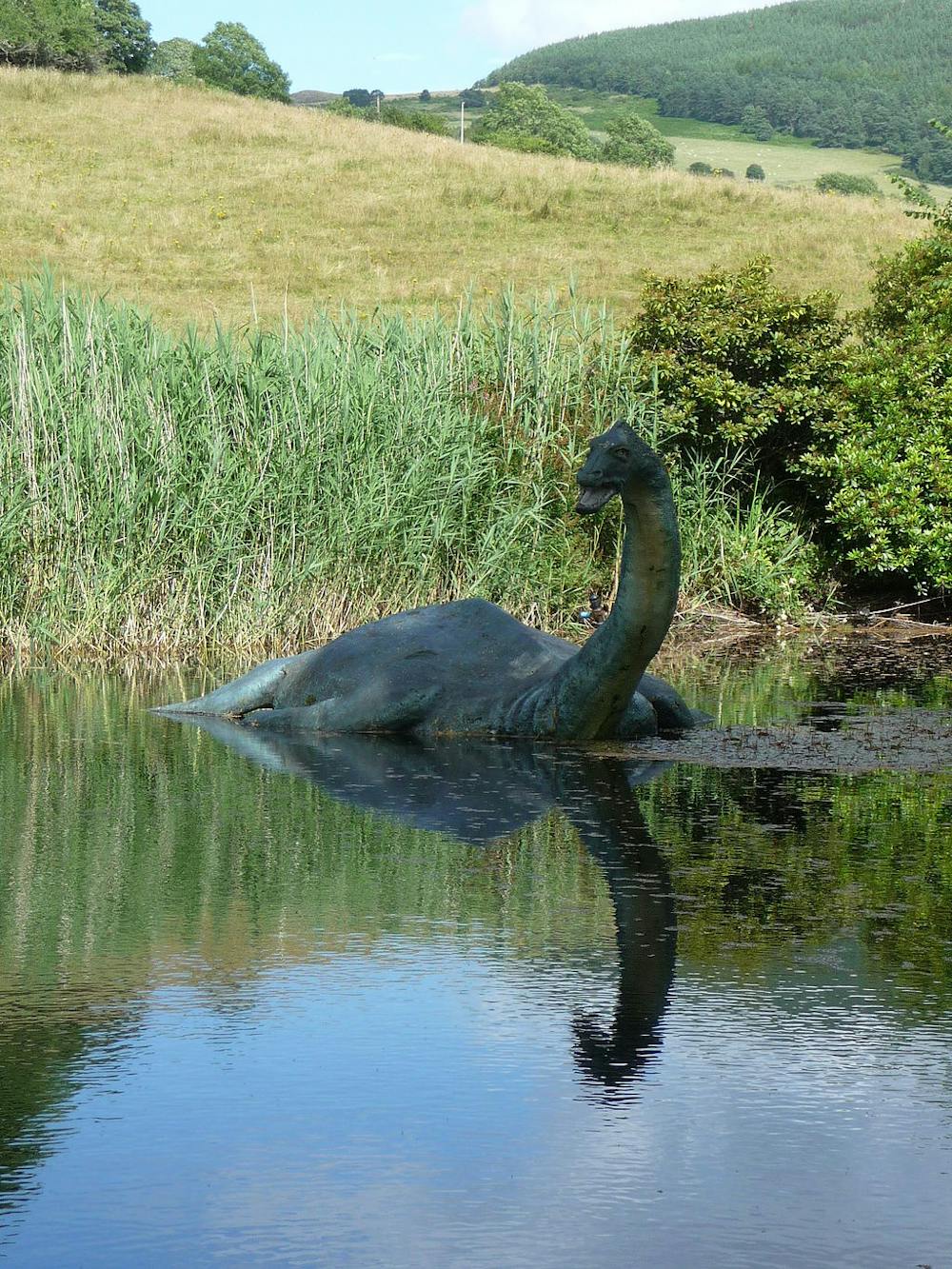 ‘Nessie’ may not be a real being, but the stories about the Loch Ness Monster may contain a kernel of geological truth.
Wikimedia
‘Nessie’ may not be a real being, but the stories about the Loch Ness Monster may contain a kernel of geological truth.
Wikimedia
Science has long vilified those who argue for the existence of giant saurians lurking in the depths of Loch Ness, but there has been some rehabilitation of these “monster sightings”. The geologist Luigi Piccardi, who has done much to make the novel field of geomythology respectable, has argued that observations of “Nessie” are no more than the unusual agitation of the lake’s water surface during an earthquake.
The first written mention of the Loch Ness Monster, in the seventh-century Life of St Columba, notes that the “dragon” appears cum ingenti fremitu (with strong shaking) before disappearing tremefacta (shaking herself). And Piccardi has noted that the most seismically active sector of the Great Glen Fault, along which periodic earthquakes occur, runs along the axis of Loch Ness.
Piccardi also argues that many temples built during the Classical period in the eastern Mediterranean were intentionally built over geological fissures from which escaping neurotoxic gases might cause those sitting above them – like Pythia in the Oracle at Delphi – to go into a trance in which they could reputedly foresee future events.
The Pacific Islands, the focus of most of my research over the past 30 years, has stories about past natural events – massive eruptions and earthquakes, giant waves, for instance – that have traditionally been regarded as largely apocryphal. I have focused on some of the stories from Pacific Island cultures about “vanished islands”, stories that come from almost every part of this vast region – nearly one-third of the earth’s surface. The idea of an entire island disappearing suddenly seems instinctively implausible, the stuff of Atlantean fantasy, yet there are many such stories in the Pacific that seem quite believable at their cores.
Take the example of Teonimenu, which probably disappeared some 400 years ago, between the islands of Makira and Ulawa in the central Solomon Islands. While most local traditions remember its disappearance as the act of a vengeful cuckold, the details about the accompanying series of tsunami waves and the location of Teonimenu on the crest of a steep underwater ridge suggest this might really have happened as a result of an earthquake-induced landslip.
Similar stories have been collected from central Vanuatu, where an island named Vanua Mamata abruptly disappeared about 1870. This was probably a result of an eruption-linked landslide on the underwater flanks of the giant Ambae Island volcano (which today is once again threatening to erupt). With great difficulty, it is said, the survivors saved themselves, paddling north to settle on the island of Maewo where today they recall the loss of Vanua Mamata bifo bifo yet (long long ago).
Of course, there is a limit. And that limit has been crossed when you confront many of the stories about “sunken continents” in the Pacific, perhaps Mu or (Pacific) Lemuria dreamed up by some of its early European explorers who struggled to rationalise the existence of such a large, almost landless, ocean. Some of them, like Dumont d'Urville and the geologist Jules Garnier, were convinced there had once been a continent spanning the Pacific that had sunk, leaving only the former mountaintops poking above the ocean surface.
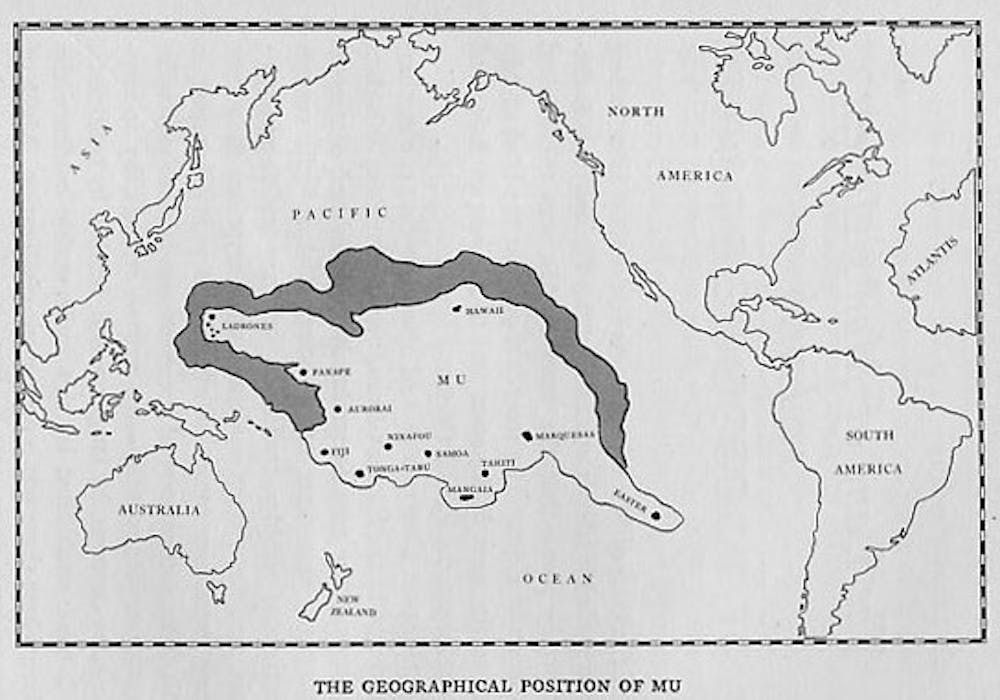 The lost continent of Mu as proposed by James Churchward in 1927.
Wikimedia
The lost continent of Mu as proposed by James Churchward in 1927.
Wikimedia
This theory allowed 19th-century Europeans to deny the manifestly extraordinary maritime abilities of Pacific Islanders who were portrayed as the fortunate survivors of the cataclysm, stranded on their isolated islands. Yet stories suggesting the entire Pacific (or indeed the entire Indian Ocean or the entire Atlantic) were once occupied by a single continent are demonstrably false. We’ve looked.
That said, there is plenty to stoke the imagination – and even a few disingenuous geoscientists happy to add fuel to the fire. Take the “sunken city” off the coast of Yonaguni Island in southwest Japan, which numerous people will assure you was once part of the continental empire of “Mu” that spanned the entire Pacific. There is no shred of real evidence of human structures off the Yonaguni coast (any more than there is of Mu), but for those untutored in the ways that sandstones and shales weather, it might appear there are giant “carved” steps and suchlike.
True legends
My involuntary introduction to geomythology came in mid-2000 when I was working at the international University of the South Pacific, based at its main teaching campus in Suva, Fiji. Having won some research funding and engaged three research assistants to accompany me to the Lau Islands of eastern Fiji, there was a coup; by far the nastiest of the four I have survived.
It seemed the wrong time to do fieldwork so I set the research assistants to work in the university library’s Pacific Collection, searching for any published stories about Pacific Islander traditions of memorable geological events. The haul they recovered astonished me and turned my attention to how oral traditions might illuminate the geological history of the Pacific.
One early example of this concerned myths about the formation of Nabukelevu (or Mt Washington), a striking volcano at the western end of Kadavu Island in Fiji. Long regarded by geologists as having last erupted tens of thousands of years ago, a legend from the people of nearby Ono Island suggested otherwise. Their story goes that the chief of Ono, who was accustomed to watching the sun set from a beach on the island, found one day a mountain (Nabukelevu) had appeared at the end of Kadavu to the west and blocked the view.
Livid, he flew to western Kadavu and battled the chief of Nabukelevu but was overwhelmed. The appearance of Nabukelevu suggests the growth of the volcano within human memory, which means about 3,000 years in Fiji.
 Nabukelevu, or Mount Washington, a volcano in Fiji. Fijian legend suggested the volcano erupted in human history.
Wikimedia/Jaejay77, CC BY-SA
Nabukelevu, or Mount Washington, a volcano in Fiji. Fijian legend suggested the volcano erupted in human history.
Wikimedia/Jaejay77, CC BY-SA
So did the legend invalidate the science? It seems it did at the time for, years later, when a road was cut around the foot of Nabukelevu, a section through the volcano’s flanks was exposed and showed buried soil with pottery fragments (a sure sign of human occupation) overlain by freshly deposited scoria. Clearly the legend was a more accurate indicator of the age of this volcano than science had once been.
Most Pacific Islanders who have shared such stories with me are surprisingly indifferent to the news that they may be true. It was never a concern to them that Western science might have once judged these stories to be fictional; they always knew otherwise.
In the last 15 years, my interest in geomythology and respect for many oral traditions have burgeoned. Moving from the Pacific Islands to Australia in 2010 inevitably led me to educate myself more about Australian Aboriginal stories. What I found was beyond my wildest dreams.
It began in the library of the University of New England where I read many works by linguists who had studied Australian Aboriginal languages. While focused on the structure of the languages, many of these linguists also recorded – generally as illustrations of how language was used in storytelling – ancillary details of the oral traditions of many tribes.
And for several of the coastal tribes, some of the most popular stories recalled times when the ocean surface – sea level – was far lower than it is today and coastal lands were consequently far more extensive. It now seems clear that Aboriginal groups in at least 22 locations all around the coast of Australia have preserved stories for more than 7,000 years; in a few cases, perhaps more than 10,000 years. That is 280 to 400 generations.
 Aboriginal stories recall a time when Fitzroy Island in northern Queensland was connected to the mainland 10,000 years ago.
Shutterstock.com
Aboriginal stories recall a time when Fitzroy Island in northern Queensland was connected to the mainland 10,000 years ago.
Shutterstock.com
Now if Australian Aboriginal cultures were able to preserve stories so long, could not others of the world’s cultures also have done so? One well-documented example is of the Klamath tribe in Oregon, USA, which seems to have successfully preserved a story about the eruption of Mt Mazama – the predecessor of Crater Lake – for some 7,700 years.
Still, there are not many examples, which suggests two things. One is that Australian Aboriginal society was especially adept at inter-generational knowledge transmission. Undoubtedly true. The other is that in other cultures perhaps we have been too quick to discount the lingering fragments of memory for what they really are. A bit more contentious.
Cities drowned
Yet from Gujarat to Tamil Nadu in India, and in Gaelic cultures from Brittany (France) to Cornwall and Wales (UK), there are stories about the consequences of the ocean rising across low-lying areas of coast. Many stories recall the “drowning” of iconic cities and narrate the very human causes to which inundation was attributed.
For instance, there are persistent stories in parts of northwest Europe about the city of Ys that once existed on the coast, efficiently defended against the sea, perhaps in the Baie de Douarnenez in Brittany. Dahut, daughter of the ruler of Ys, King Gradlon, became possessed by a demon and wilfully opened the tide gates when the sea was high, causing the city to be drowned.
It is possible that this story recalls a history of sea level rising across coastal lowlands, forcing coastal cities to build and manage sea defences. Then, as sea level continued its post-glacial rise, one day, perhaps several millennia ago, the defences gave way, the ocean rushed into the city, “drowning” it and condemning its history to myth.
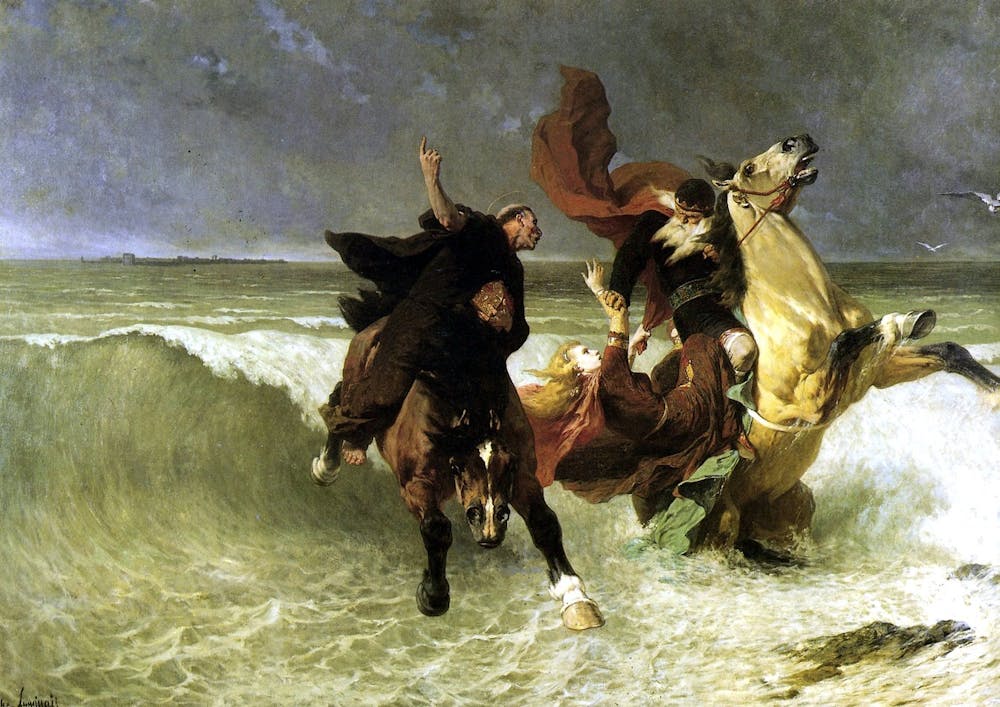 Flight of King Gradlon, by E.V. Luminais, 1884, shows the ruler of the city of Ys fleeing from the encroaching sea.
Wikimedia
Flight of King Gradlon, by E.V. Luminais, 1884, shows the ruler of the city of Ys fleeing from the encroaching sea.
Wikimedia
Such stories, celebrated in art and literature, are often regarded as integral to cultural identity. For this reason, attempts to explain them by science are sometimes resisted.
Yet, viewed dispassionately, it seems possible that stories from both sides of the English Channel (La Manche), for example, recall times when it was much narrower than today, as was indeed the case several millennia ago.
Not only are there stories like that of Ys from the north coast of Brittany and parallel stories from that of Cornwall, but also folk tales from the Channel Islands about how people were once able to walk, crossing a few streams, from there to the French mainland. This is exactly what you would expect a few millennia back, when sea level was 5-10 metres lower than it is today.
What research is showing is that knowledge can be transmitted orally and with a high degree of replication fidelity for thousands of years. Using phylogenetic analysis, Jamie Tehrani has demonstrated that many popular folktales, like Little Red Riding Hood, are at least 2,000 years old.
This remarkable fact does not mean of course that all oral knowledge is that old, but it does open up opportunities for understanding the minds of our ancestors that we never dreamed possible. Or did we?
Authors: Patrick D. Nunn, Professor of Geography, Sustainability Research Centre, University of the Sunshine Coast


 Daily Bulletin


