

Schools can’t tackle child literacy levels alone – it takes a village
- Written by: Catherine Wade, Principal Research Specialist, Parenting Research Centre
The recently released NAPLAN 2017 results and findings from the latest Progress in International Reading Literacy Study (PIRLS) have got Australia talking again about how our children are faring when it comes to literacy.
Read more: NAPLAN 2017: results have largely flat-lined, and patterns of inequality continue
We know from PIRLS, while most Australian children are meeting international benchmarks for reading at year 4, nearly one in five are not meeting these benchmarks. Australia has one of the largest proportions of students who fall below the “intermediate” benchmark into the “low” or “below low” categories, compared to other English-speaking countries, including the US, Canada, and England.
Despite the range of steps that have been taken to address literacy levels across Australia, a large proportion of children are still not meeting international standards for reading. So what other approaches could we try?
Parents: an untapped resource
New research from the Parenting Research Centre highlights an area ripe for intervention: better supporting parents in reading to their children.
Our findings from a study of 2,600 parents showed more than half of children under two and nearly half of children aged three to five are not being read to every day.
We found, while most children were being read to by an adult in the household four to five days a week, a concerning proportion were not being read to at all or very infrequently. Specifically, 13% of 0–2-year-olds and 4% of 3–5-year-olds were not read to at all by an adult at home in the previous week.
Our research also looked at how important parents’ educational values and aspirations for their children were and how they felt about their interactions with their children’s educators. The survey has national relevance, as most of the findings relate to broader parenting issues.
Why early reading is vital
We know from decades of international research that what parents do at home with their children has a profound effect on children’s learning outcomes. Children who experience enriched, cognitively stimulating home environments are at an advantage in the learning process because they have had exposure to many more words.
The evidence in support of providing a language-rich environment to children is vast. Children with language delays at school entry are at greater risk for academic difficulties. With flow-on effects to later academic and socio-emotional challenges, the imperative to tackle language and literacy problems early is paramount.
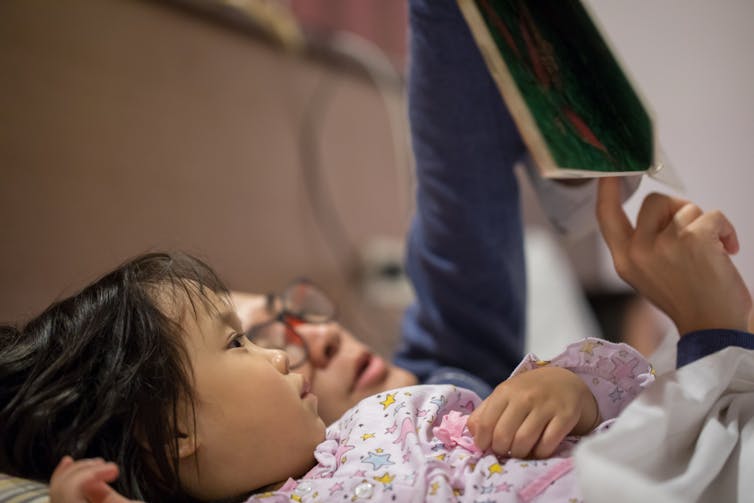 Sitting together, opening a book, and reading and pointing to words can be incredibly helpful in building the foundations of good literacy.
Shutterstock
Sitting together, opening a book, and reading and pointing to words can be incredibly helpful in building the foundations of good literacy.
Shutterstock
A number of high-quality reviews of the scientific literature show good evidence for the benefits of parental shared reading for children’s literacy.
And while older children typically need less input from parents when it comes to actually looking at words on the page, that doesn’t mean the parents’ role in supporting reading diminishes. Creating a home environment that encourages time and space for books is key.
Read more: Research shows the importance of parents reading with children – even after children can read
If we know reading works, why don’t we do it?
The message that simply sitting together, opening a book, and reading and pointing to words can be incredibly helpful in building the foundations of good literacy has certainly cut through with many parents of young children.
But there are many reasons parents don’t read at home. As we know from sectors such as health, simply telling people what needs to be done – such as exercising more – does not take their personal context into consideration. Alone, it’s not enough to motivate people to adopt new patterns of behaviour.
Considering how best to support parents to read more often to their children is an important question and will depend on a thorough understanding of the barriers that are preventing them from doing so. Family and work pressures and parental confidence around reading books are some possible factors that could be further explored as barriers.
A shared concern
Children’s literacy is not the sole responsibility of parents, but it’s clearly an area where parents and schools can work together. This parent-educator partnership featured in our survey, which explored parents’ views about their interactions with kindergarten, child care and school teachers.
Most parents (92%) felt comfortable communicating with their children’s teachers. Although 21% did not think or were unsure if their child’s teacher understood their child.
Also, 20% did not agree they were able to participate in decisions that affected their child at kinder or school.
Of note, fathers tended to feel less comfortable talking with their child’s teachers than mothers did.
While 82% of parents felt their opinions were valued in discussions with their child’s educators, 11% had mixed feelings about this and 7% felt their opinions weren’t valued.
Given what we know from research about the value of parents being connected with their children’s educational settings, it follows that parent-teacher partnerships are important for children’s educational outcomes.
Consequently, it’s important issues like literacy are looked at holistically. Literacy is not just as an education system issue, and not just a parenting issue. It’s a societal issue.
Parents are ready to engage
We found the vast majority of parents (93%) see their own contribution to their children’s learning in the early years as important. This supports the view that today’s parents are generally well placed for taking on information about how to improve their children’s literacy and educational outcomes.
It’s encouraging that most children are being read to at home – even if not every day. But in the context of concerns about Australia’s position in international literacy rankings there’s more to be done.
The message to parents is clearly “read early and read often”. The message for policy makers and professionals is “support parents to better engage with their children’s learning”. This could take many forms and is dependent on context. It could include strategies such as building literacy messages and materials into existing parenting support services and promoting online resources for parents, given our survey found 79% of parents look for answers online about parenting issues.
Authors: Catherine Wade, Principal Research Specialist, Parenting Research Centre
Read more http://theconversation.com/schools-cant-tackle-child-literacy-levels-alone-it-takes-a-village-89532


 Daily Bulletin


