

Why Australia Day survives, despite revealing a nation's rifts and wounds
- Written by: Frank Bongiorno, Professor of History, ANU College of Arts and Social Sciences, Australian National University
As the debate continues over whether Australia Day should be celebrated on January 26, this series looks at the politics of some unresolved issues swirling around Australia Day – namely, the republic and reconciliation. And just for good measure, we’ll check the health of Australian slang along the way.
Wendy McCarthy checked anxiously for signs of rain when she went to bed the night before Australia Day in 1988. A senior manager with the Australian Bicentennial Authority, McCarthy was staying at a hotel in The Rocks, Sydney, so she could wake up close to the action the following day.
McCarthy rose early to what sounded like rain. Fearing the worst, she rushed to the window. But the sound that had alarmed her was not rain. It was thousands of Australian feet, shuffling in their sneakers and thongs to the biggest party the country had ever seen. “It was my moment to weep with relief,” she reflected in her memoir. “Everyone had decided to be there.”
Not quite everyone perhaps, but Sydney Harbour was soon teeming with activity; of spectator craft, but also of tall ships and First Fleet re-enactment vessels, one of them famously bearing a Coca-Cola logo on its sails. Crowds lined the shores – some slept overnight in caves to get a nice possie – and millions more watched on television around the nation.
Read more: Australia Day, Invasion Day, Survival Day: a long history of celebration and contestation
While Australia Day is an occasion for barbecues, concerts and fireworks, as well as the display of flags that no one has any use for at other times, it has never been as spectacular since.
As a public holiday, it marks the boundary between the summer break – even for those who have long since returned to work – and the rest of the year.
For students, it announces the return to the world of uniforms, teachers, classes and books. For most of us, the normal balance (or imbalance) of work and leisure asserts its authority, even as we still swelter in blistering heat.
Australia Day is, among other things, a seasonal festival, like May Day is to the northern spring. Many, perhaps most, Australians are no more likely to reflect deeply on its historical significance than maypole dancers are inclined to ponder phallic symbolism. Some would have difficulty naming the historical event that Australia Day commemorates, the arrival of the First Fleet in 1788. If pressed, they might tell you it was when Captain Cook turned up at Botany Bay.
It has long had its critics. In 1938, the year of the sesquicentenary of settlement, the Aborigines Progressive Association declared it a Day of Mourning and Protest. In the lead-up to the Bicentenary, Aboriginal activists embraced the slogan “White Australia has a Black History”. They said January 26, 1788, was a day of invasion.
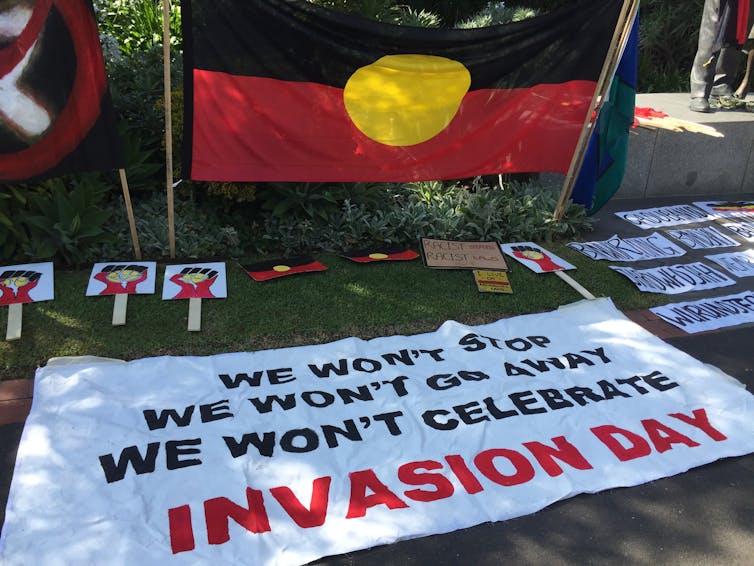 January 26 is increasingly a date of protest for those who see it as Invasion Day.
AAP/Jacqueline Le
January 26 is increasingly a date of protest for those who see it as Invasion Day.
AAP/Jacqueline Le
On the day of the Bicentenary in 1988, thousands of Indigenous people who had come from all over the country, as well as white sympathisers and supporters, marched through Sydney in protest. Some set up with flags and banners at Mrs Macquarie’s Chair. Later, many would head out to Kurnell, near Botany Bay, the site of Cook’s arrival in 1770, for a night of traditional dancing followed in the morning by a smoking ceremony.
So, what has changed with Change the Date? Social media have provided new opportunities for such campaigns. But the change since the 1980s is profound.
What was still just a counter-narrative in 1988 – one only partly absorbed into the historical consciousness of settler Australians – now more thoroughly permeates their sense of the Australian story. Those were times before Mabo, before the reconciliation movement and before the ascendancy of the Stolen Generations narrative.
Today, even if they are hazy about detail, white Australians increasingly appreciate that January 26 is for many Indigenous people a day of sadness, reminding them of dispossession, violence and suffering.
Some disagree, claiming to speak for ordinary Australians unimpressed with the latest iteration of political correctness. Former Labor Party leader turned right-wing activist Mark Latham tells us:
It’s a day of national unity and celebration where people can feel genuinely proud of being Australian.
Yet that he felt the need to tell us so, while launching an advertising campaign in partnership with Indigenous leader Jacinta Price to save Australia Day, only serves to highlight the contentious and increasingly divisive nature of the day.
Last year, responding to a couple of Melbourne councils announcing they would not conduct citizenship ceremonies on the day, the conservative historian Geoffrey Blainey also condemned “the latest move against Australia Day”, which was “often led by suburban Greens”. Blainey declared:
At a time when there is a widespread fear that the nation could be weakened by the hidden circles of Muslim terrorists, more social cohesion is essential.
It may be doubted whether Australia Day can do much to protect us from such a menace. To be sure, here and abroad, the state has long used national days to promote national unity. Australia Day was celebrated as Anniversary Day in Sydney in the early decades of white settlement, with an annual dinner and sporting events such as boat and horse races.
Read more: The day I don’t feel Australian? That would be Australia Day
But in the late 19th century, a Victorian-based organisation of white native-born men, the Australian Natives’ Association (ANA), campaigned in favour of January 26 becoming a public holiday and the national day. It was sometimes subsequently known as ANA Day.
National days proliferated around the world, as nation-states invented traditions aimed at mobilising their populations in the years leading up to the first world war. One historian, Eugen Weber, famously called this the process of turning “peasants into Frenchmen”.
But the idea that January 26 might become Australia’s national day developed only slowly, not least because from 1916 it was competing to some extent with Anzac Day. The various civic rituals and occasions that now grace Australia Day – such as citizenship ceremonies and the announcement of the Australian of the Year awards and the honours list – were progressively grafted on to the day from the mid-20th century onwards.
The historian Ken Inglis, writing in 1967, reported that Australia Day was not marked in any public manner in Canberra at that time.
The problem for those who have harboured grand ambitions for Australia Day is that it is not our answer to Independence Day in the United States or to Bastille Day in France. Australia had no revolution.
The break that Australia Day marks is not that between dependence and independence, colony and republic, or the despotism of the old order versus the liberty, equality and fraternity of the new – even if strident Australia Day advocates do wax lyrical about the gift to Indigenous people of Western civilisation that the British arrival in 1788 so generously bestowed.
Australia Day will likely survive because of its seasonality. As a summer public holiday supporting some modest civic activity and public spectacle, it retains the backing (and money) of government and of a still considerable and powerful section of civil society. And it remains a popular occasion for social gatherings.
But as it becomes ever more entangled in battles over the meaning of our history, Australia Day will find it difficult to carry a “successful” national day’s normal civic burden of fostering common belonging and social cohesion.
Authors: Frank Bongiorno, Professor of History, ANU College of Arts and Social Sciences, Australian National University


 Daily Bulletin


