

It's 20 years since privatisation lit the spark under South Australia's livewire energy politics
- Written by: Marc Hudson, PhD Candidate, Sustainable Consumption Institute, University of Manchester
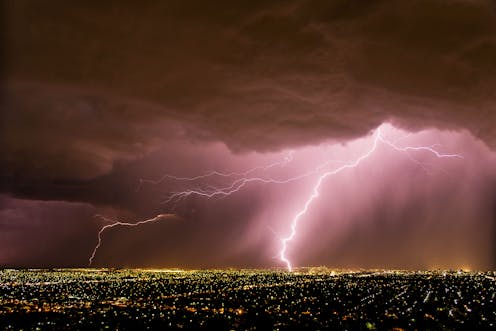
February 17, 2018, marks the 20th anniversary of a momentous day in South Australian energy politics. The then premier, John Olsen, announced that, despite repeated promises during the previous year’s state election campaign, his Liberal government would be putting the Electricity Trust of South Australia (ETSA) up for sale.
ETSA had been created in 1946 when a previous Liberal premier, Sir Thomas Playford, nationalised the Adelaide Electric Supply Company (yes, you read that right).
Even when Olsen made his announcement, privatisation was on the nose with voters, literally as well as metaphorically. The “big pong” – a smell of rotten gas that pervaded Adelaide for several months during 1997 – had been traced back to a lack of maintenance after the privatisation of water treatment works.
Despite the big pong having put privatisation in bad odour, Olsen ploughed on. Faced with the impending launch of the National Electricity Market, and with the 1993 Hilmer Report having recommended competition as a way to drive down prices (although we all know how that worked out), SA was set to follow in neighbouring Victoria’s footsteps and embrace deregulation.
From state bank to bankrupt state
The story had begun, as so many stories seem to, with hubris on the part of the financial sector. The State Bank of South Australia had, through reckless lending, got itself into a huge hole that ultimately led to the resignation of the Labor premier, John Bannon, in 1992 and a heavy election defeat for the government the following year.
Despite the Liberals’ thumping win in 1993, voters swung back again and the 1997 contest was far tighter than it had any right to be. ETSA had already been broken up into separate retail, transmission and energy subsidiaries in preparation for its participation in the NEM, and Labor seized on rumours of ETSA’s privatisation, despite adamant denials by the Liberals. On Nine News, Olsen flatly stated: “We are not pursuing a privatisation course with ETSA.”
Olsen’s Liberals were returned to government only thanks to the support of two conservative independents and one extremely independent National.
After Olsen’s February 1998 announcement, there were power plays back and forth. The Liberals were now claiming that privatising electricity assets would wipe out the state’s enormous debt, creating “an additional A$2 million a day to spend on things like schools, hospitals and other infrastructure”.
Labor and other opponents were, to put it mildly, sceptical. A normally pro-privatisation economist, Richard Blandy, pointed out: “Mr Lucas keeps on talking about saving on interest but he ignores the aspect of lost revenue… Interest payments are now so low it is much less interesting to pay off debt.”
Nick Xenophon – at the time a newly elected independent state MP – indicated that he would support a long-term lease, but only if there were a referendum. Eventually, in June 1999, two Labor MPs switched sides and the privatisation went ahead. The journalist Chris Kenny put it best when he wrote in the Sunday Mail at the time:
Rumoured, denied, ruled-out, revealed, reviled, rejected, revamped, revived and ratified, John Olsen’s power privatisation deal has somehow, finally, sparked into life. Politics and economics in South Australia will not be the same. It is our millennial change – our circuit-breaker.
There was collateral damage. A proposed interconnector with New South Wales – to supplement the existing cable to Victoria completed in 1990 – was canned because it would have added more competition to the SA market, hitting the value of assets the Liberals wanted to sell. Xenophon was scathing, accusing the government of having a “blinkered view of just maximising the value of the assets rather than maximising the benefits to consumers”.
Over the past decade, South Australia has gone from zero (renewable energy) to hero (at least to environmentalists) for its staggering growth in wind generation, as well as its more recent trendsetting in solar and batteries. This is partly thanks to a Howard government decision: the Mandatory Renewable Energy Target (such are the ironies of history).
Power still in play
If – as the old adage goes – a week is a long time in politics, then two decades is several eternities. But remarkably, three players from this chapter of South Australia’s political life are still on the scene.
Rob Lucas was in 1997 the Liberal government’s treasurer, a post he might regain in next month’s state election. Nick Xenophon, who cautiously supported discussion of privatisation but then came out against it, is back in the running for state office after a decade in Canberra. And Tom Koutsantonis, currently SA treasurer, was by Kevin Foley’s side when they tried to stop those two Labor MPs from switching.
Since then, of course, there was also the notorious statewide blackout of September 2016 – an event that has had monumental political and economic consequences. Jay Weatherill’s Labor government, already a staunch backer of renewables, responded with a radical new plan for energy security (including, famously, the world’s biggest battery), while the Liberal opposition has presented voters with its own energy policy.
In the past few weeks we have seen yet more headline-grabbing announcements from Weatherill’s government, including a “virtual power plant” made up of people’s rooftop panels and energy storage, and more money for pumped hydro.
South Australian energy and climate campaigners are trying to hold all the politicians’ feet to the fire, calling on them to bring forward a 100% renewable target to 2025.
Read more: A year since the SA blackout, who's winning the high-wattage power play?
In September 2016, just before the blackout, the Adelaide Advertiser commissioned an opinion poll on electricity privatisation. The front-page story relayed the “extraordinary finding”, to the palpable shock and disbelief of reporter Paul Starick, that 51% of those polled blamed Olsen’s sell-off for rising electricity prices.
The story added that “only 15% blamed Labor’s investment in renewable energy to replace coal, a significant factor in Port Augusta power station’s closure in May at the cost of more than 180 jobs”.
John Quiggin, an economist who fought in vain to keep ETSA in public hands, has put the case for renationalising Australia’s electricity. In the UK, Opposition Leader Jeremy Corbyn has proposed a similar move as part of his policy platform.
But whatever happens, we can definitely say three things:
This is not the issue on which the SA Liberals would have chosen to fight the coming election, for both state-based historical and federal-present reasons.
If Weatherill loses, opponents of renewables will label it a referendum on wind, solar and storage, regardless of voters’ actual opinions.
And two decades on, power policy is still just as much a red-hot political battleground as it was during South Australia’s millennial circuit-breaking moment.
Authors: Marc Hudson, PhD Candidate, Sustainable Consumption Institute, University of Manchester


 Daily Bulletin


