

Shorten's plan to triple anti-dumping penalties misunderstands the law
- Written by: Weihuan Zhou, Senior Lecturer and member of China International Business and Economic Law (CIBEL) Initiative, Faculty of Law, UNSW Sydney, UNSW
Bill Shorten’s proposal to triple anti-dumping penalties demonstrates a misunderstanding of dumping and its impact on the economy. It also misunderstands when anti-dumping measures may be lawfully applied and to what extent.
Shorten’s proposal is purportedly to prevent Australia from becoming a “dumping ground for cheap foreign goods sent here by trade cheats”. The Opposition Leader says Labor is a strong believer in trade, but it should be conducted on a “level playing field”. He also wants to give the Anti-Dumping Commission 30 new staff and new responsibilities.
Read more: Australia may be engaging in 'free trade' but it's becoming more protectionist too
There are no existing penalties in the World Trade Organisation (WTO) anti-dumping regime, or in Australia’s anti-dumping regime – that would be in breach of WTO rules. Australia’s current regime involves the use of anti-dumping measures to counteract injury caused by dumped imports to domestic industries. These typically take the form of import tariffs.
Anti-dumping measures like duties are not “penalties” as such, but simply taxes in the form of a customs duty to remove the injury caused by dumping.
In recent years, the use of anti-dumping measures has been on the rise predominantly to protect the steel industry in Australia.
Current dumping rules
“Dumping” is when an exporter exports goods to another country at an export price less than what it sells the same like goods in its own country. Under WTO rules, this is neither illegal nor unlawful.
It is a perfectly legitimate commercial practice. In fact, in 2016 the Productivity Commission found there was no compelling economic rationale for a country like Australia to act against dumping.
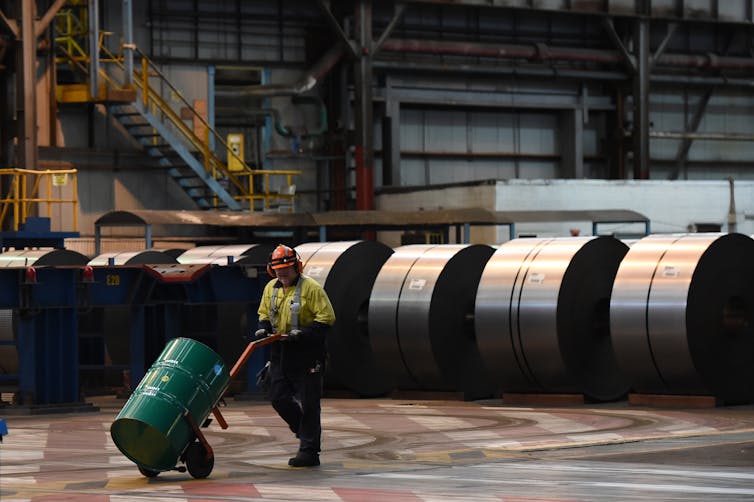 In Australia, the recent use of anti-dumping measures has primarily been to protect the steel industry.
Dean Lewins/AAP
In Australia, the recent use of anti-dumping measures has primarily been to protect the steel industry.
Dean Lewins/AAP
Rather than prohibiting the practice of dumping, WTO anti-dumping rules only provide a remedy where the dumping causes material injury to a domestic industry in the country of import, for example reduced revenues and profits. The remedy is the imposition of dumping duties, or customs duties.
This should be equal to or less than the margin of dumping – the extent to which an exporter’s export price is lower than its home market price.
It’s not clear how the “triple penalties” proposed by Shorten could be imposed in line with the WTO rules.
Read more: It’s time to drop Australia’s protectionist anti-dumping rules
Increasing penalties could hurt the economy
Mr Shorten’s anti-dumping penalties would have several effects – including to increase prices of imported goods and inputs for Australian produced goods. This price rise would be passed on to Australian companies and consumers. For example, this would increase the cost of steel for construction industries.
Shorten’s policy would benefit a small group of import-competing industries, such as those producing steel and A4 copy paper, including companies that are wholly owned by foreign companies. But such policy completely ignores the interest of Australian manufacturers using imported materials, their employees or consumers.
Increased dumping penalties could also stifle competition, increasing prices. This could also increase unemployment, as the imposition of the penalties would make the cost of business uneconomical.
Read more: Consumers lose out to Australia's protectionist anti-dumping laws
Shorten’s policy on dumping seems misguided and ill-informed and can only operate to Australia’s detriment. These observations are consistent with the findings of the Productivity Commission that Australia’s anti-dumping system has become increasingly more protectionist and damaging.
In the interests of fair trade, similar penalties would need to apply to Australian companies engaged in dumping, and to both export and domestic sales to ensure a “level playing field”.
More fundamentally, as the Productivity Commission has observed, “fairness” does not provide a justification for anti-dumping measures which fail to consider the impact of such measures on the community as a whole.
What’s more, Shorten’s “triple penalty” could drag Australia into the ongoing trade conflict and harm Australian consumers and industries using imports from China. If the “triple penalty” provokes China’s retaliation, that will hurt Australian goods and services exporters.
This article was co-authored by Andrew Percival, Principal at Percival Legal.
Authors: Weihuan Zhou, Senior Lecturer and member of China International Business and Economic Law (CIBEL) Initiative, Faculty of Law, UNSW Sydney, UNSW


 Daily Bulletin


