

A sperm race to help save one of New Zealand’s threatened birds, the sugar-lapping hihi
- Written by: Helen Taylor, Research fellow in conservation genetics, University of Otago
It’s likely you’ve never heard of a hihi, let alone seen one in the wild. Also known as stitchbirds, these colourful little critters are a true taonga, or treasure. They’re only found in New Zealand, and currently restricted to just seven sanctuary sites.
Without the caché of kiwi or kākāpō, hihi have gone largely ignored by conservation fans and also, crucially, by funders. Researchers have been interested in these sunny little birds for decades because of their crazy mating system and high-octane lifestyle.
A major part of hihi research goes into figuring out ways to make more hihi and get them in more places. Now, we’re combining research on hihi sperm with a major fundraising effort to try to turn this bird’s fortunes around.
Researchers are studying sperm quality to figure out what contributes to the low breeding success of the hihi, or stitchbird.A taonga in trouble
The story of hihi is a sadly familiar one for New Zealand. They were widespread across the country’s North Island, but then humans arrived. Forest clearance and introduced mammalian predators were bad news for most of New Zealand’s native wildlife, including hihi. By 1880, hihi had been reduced to just one population on Hauturu (Little Barrier Island).
Over the past 25 years or so, conservation managers and researchers have established six new hihi populations in predator free sanctuary sites around the North Island, and numbers are on the rise, but hihi are not out of the woods yet.
At each site except for Hauturu, hihi rely on supplementary sugar-water feeding. They use the energy from the sugar water to hunt insects – their real food. On Hauturu, they get their sugar from plant nectar, but no other site in New Zealand seems to have the diverse, old growth forest that hihi need.
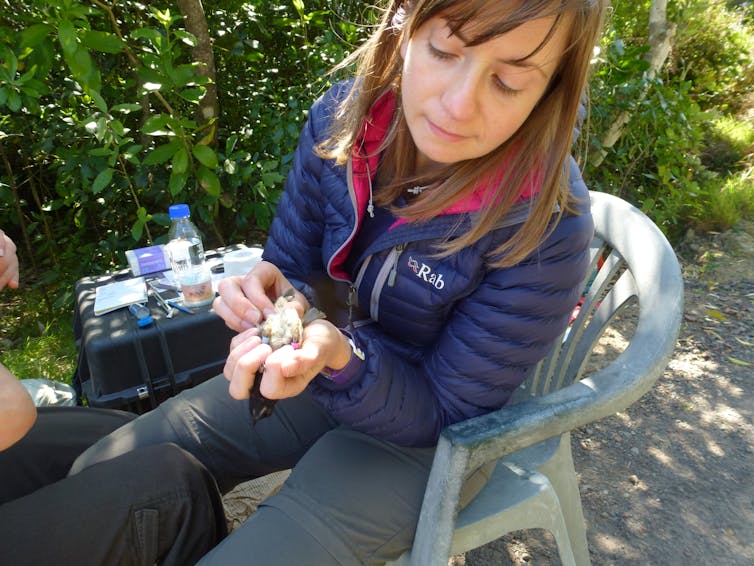 Catching hihi on Tiritiri Matangi, one of the island sanctuaries where they survive, to get a sperm sample.
Mhairi McCready, CC BY
Catching hihi on Tiritiri Matangi, one of the island sanctuaries where they survive, to get a sperm sample.
Mhairi McCready, CC BY
Experiments have shown that when the supplementary sugar is removed, hihi numbers go into decline. The absence of decent forest isn’t the only problem for this little sugar addict though.
Small populations and dodgy sperm
The hihi’s drastic decrease in numbers after human arrival is known as a population bottleneck. When a species experiences a bottleneck, we typically see a reduction in genetic variation and an increase in mating between relatives (inbreeding).
Inbreeding can negatively affect reproduction and survival. One characteristic that seems particularly sensitive to the negative effects of inbreeding is male fertility.
Inbreeding causes dodgy sperm (and dodgy pollen) across a wide range of mammals, insects and plants. However, no one has ever really looked into how it affects sperm quality in birds.
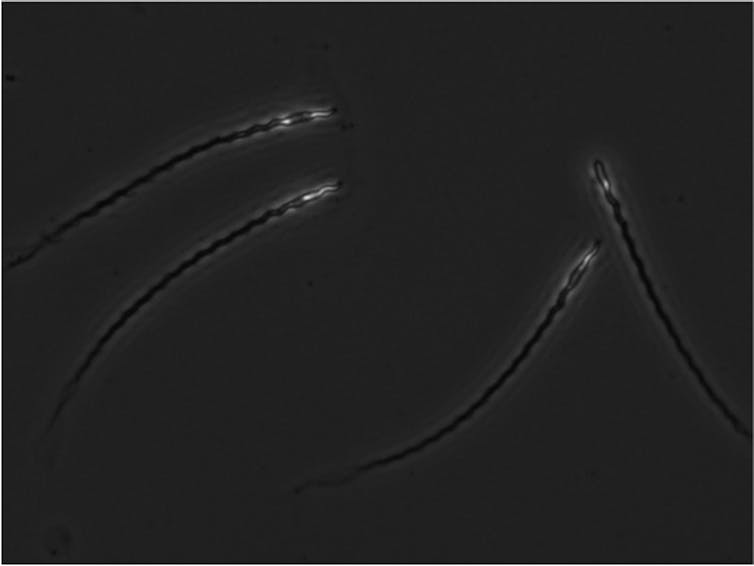 Hihi sperm seen under a microscope.
Helen Taylor, CC BY
Hihi sperm seen under a microscope.
Helen Taylor, CC BY
We know that New Zealand’s birds have relatively high rates of hatching failure. We know that hihi egg hatching rates and chick survival are negatively affected by inbreeding. But we don’t know whether this hatching failure is a result of poor male fertility, developmental problems, or a bit of both. That’s where my research comes in.
Studying bird sperm in the wild
I’m looking for links between inbreeding and sperm quality in native New Zealand birds, including the hihi. To measure bird sperm quality, we look at three things: sperm swimming speed, sperm length and the proportion of sperm with abnormalities (two heads/no tail etc.).
Getting this data from wild birds is challenging for a number of reasons.
First, you need to get the sperm. This is actually the easiest part, especially with hihi. Their mating system is so competitive that males are usually jam-packed with sperm during the mating season.
In most bird species (including hihi), males don’t have a penis. They have an opening called a cloaca, just like the female. During mating season, the area around the male’s cloaca swells as it fills up with semen. By gently massaging this swelling, I can cause a small amount of semen to pool on the surface of the cloaca and, voila! I have my sperm sample.
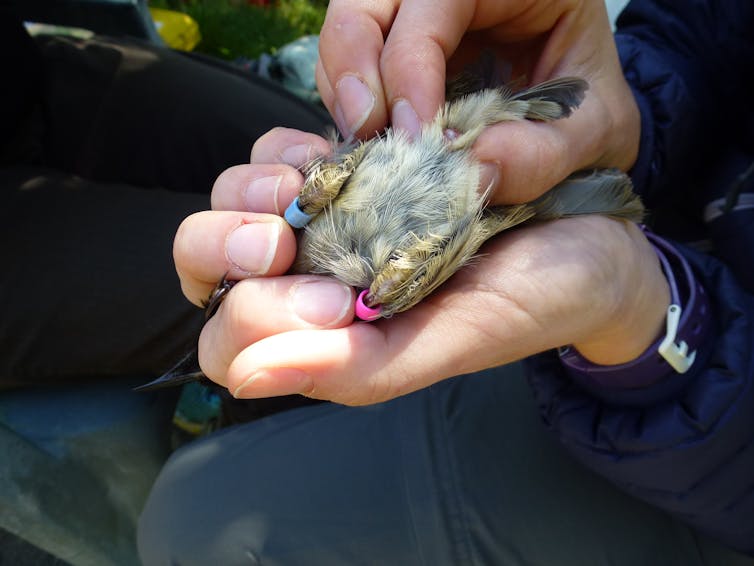 Massaging a male hihi to extract sperm.
Mhairi McCready, CC BY
Massaging a male hihi to extract sperm.
Mhairi McCready, CC BY
The next challenge is measuring sperm swimming speed. Everything else can be done back at the lab, but speed has to be measured there and then and sperm have to be kept at a constant temperature, or they die. We need to run a microscope, camera and laptop to film the sperm and measure the speed. And I’m usually on a remote island or in the middle of the bush.
 Working in the mobile sperm lab.
Robyn White, CC BY
Working in the mobile sperm lab.
Robyn White, CC BY
To overcome these issues, I’ve designed a mobile sperm lab that runs off a small generator so I can take it pretty much anywhere. It houses my sperm speed measuring set up, plus some heat pads to keep anything that touches the sperm at a constant temperature.
The pièce de résistance is my specially designed in-bra sperm sample tube holder, which keeps samples warm against my skin before they get to the microscope.
The great hihi sperm race
In October 2017, I took my mobile sperm lab to four hihi sites: Hauturu, Trititiri Matangi, Bushy Park Sanctuary, and Zealandia.
I collected sperm and DNA samples from 128 males and am currently analysing the data to investigate the connection between sperm quality and inbreeding in this species.
At the same time, we’re attempting to address the major lack of funding for hihi conservation by encouraging people to bet on which of my 128 males will have the fastest sperm.
This innovative fundraiser has grabbed a fair few headlines in New Zealand and overseas, and we’ve seen bets coming in from all over the world. The race runs until April 22, 2018. To get involved, visit www.hihispermrace.nz and place your bets!
Authors: Helen Taylor, Research fellow in conservation genetics, University of Otago


 Daily Bulletin


