

how the Australian intelligence community works
- Written by: John Blaxland, Professor, Strategic and Defence Studies Centre, Australian National University
This article is the first in a five-part series exploring Australian national security in the digital age.
National security, intelligence and espionage have been in the headlines due to events abroad and significant developments at home. News of diplomatic expulsions, cyber-attacks, leaked documents about sweeping new surveillance powers and the creation of a new Home Affairs Department make it hard to follow.
What’s more, everyone has heard of the CIA, for instance, but Australia’s own national security organisations are comparatively unknown. So how is intelligence gathered? What are Australia’s peak national security bodies and how do they interact?
Australia’s national security architecture consists of a number of federal government departments and agencies, with links to state government counterparts. These include the state police forces and counter-terrorism authorities. Those arrangements are in transition, the full details of which are still to unfold.
The major players
The peak national security body in the Commonwealth is the National Security Committee of Cabinet (NSC). It includes the ministers of the principal departments concerned with national security, including the Departments of Defence, Home Affairs, Foreign Affairs and Trade, the Attorney-General, Prime Minister and Cabinet, and Treasury.
Several of the ministers on the NSC oversee a range of national security bodies. These have emerged as a result of trial and error, royal commissions and various reforms over several decades.
For starters, the defence portfolio includes a range of military intelligence units. There are hundreds of uniformed intelligence practitioners across the nation in the navy, air force and army, as well as in the Headquarters Joint Operations Command in Canberra. It also includes three of the nation’s principal intelligence agencies (with a mix of civilian and military intelligence practitioners):
• the Defence Intelligence Organisation (DIO), defence’s principal intelligence assessment agency
• the Australian Geospatial Intelligence Organisation (AGO), responsible for satellite and aerial imagery intelligence, maps, nautical charts and related geo-spatial products
• the Australian Signals Directorate (ASD), responsible for the collection and processing of signals intelligence (essentially, eavesdropping on radio and electronic transmissions).
ASD’s motto, “to reveal their secrets and protect our own”, captures the essence of its functions, which have been the subject of recent controversy after leaked documents proposed giving the ASD domestic surveillance powers.
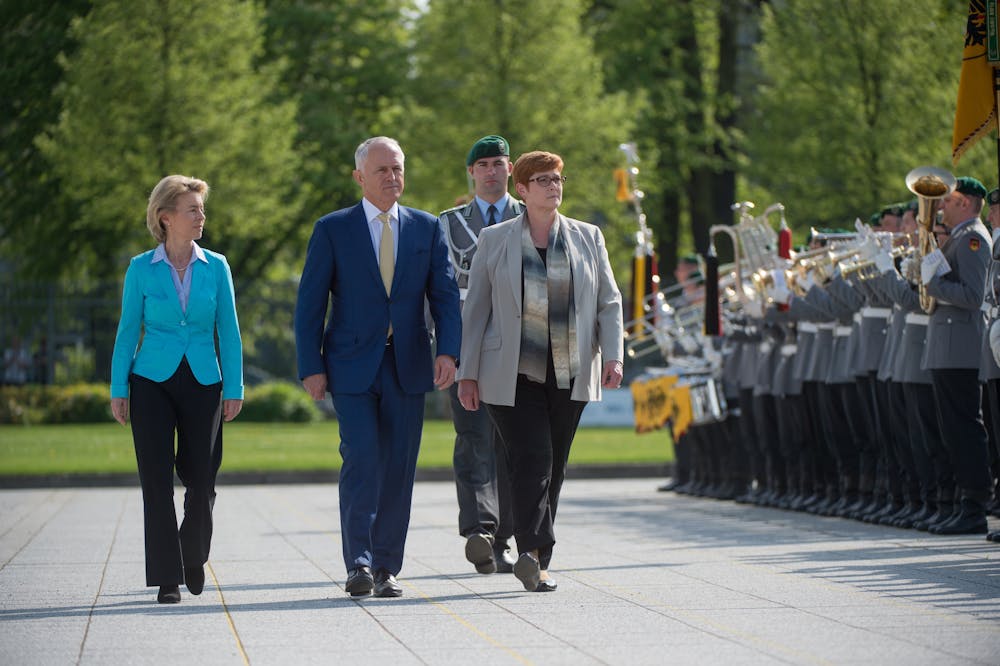 German Defence Minister Ursula von der Leyen greets Prime Minister Malcolm Turnbull and Defence Minister Marise Payne with a guard of honour.
Arne Immanuel Bänsch/DPA
German Defence Minister Ursula von der Leyen greets Prime Minister Malcolm Turnbull and Defence Minister Marise Payne with a guard of honour.
Arne Immanuel Bänsch/DPA
The antecedents of these defence agencies date back to the intelligence organisations established, alongside their American and British counterparts, during the second world war. The ties to that era have endured in the so-called “Five Eyes” intelligence arrangement.
Initially focused on signals intelligence (the principal remit of ASD), Five Eyes is a trusted network between the US, Britain, Australia and the two other predominantly English-speaking allies from that era, Canada and New Zealand.
The title was a derivative of the stamp used to restrict the dissemination of sensitive intelligence to a particular classification: “SECRET – AUS/CAN/NZ/UK/US EYES ONLY” – hence Five Eyes.
Nowadays, the network extends beyond signals intelligence and defence circles to include a broader range of departments, including the Department of Foreign Affairs and Trade (DFAT).
DFAT is Australia’s principal agency tasked with “promoting and protecting our interests internationally and contributing to global stability and economic growth”. As part of that role, it is responsible for diplomatic reporting. Much of the information Australia gathers from counterpart governments abroad is collected openly, but discreetly, by Australia’s diplomats.
In addition, the Australian Secret Intelligence Service (ASIS) is in the foreign minister’s portfolio. Established in 1952 and tasked with the collection overseas of secret intelligence, the ASIS mission is listed as being “to protect and promote Australia’s vital interests through the provision of unique foreign intelligence services as directed by the Australian Government”. This is otherwise known as human intelligence collection or, in traditional terms, foreign espionage.
Countering foreign espionage (particularly from Soviet, later Russian and other countries operating in Australia) is the remit of the Australian Security Intelligence Organisation (ASIO). Established in 1949, ASIO has been part of the attorney-general’s portfolio until now.
Today, ASIO’s purpose is described as being to “counter terrorism and the promotion of communal violence”, “counter serious threats to Australia’s border integrity”, “provide protective security advice to government and business” and “counter espionage, foreign interference and malicious insiders”.
The Office of National Assessments (ONA) is Australia’s peak intelligence assessment agency. It was established in 1977, after the Royal Commission on Intelligence and Security commissioned by then Prime Minister Gough Whitlam and chaired by Justice Robert Marsden Hope.
ONA was established to help coordinate priorities across related intelligence agencies. Today, it is charged with assessing and analysing international political, strategic and economic developments for the prime minister and senior ministers. ONA draws on the intelligence collected by the other intelligence agencies, as well as unclassified, or “open source”, intelligence and material provided by international partners.
The agencies mentioned so far – ONA, ASIO, ASIS, AGO, ASD and DIO – form what has come to be known as the Australian Intelligence Community (AIC). The AIC emerged from the reforms initiated by Justice Hope in the 1970s and 1980s, notably following the 1977 commission and the 1985 Royal Commission on Australia’s Security and Intelligence Agencies. The combined effect of these commissions was that ONA was tasked with coordinating intelligence priorities along with the other agencies.
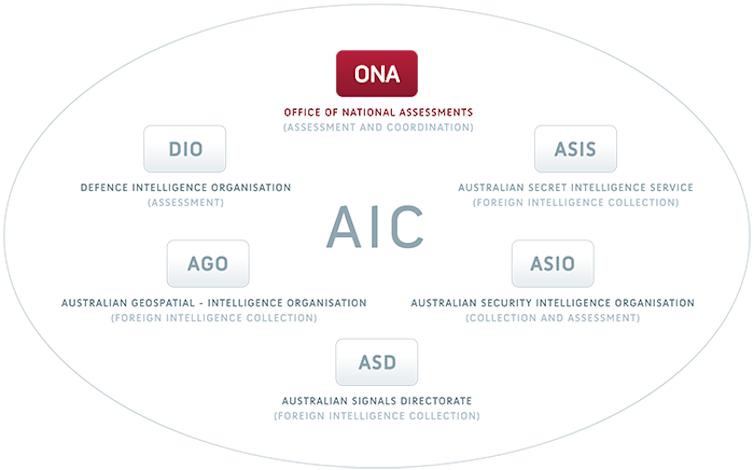 The tangled web of the Australian Intelligence Community.
Office of National Assessments
The tangled web of the Australian Intelligence Community.
Office of National Assessments
A greater level of scrutiny
Another mechanism that emerged during this period was the office of the Inspector General of Intelligence and Security (IGIS), currently held by former Federal Court judge Margaret Stone. Established in 1987 with the enduring power of a royal commissioner, the IGIS has extraordinary powers to inspect and review the operations of AIC agencies.
The Parliamentary Joint Committee on Intelligence and Security (PJCIS) exists to provide a level of parliamentary oversight, complementing the work of the IGIS. It conducts inquiries into matters referred by the Senate, the House of Representatives or a minister of the Commonwealth government.
The Intelligence Services Act 2001 saw legislation more closely account for the functions that AIC members were expected to perform and the Inspector General monitors. In addition, an Independent National Security Legislation Monitor (INSLM) was established.
The 2017 Independent Intelligence Review was the third such review since 2001. As part of the review, ONA is to become the Office of National Intelligence (ONI), exercising oversight of the expanded National Intelligence Community (NIC). This covers the initial six AIC members and four additional ones described below.
In addition, ASD is being established as a statutory body (still under the defence minister, but administered separately from the rest of the Defence Department) alongside other principal agencies ASIO and ASIS.
An expanded community with ambiguous oversight
The ONI is now tasked with overseeing implementation of recommendations arising from the 2017 review. This includes managing the four-body expansion to the ten-agency NIC.
These four bodies have played an increasingly prominent national security role since 2001. They are:
• the Australian Federal Police (AFP), with a remit for criminal intelligence and counter-terrorism
• the Australian Transaction Reports and Analysis Centre (AUSTRAC), Australia’s specialist financial intelligence unit
• the Australian Criminal Intelligence Commission (ACIC), responsible for “investigative, research and information delivery services work with law enforcement partners”.
• the Australian Border Force (ABF), described as Australia’s customs service and an “operationally independent” agency in the Home Affairs portfolio.
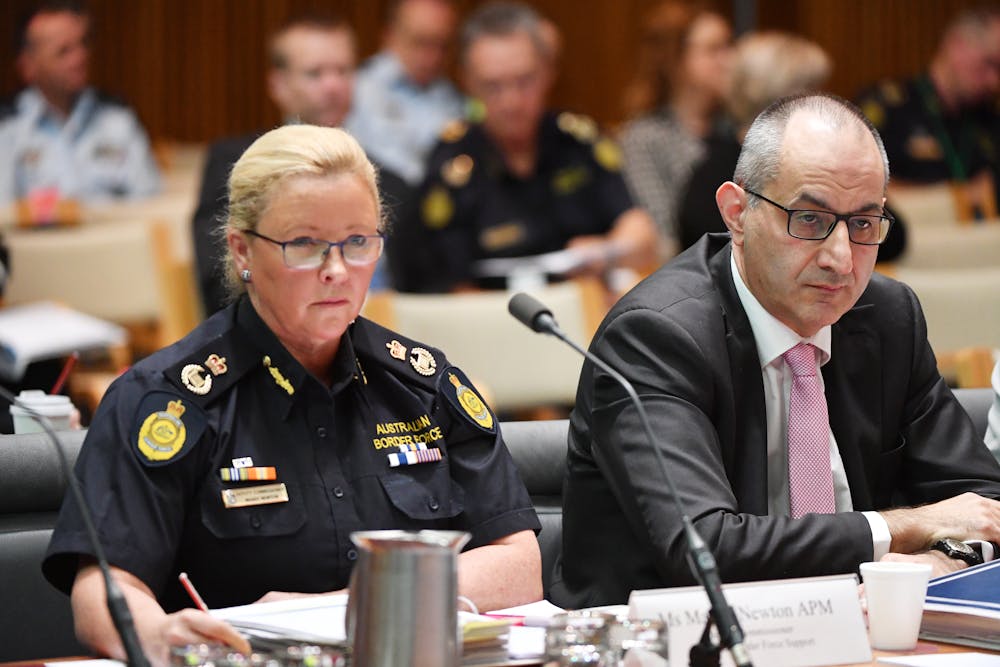 Deputy Commissioner Mandy Newton represents the Australian Border Force alongside Home Affairs Secretary Michael Pezzullo at a senate estimates committee hearing.
Mick Tsikas/AAP
Deputy Commissioner Mandy Newton represents the Australian Border Force alongside Home Affairs Secretary Michael Pezzullo at a senate estimates committee hearing.
Mick Tsikas/AAP
These agencies work in conjunction with other AIC agencies as well as state police and security counterparts.
The 2017 independent review was announced at the same time the new Home Affairs Department was made public. These four bodies are among the agencies transitioning to the Home Affairs portfolio. This has complicated arrangements for implementing the review recommendations and left considerable ambiguity concerning overlap of changed arrangements.
The INSLM certainly has a significant task as well and the PJCIS will be growing in staff to meet the expanded set of responsibilities outlined by the 2017 review as our intelligence community grows from six to ten agencies.
Implementing the 2017 review recommendations alone presents a significant challenge. The creation of Home Affairs on top of this adds to the complexity at a time of growing security challenges.
Authors: John Blaxland, Professor, Strategic and Defence Studies Centre, Australian National University
Read more http://theconversation.com/explainer-how-the-australian-intelligence-community-works-94422


 Daily Bulletin


