

Don't want to take a contraceptive pill every day? These are the long-acting alternatives
- Written by: Deborah Bateson, Clinical Associate Professor, Discipline of Obstetrics, Gynaecology and Neonatology, University of Sydney
ON THE PILL: In this seven-part series we explore the history, myths, side-effects and alternatives of the pill, and why it’s the most popular form of contraception in Australia.
The arrival of the pill in 1961 was pivotal in enabling women to control their fertility with a method unrelated to sex. Long-acting reversible contraception (LARC) methods add another dimension to contraceptive choice, freeing women from having to remember a pill every day.
LARC methods include the contraceptive implant and hormonal intrauterine device (IUD), available in Australia since the early 2000s, and copper IUDs which have been around since the 1970s.
Global and local institutions from the World Health Organisation to the Royal Australian and New Zealand College of Obstetricians and Gynaecologists and family planning organisations advocate for increased access to LARCs. But there is still a lack of awareness and negative perceptions about these methods.
Read more: Few Australian women use long-acting contraceptives, despite their advantages
What are the options?
Unlike condoms, which need to be used every time with sex, or the pill, which must be taken every day, LARC doesn’t require any action after placement in the body and is immediately reversible.
Arm implant
 Implanon implants are placed in the arm.
Family planning NSW., Author provided
Implanon implants are placed in the arm.
Family planning NSW., Author provided
The contraceptive implant available in Australia, known under the brand name Implanon, is a 4cm flexible rod, placed under the skin of the upper inner arm. It slowly releases a progestogen hormone called etonogestrel over a three-year period.
Two-rod implants are available in other countries, including New Zealand. These last for up to five years.
Implants work by preventing the release of an egg each month from the ovary. They also thicken the mucus at the cervix to prevent sperm reaching the uterus.
Implants are more than 99.9% effective, which means fewer than one in every 1,000 women using the implant will become pregnant in a year.
Implants are subsidised by the Pharmaceutical Benefits Scheme so patients pay A$39.50 for the device (A$6.40 concession).
Interuterine device
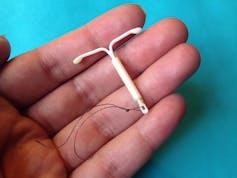 Hormonal IUDs sit in the uterus.
Sarah Mirk/Flickr, CC BY-NC
Hormonal IUDs sit in the uterus.
Sarah Mirk/Flickr, CC BY-NC
The hormonal IUD, known under the brand name Mirena, is a plastic T-shaped device placed in the uterus. It releases a low dose of a progestogen hormone called levonorgestrel for up to five years.
Copper devices don’t emit hormones and last between five years (for the Load-375 IUD) and ten years (for the Copper T380).
IUDs mainly work by interfering with sperm movement, which stops them fertilising an egg. Sometimes they work by preventing implantation of a fertilised egg, but they never have an effect after implantation has occurred.
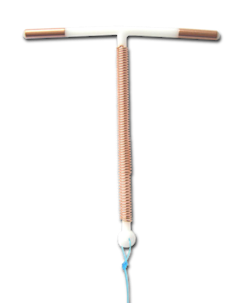 Copper IUDs don’t contain hormones.
AnnaMartheK, CC BY
Copper IUDs don’t contain hormones.
AnnaMartheK, CC BY
Hormonal IUDs also thicken the cervical mucus to prevent sperm reaching the uterus and can, less commonly, prevent ovulation.
While the hormonal IUD is slightly more effective than the copper device, especially in young women, both are more than 99% effective. This means fewer than one in every 100 women using IUDs become pregnant each year.
The hormonal IUD is also subsidised by the PBS, so patients pay A$39.50 for the device (A$6.40 concession). Copper IUDs aren’t listed on the PBS and cost up to A$150.
There are specific Medicare rebates for the insertion and removal of implants and the insertion of an IUD. Patients may also pay a gap fee for the consultations.
Choosing contraception
As a family planning doctor, I know that finding the best contraceptive to suit a woman’s individual circumstances is based on a multitude of factors from side-effects to cost and personal preference.
Read more: Explainer: what are the options for birth control?
While some women prefer a contraceptive they can stop and start themselves or one that is hormone-free, others like a method they can forget about from day to day.
Some women want a contraceptive that can eliminate their menstrual bleeding, while others prefer a regular bleeding pattern.
Individual experience is hugely variable:
I’ve just had my third Implanon taken out. So it’s been nine years. I think I got one taken out early, but yeah, nine years of Implanon. I just loved the convenience of that and the price… – Chloe (30s)
I kind of I feel like a, you’re being microchipped or something… I think it’s amazing technology … but I just, I don’t think I could do it. – Maya (20s)
 A woman’s contraceptive needs may change throughout her life.
Tanja Heffner
A woman’s contraceptive needs may change throughout her life.
Tanja Heffner
Informed choice is fundamental. What suits a woman as a teenager may be very different to what suits her in her 30s or late 40s. Informed choice needs to be based on evidence that includes the pros as well as the cons of all options.
What are the pros of LARC?
There are very few medical reasons preventing women of any reproductive age using LARC.
None of the implants or intrauterine devices contain oestrogen, so they avoid the risk (albeit very small) of venous blood clots associated with the combined oral contraceptive pill or the vaginal ring.
LARC methods don’t rely on remembering to take a daily pill or stopping to put on a condom. Once in place, they don’t require a visit to the doctor or any ongoing costs.
The hormonal IUD thins out the lining of the uterus and is highly effective at reducing menstrual blood loss. It is recommended as a first-line option for women with heavy menstrual bleeding, which can result in iron deficiency and anaemia.
It can also be effective in controlling the symptoms of endometriosis.
Read more: What happens to endometriosis when you're on the pill?
The copper IUD can be used as a highly effective method of emergency contraception when inserted within five days of unprotected intercourse. It can then be continued for up to ten years.
 The set and forget aspect of LARC appeals to many users.
Matthew Miner, CC BY
The set and forget aspect of LARC appeals to many users.
Matthew Miner, CC BY
What about the cons?
Insertion of an implant just under the skin of the arm requires a simple procedure using local anaesthetic.
An IUD is inserted into the uterus through the cervix, which can be uncomfortable. Most women have their IUD inserted using local anaesthetic but some choose to have it put in under light sedation.
There are some complications associated with these procedures, including a small risk of infection.
Once in place, the implant can cause unpredictable and sometimes troublesome vaginal bleeding. The copper IUD can be associated with heavier and longer-lasting periods.
Women using an implant or hormonal IUD can have hormonal side effects such as headache, acne, mood changes, or reduced libido.
While it’s impossible to predict who will experience side-effects, it’s important all women are aware of this risk and know to seek medical advice if needed.
How common are they?
The uptake of implants and IUDs in Australia has increased from 2.3% in 2001/02 to 11.0% in 2012/13.
But lack of awareness and persistent misperceptions prevent some women from considering this option. Some women (and sometimes their doctors) erroneously believe an IUD cannot be used by young women or women who have not had children, or that LARC will cause a problem with future fertility.
Finding a clinic nearby to put in an IUD or an implant can also be difficult. To ensure equitable access, we need to increase the number of doctors and nurses inserting LARC across Australia through enhanced training programs and improved remuneration.
While the pill continues to serve many women well, and its introduction over 50 years ago is rightly regarded as a significant step in women’s empowerment, the highly effective (and cost-effective) LARC methods are increasingly chosen by women from adolescence through to menopause across the globe.
Authors: Deborah Bateson, Clinical Associate Professor, Discipline of Obstetrics, Gynaecology and Neonatology, University of Sydney


 Daily Bulletin


